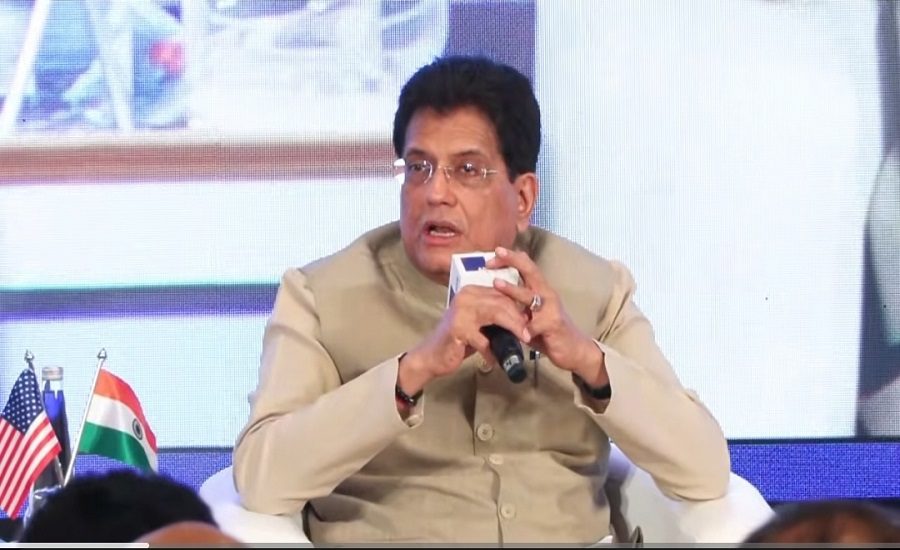
New Delhi: In a major push to accelerate industrial growth, manufacturing and investment in India, Union Commerce and Industry Minister Piyush Goyal on Saturday announced the launch of operational guidelines for the Bharat Audyogik Vikas Yojana (BHAVYA), under which 100 world-class industrial parks will be developed across the country.
The ambitious ₹33,660-crore scheme aims to create plug-and-play industrial ecosystems equipped with modern infrastructure, logistics connectivity and worker facilities to strengthen India’s manufacturing capabilities and improve ease of doing business.
At the same time, the minister also assured that the Centre has absorbed the burden of rising global fertiliser prices and has not passed the additional costs on to farmers, reaffirming the government’s commitment towards the agriculture sector.
BHAVYA Scheme to Create Modern Industrial Ecosystems
Addressing a press conference, Piyush Goyal said the BHAVYA scheme was approved by the Union Cabinet on March 18, 2026, and operational guidelines have now been issued within two months, reflecting the government’s urgency in implementing industrial reforms.
Under the scheme, 100 industrial parks will be developed in partnership with state governments and Union Territories.
The proposed parks will provide:
- Ready industrial plots
- Internal roads and water supply systems
- Flatted factories
- Worker housing and accommodation
- Schools and colleges
- Hospitals and healthcare facilities
- Multimodal logistics infrastructure
The minister said the integrated infrastructure model will help industries begin operations quickly while reducing project delays and logistics costs.
20 Industrial Parks to Be Developed in First Phase
According to the minister, 20 industrial parks will be developed during the first phase over the next two months, followed by another 30 parks in the subsequent phase.
Applications for the remaining 50 industrial parks will also be invited shortly to ensure rapid nationwide implementation.
The parks are expected to range between 100 acres and 1,000 acres, although hilly states may be allowed to establish smaller parks starting from 25 acres.
Goyal clarified that the Centre has not allocated parks on a state-wise quota basis and expects all states to actively participate in the programme.
Focus on Manufacturing, Investment and Ease of Doing Business
The BHAVYA scheme is aimed at strengthening India’s industrial infrastructure and supporting long-term economic growth.
The government believes the initiative will:
- Boost manufacturing output
- Attract domestic and foreign investment
- Improve logistics efficiency
- Generate employment opportunities
- Enhance ease of starting and operating businesses
The minister said the scheme aligns with India’s broader goal of becoming a global manufacturing hub and strengthening supply chain resilience.
India Receives Record $95 Billion FDI Inflow
Highlighting India’s economic momentum, Piyush Goyal said the country recorded a historic gross Foreign Direct Investment (FDI) inflow of $95 billion during the financial year ending March 2026.
According to him, the figure represents a 17 per cent year-on-year increase and reflects growing global confidence in India as an investment destination.
He also stated that India’s exports have remained resilient despite global economic uncertainty and geopolitical tensions.
Centre Absorbing Fertiliser Cost Burden to Support Farmers
Speaking on rising international commodity prices, the minister emphasized that the government has protected farmers from higher fertiliser prices by fully absorbing the increased costs.
“In terms of elevated fertiliser prices, these costs have not been passed on to farmers; instead, the entire burden has been fully borne by the Central Government,” Goyal said.
The statement comes amid concerns over global supply disruptions and rising input costs due to geopolitical tensions and volatile commodity markets.
The minister reiterated that farmer welfare remains a key priority of the government.
India’s Economic Growth Driven by Structural Reforms
Piyush Goyal further highlighted India’s growing economic influence globally, citing nine free trade agreements and Prime Minister Narendra Modi’s international engagements as signs of the country’s rising stature.
He stated that India’s current economic strength is the outcome of over 12 years of structural reforms, policy initiatives and long-term planning undertaken by the Modi government.