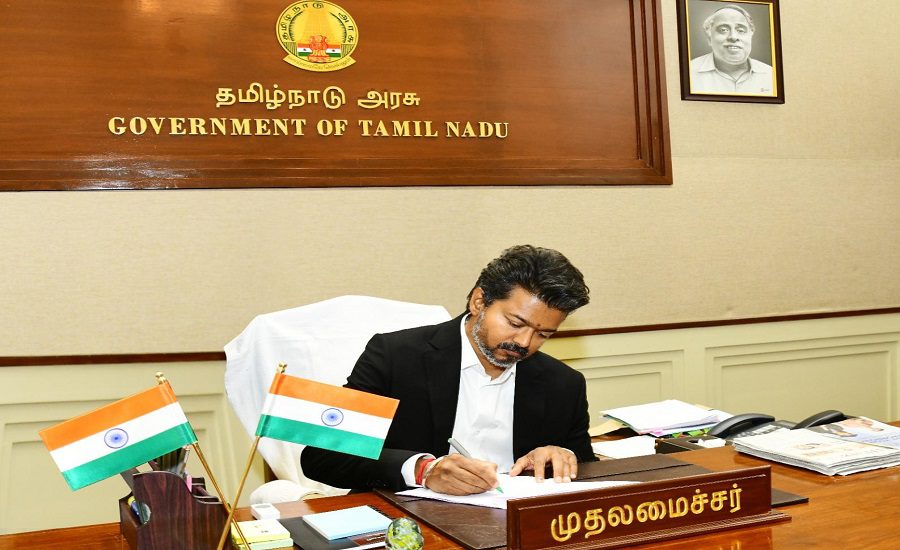
Chennai: In a significant departure from long-standing political practice, the newly elected Tamil Nadu government led by Chief Minister C. Joseph Vijay has chosen continuity over administrative upheaval, retaining several senior bureaucrats in key positions despite the change in political leadership.
Historically, transitions of power in many states have often been accompanied by large-scale transfers and removals of senior officers perceived to be close to the outgoing government. However, the new Tamil Nadu administration appears determined to break away from that convention, prioritising competence, institutional continuity and governance stability over political considerations.
The move is being viewed by administrative observers as a conscious effort to usher in a new political culture in the state.
Breaking a Long-Standing Political Tradition
Tamil Nadu’s political landscape has traditionally been dominated by alternating governments led by the DMK and AIADMK. Over the years, every change of government was often followed by extensive reshuffles in the bureaucracy, with senior officers occupying influential positions frequently being transferred or sidelined.
Such administrative changes often became associated with political rivalry, creating uncertainty within the civil services and affecting continuity in governance.
The government led by Chief Minister C. Joseph Vijay, however, has adopted a markedly different approach.
Instead of initiating a widespread bureaucratic restructuring, the administration has retained several senior officials in strategic positions, signalling confidence in professional competence rather than political affiliation.
Chief Secretary M. Sai Kumar Continues in Office
One of the most notable decisions has been the continuation of Dr. M. Sai Kumar (IAS: 1990: Tamil Nadu) as the state’s Chief Secretary.
Despite being due for retirement in August 2026, Dr. Sai Kumar remains at the helm of the state’s administrative machinery, reflecting the government’s emphasis on stability and institutional continuity during the transition period.
As the senior-most bureaucrat in the state, the Chief Secretary plays a crucial role in coordinating government departments and implementing policy decisions.
His retention has been widely interpreted as a signal that the new administration intends to leverage existing administrative experience rather than disrupt governance structures.
Mahesh Kumar Aggarwal Appointed Full-Time DGP
The Tamil Nadu government also announced several key appointments on May 29, 2026, aimed at strengthening the state’s administrative and law enforcement leadership.
Among the most significant appointments was that of Mahesh Kumar Aggarwal (IPS: 1994: Tamil Nadu) as the Director General of Police (DGP) and Head of the Police Force.
The appointment places an experienced officer at the top of Tamil Nadu Police and reflects the government’s focus on professional leadership in law enforcement.
Dr. P. Senthilkumar Appointed Secretary-I to the Chief Minister
The administration has also entrusted senior IAS officer Dr. P. Senthilkumar (IAS: 1995: Tamil Nadu) with a key role in the Chief Minister’s Office.
He has been appointed as:
Additional Chief Secretary and Secretary-I to the Chief Minister
The position is among the most influential in the state administration and involves close coordination with the Chief Minister on governance, policy implementation and administrative affairs.+
G. Laxmi Priya Named Secretary-II to Chief Minister
Further strengthening the Chief Minister’s Office, G. Laxmi Priya (IAS: 2006: Tamil Nadu) has been appointed as:
Secretary-II to the Chief Minister
Her appointment is seen as part of a broader effort to build a capable and efficient administrative team around the Chief Minister while ensuring continuity in governance.
Merit Over Politics
Observers note that the appointments reflect a governance philosophy centred on professional competence rather than political alignment.
Rather than replacing officers solely because they served under the previous administration, the government appears to have evaluated officials on the basis of:
- Administrative capability
- Professional track record
- Experience
- Institutional knowledge
- Governance outcomes
Such an approach is being viewed as an attempt to depoliticise senior bureaucratic appointments and foster a more stable administrative environment.
A New Governance Model for Tamil Nadu?
Political and administrative analysts suggest that the decision could mark the beginning of a new era in Tamil Nadu’s governance culture.
By resisting the temptation to undertake politically motivated administrative reshuffles, the government is projecting an image of confidence and institutional maturity.
The emphasis on continuity may also help ensure uninterrupted implementation of development programmes, policy initiatives and public service delivery mechanisms during the transition period.
Setting a Healthy Precedent
The retention of key officers and the merit-based appointments made by the new administration are being seen as a positive signal for the state’s bureaucracy.
If sustained, this approach could strengthen administrative neutrality, encourage professionalism within the civil services and reduce uncertainty associated with political transitions.
As Chief Minister C. Joseph Vijay’s government settles into office, its decision to prioritise competence and continuity over political retaliation may emerge as one of the defining features of its administrative philosophy.
Read also: Who Is Prasanth M S? Tamil Nadu IAS Officer Appointed Deputy Secretary in Cabinet Secretariat