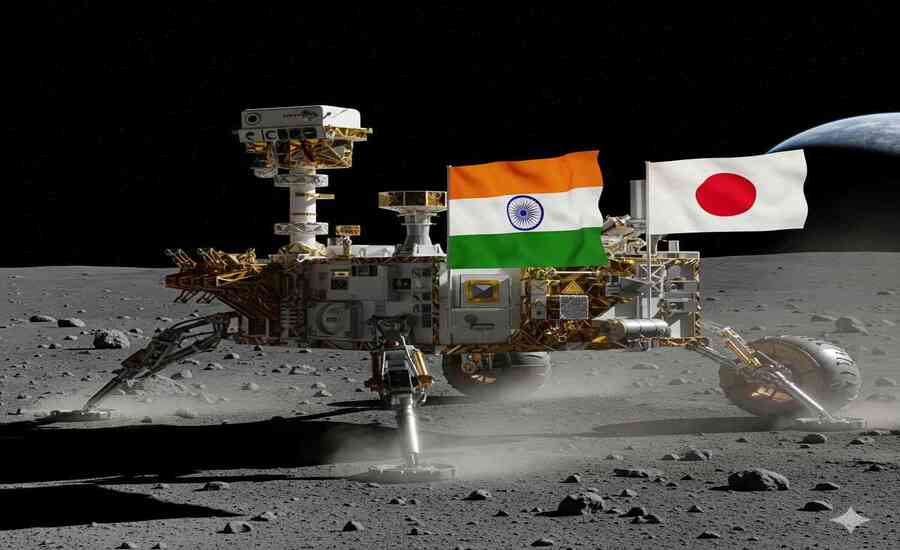
New Delhi: The Chandrayaan-5 mission is gaining momentum as the Indian Space Research Organisation (ISRO) and Japan Aerospace Exploration Agency (JAXA) deepen their collaboration to explore the Moon’s south pole.
This joint lunar project, also known as LUPEX (Lunar Polar Exploration Mission), represents a significant step in global space exploration. With advanced technology, a heavier rover, and extended mission life, the Chandrayaan-5 mission aims to unlock crucial insights about lunar water and resources, strengthening India’s position in the international space race.
What is Chandrayaan-5 Mission
Chandrayaan-5 is a joint India–Japan lunar mission focused on exploring the Moon’s south polar region—one of the least explored and most scientifically important areas.
Read also: ISRO Human Spaceflight Explained: Gaganyaan Timeline, Crewed Chandrayaan, and Reusable Tech
- It is part of India’s Chandrayaan programme.
- Also called LUPEX (Lunar Polar Exploration Mission).
- Approved by the Government of India in 2025.
- Planned launch window: 2027–2029.
The mission reflects a growing trend of international cooperation in space exploration, especially in high-cost, high-risk deep-space missions.
What are the Objectives of Chandrayaan-5 Mission
1. Search for Lunar Water
The primary goal is to detect and analyze water ice in permanently shadowed regions of the Moon’s south pole.
2. Study Lunar Soil and Volatiles
The mission will study lunar regolith (soil) and volatile compounds to understand the Moon’s composition and evolution.
3. Support Future Human Missions
Data from Chandrayaan-5 will help in planning future human settlements and long-duration missions on the Moon.
Advanced Technology and Design
Heavier Lander and Rover
- The lander will be heavier and more advanced than previous missions.
- The rover is expected to weigh around 350 kg, much larger than Chandrayaan-3’s 25 kg rover.
Longer Mission Life
- Expected operational life: around 100 days, significantly longer than earlier missions.
International Payloads
- Scientific instruments from global agencies like NASA and ESA may be included.
This combination of advanced systems will allow deeper and longer exploration of the lunar surface.
Roles of ISRO and JAXA in Chandrayaan-5 Mission
The Chandrayaan-5 mission clearly divides responsibilities between both space agencies:
- ISRO: Responsible for the lander module.
- JAXA: Developing the rover and launch system (H3 rocket).
This partnership leverages:
- India’s expertise in cost-effective space missions
- Japan’s strength in precision robotics and launch systems
Strategic Importance of Chandrayaan-5 Mission
1. Strengthening Global Space Position
After the success of Chandrayaan-3, this mission positions India as a major space power.
2. Technological Advancement
The mission will push India into:
- Heavy rover operations
- Long-duration lunar missions
- Deep-space collaboration
3. Economic and Scientific Impact
- Potential for space mining and resource utilization
- Boost to India’s space-tech ecosystem
Chandrayaan-4 and 5: A Combined Lunar Strategy
India is working on two major lunar missions simultaneously:
- Chandrayaan-4: Aims to bring Moon samples back to Earth.
- Chandrayaan-5: Focuses on in-depth exploration of the Moon’s south pole.
Together, these missions mark a shift from exploration to utilization of lunar resources.
Key Challenges Ahead
Despite strong progress, Chandrayaan-5 faces several challenges:
- Operating in extreme cold and darkness at the lunar poles
- Ensuring precision landing in rough terrain
- Managing international coordination and timelines
However, ISRO’s recent success rate increases confidence in overcoming these hurdles.