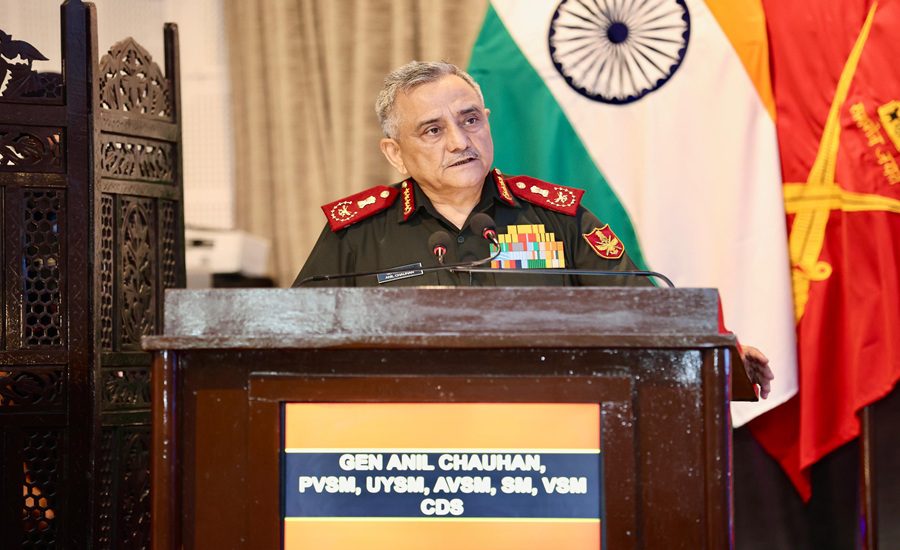
New Delhi: India’s non-contact warfare during Operation Sindoor has redefined how modern military victories are measured, according to Chief of Defence Staff (CDS) General Anil Chauhan. Speaking during the “Sena Se Samvad 2026” interaction, the CDS described the operation as a completely different kind of conflict that relied heavily on technology, coordination, cyber capabilities, and long-range precision strikes instead of traditional battlefield combat.
Details of Operation Sindoor
Operation Sindoor was launched after the deadly Pahalgam terror attack and became one of India’s most discussed modern military operations.
Read also: Why Did India Stop Operation Sindoor? Rajnath Singh Reveals the Real Reason Behind the Decision
The operation reportedly lasted around 88 hours and involved coordinated actions across land, air, maritime, cyber, and space domains.
According to CDS General Anil Chauhan:
- The operation was “largely non-contact warfare”
- India conducted coordinated multi-domain operations
- Precision strikes were carried out from 300–400 km away
- Cyber and space technologies played a major role
- Multiple government agencies worked together with the armed forces
CDS Anil Chauhan Explains “Non-Contact Warfare”
General Chauhan stated that traditional wars were usually measured by:
- Territory captured
- Prisoners taken
- Equipment destroyed
However, during Operation Sindoor, the “matrices of victory” changed completely. Victory was instead judged through:
- Precision targeting
- Smart coordination
- Visible operational impact
- Superior situational awareness
- Escalation control
The CDS emphasized that Indian forces maintained better battlefield transparency and situational awareness than the adversary throughout the operation.
Multi-Domain Warfare Became the Key
The operation highlighted India’s growing focus on integrated warfare systems. Experts believe this reflects the country’s long-term push toward integrated theatre commands and joint military operations.
Key areas involved during the operation included:
- Air operations
- Long-range missile strikes
- Cyber warfare
- Space-based intelligence
- Drone and surveillance systems
- Real-time command coordination
The CDS said the operation required “extreme coordination” between:
- Indian Army
- Indian Air Force
- Indian Navy
- Intelligence agencies
- Government departments
Precision Strikes and Technology Played Major Roles
Reports suggest Indian forces used advanced technologies and stand-off weapons during the operation. These reportedly included:
- Precision-guided munitions
- Long-range strike systems
- Drone-based operations
- Electronic warfare tools
- Integrated Air Command and Control Systems
The operation also demonstrated India’s growing emphasis on indigenous defence technology and network-centric warfare capabilities.
India Dominated the Escalation Matrix: CDS
General Chauhan stated that Indian forces “dominated every ladder of escalation” during all four days of the conflict because of superior awareness and operational clarity.
According to him:
- Indian forces knew what they had targeted
- They monitored developments in real time
- Coordination remained effective across services
- Operations remained controlled and calibrated
This reflects a shift toward information-driven warfare where intelligence and coordination become more important than direct battlefield engagement.
Why Operation Sindoor Matters for India’s Future Defence Strategy
Military analysts believe Operation Sindoor may influence future Indian military doctrine in several ways:
- Increased use of non-contact warfare
- Faster integration of theatre commands
- Greater investment in cyber defence
- Expansion of drone warfare systems
- Enhanced space-based military surveillance
- More emphasis on precision and rapid-response operations
The operation also showed how modern conflicts are increasingly technology-driven rather than troop-heavy.
Global Shift Toward Non-Contact Warfare
Operation Sindoor reflects a broader global military trend where nations are focusing on:
- Artificial intelligence
- Cyber warfare
- Electronic warfare
- Long-range precision strikes
- Data-driven combat systems
India’s experience during the operation may become an important case study for future military planning in the region.
Read also: HAL CATS Warrior Prototype Set for 2026 Reveal, First Flight Expected Next Year