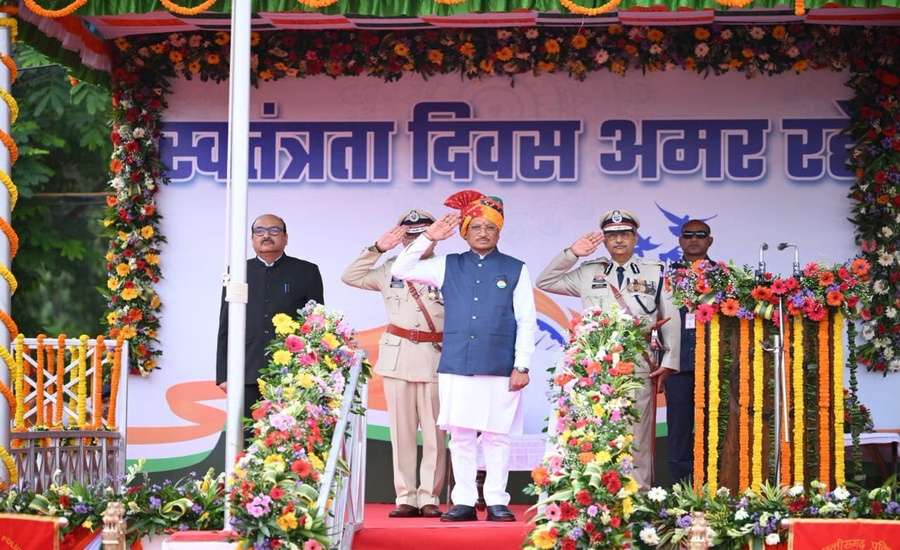
Raipur: Chhattisgarh celebrated its first Independence Day after being declared free from armed Maoists on March 31, 2026, with Chief Minister Vishnu Deo Sai describing the milestone as the beginning of a new phase of peace, development and prosperity.
Addressing the Independence Day function at the Police Parade Ground in Raipur, Sai outlined the government’s priorities, with a major focus on Bastar, along with agriculture, healthcare, employment, infrastructure, digital connectivity and tourism.
Bastar Development Takes Centre Stage
Sai said comprehensive development of Bastar remains one of the government’s key priorities. Initiatives such as Niyad Nellanar 2.0 and Bastar Munne Abhiyan are being used to take government schemes and services to remote communities.
According to the Chief Minister, more than 39 lakh people in Bastar division have benefited from the saturation of 31 government schemes and 14 community facilities.
The government is also rebuilding educational infrastructure in areas affected by Maoist violence. Schools that had previously shut down have reopened, while 36 new schools have been sanctioned.
Education Cities are also being developed in remote areas such as Orchha in Narayanpur and Jagargunda in Sukma.
Read Also: 23 Arrested in Multi-State Cyber Fraud Case; IPS Officer Rahul Bansal Faces Bribery Allegations
Healthcare and Livelihoods
Healthcare has also emerged as an important part of the development push in Bastar.
Under the Mukhyamantri Swasth Bastar Abhiyan, more than 34 lakh people have undergone health screening and their health profiles have been prepared.
Sai said around 85% of families in Bastar have a monthly income below ₹15,000. To improve livelihoods, the government has prepared the ₹4,824-crore Aajeevika Unnayan Yojana, targeting around 10 lakh families.
Five new medical colleges will also be started in:
- Geedam
- Kunkuri
- Janjgir-Champa
- Manendragarh
- Kawardha
The new institutions are expected to expand access to medical education and healthcare infrastructure across different regions of the state.
Roads, Electricity and Digital Connectivity
Infrastructure expansion remains another priority as the state moves into its post-Maoist phase.
The government is connecting 461 solar-powered villages to the electricity grid and constructing roads to link 234 interior habitations with the main road network.
The Mukhyamantri Gramin Bus Seva is providing public transport connectivity to 814 villages across Bastar and Surguja divisions.
Digital connectivity is also expanding. Sai said 829 mobile towers have been installed in the state during the last two-and-a-half years.
Under BharatNet 3.0, as many as 5,659 gram panchayats are expected to receive high-speed internet connectivity.
Agriculture and Rural Housing
Sai said paddy is being procured at ₹3,100 per quintal for up to 21 quintals per acre, while fertiliser supplies were maintained despite global disruptions.
Under PM Awas Yojana, 24.5 lakh houses have been sanctioned in 2.5 years, with around 1,600 built daily. The Meri Beti-Mera Abhiman campaign will add girls’ toilets in 6,671 schools and muktidhams and waiting areas in 6,524 villages.
Focus on Jobs and Agniveers
Employment generation was a key focus, with 10% reservation announced for Agniveers in police, forest and jail guard recruitment after four years of service.
Chhattisgarh has also set up a ₹100-crore startup fund and plans district- and state-level employment fairs after the monsoon to boost youth opportunities.
Major Policy and Recruitment Reforms
Sai announced policy and legislative reforms, including steps towards implementing the Uniform Civil Code and the Chhattisgarh Dharm Swatantraya Act 2026 to curb illegal conversions.
The government also formed the Chhattisgarh Staff Selection Board for transparent Class III and IV recruitment, enacted a law against exam cheating, and set up a task force for effective PESA Act implementation.
Tourism and New-Economy Push
The government is also looking to use tourism and technology to create new economic opportunities.
Bastar and Surguja are being developed as major tourism destinations, while Chitrakote is being developed with the ambition of becoming a global tourist destination. A tent city is also planned.
Chhattisgarh is simultaneously developing what the government describes as the country’s first AI Special Economic Zone, signalling a push towards emerging technology and new industries.
Women and Cultural Heritage
Sai said 13.85 lakh women in Chhattisgarh have become Lakhpati Didis, strengthening women-led livelihoods.
He also announced the Dr Teejan Bai Lok Kala Alankaran award to honour the late folk artist’s legacy. An excavation at Rewa in Arang uncovered evidence of a 2,750-year-old human settlement, highlighting Chhattisgarh’s ancient heritage.
From Security to Development
Chhattisgarh’s first Independence Day after being declared Maoist-free has been presented by the state government as the beginning of a broader development phase.
The government’s agenda combines improved security with better access to schools, healthcare, roads, electricity, digital services, jobs and livelihoods.
For Bastar in particular, the key challenge will be ensuring that the gains from improved security translate into sustained economic opportunities and better public services for communities in remote areas.
Read Also: From Naxalism to the Ramp: Women Showcase a New Face of Chhattisgarh