Ladakh: China has deployed its J-20 Mighty Dragon stealth fighter jets near the Line of Actual Control (LAC) with India. Defence experts say this is one of the biggest deployments of China’s fifth-generation fighter aircraft close to the India China border.
The move has raised questions about India’s air defence, military preparedness and the growing competition between Asia’s two largest powers.
What Is China J-20 Stealth Fighter
The Chengdu J-20 Mighty Dragon is China’s first operational fifth-generation stealth fighter jet. It was developed by the Chengdu Aircraft Industry Group for the People’s Liberation Army Air Force (PLAAF). The aircraft is designed for air superiority, long-range attacks and deep strike missions. It officially entered service in 2017 after completing years of testing.
Read also: Indian Army Unveils 5 New Integrated Battle Groups to Enhance Border Security Against China
Details of China J-20 Stealth Fighter Deployment
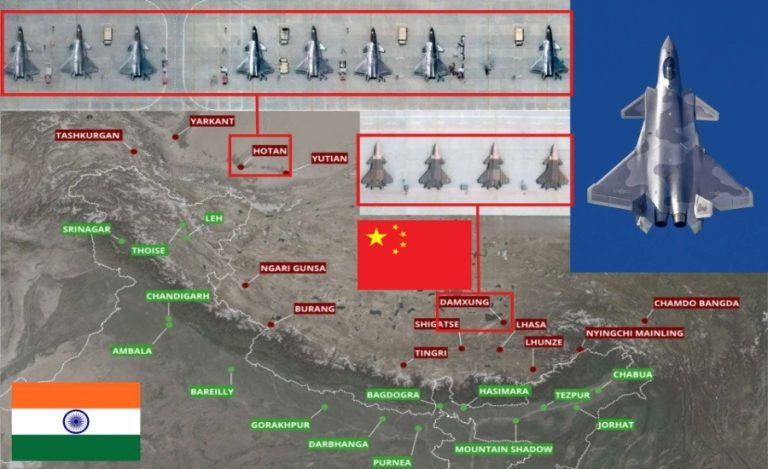
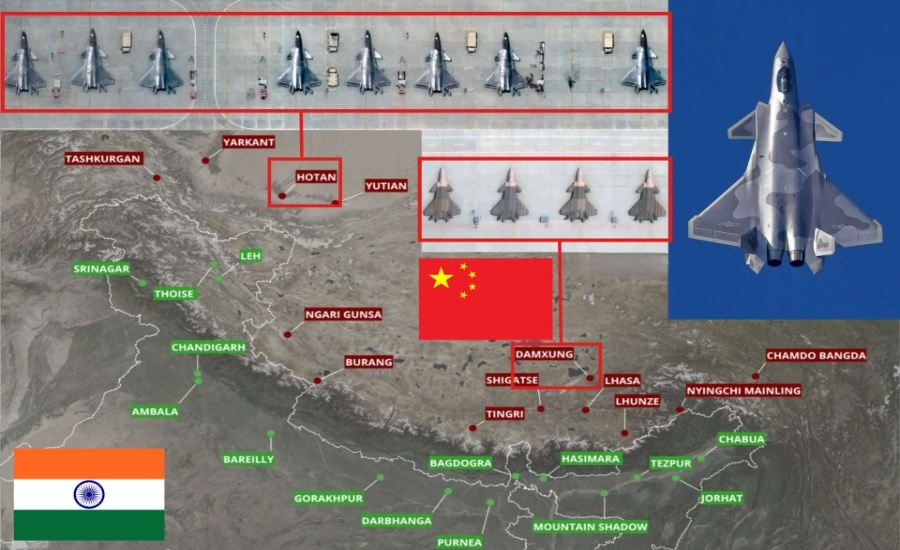
According to satellite images cited by NDTV and sourced from Vantor, China deployed 11 J-20 stealth fighters at two important airbases near India’s border. The aircraft were seen at:
- Hotan Airbase in Xinjiang
- Damxung Airbase in Tibet
Defence experts believe this is China’s largest known deployment of J-20 fighters facing India. The deployment strengthens China’s air power along the Himalayan border and improves its ability to respond quickly during any military crisis.
Why Is China J-20 Stealth Fighter Deployment Important
Military experts say the deployment shows that China is making stealth fighter operations near India a regular practice instead of a temporary military exercise. It also demonstrates China’s rapid progress in military technology and aircraft production. For India, this means future air operations near the northern border could become more challenging.
What Makes The J-20 A Fifth-Generation Fighter
The J-20 belongs to the fifth generation of fighter aircraft because it combines several advanced technologies. These include:
- Stealth design
- Radar-absorbing materials
- Internal weapon bays
- Advanced AESA radar
- Infrared sensors
- Electronic warfare systems
- Long-range air-to-air missiles
- Network-centric battlefield communication
These technologies help the aircraft detect enemy targets earlier while remaining difficult to detect itself.
How Does The J-20 Work
The J-20 follows the “first detect, first attack” strategy. Its advanced sensors collect information from different systems and combine it into a single picture for the pilot. This allows the aircraft to identify threats earlier and launch missiles from long distances before enemy aircraft can react.
What Are The Strengths Of The J-20 Stealth Fighter
Excellent Stealth Capability
The aircraft has a very small radar signature, making it difficult for enemy radar systems to detect.
Long Combat Range
Large internal fuel tanks allow the J-20 to fly longer distances without frequent refuelling.
Powerful Sensors
Its radar, infrared sensors and electronic warfare systems work together to improve situational awareness.
Network-Centric Warfare
The aircraft can exchange battlefield information with other fighter jets, drones and command centres in real time.
High-Speed Long-Range Combat
The J-20 is designed mainly for beyond-visual-range combat rather than traditional close-range dogfights.
What Are The Weaknesses Of The J-20 Stealth Fighter Jet
Despite its advanced technology, the aircraft still has some limitations. Earlier versions depended on Russian engines. Although China now produces its own engines, experts believe they still need further improvements. The aircraft is also less suitable for close-range aerial combat because its design focuses mainly on stealth and long-range engagements. Another important limitation is that the J-20 has very little real combat experience compared to some Western fighter aircraft.
How Strong Is China’s J-20 Fleet?
China has rapidly increased production of the J-20 over the past few years. Defence estimates suggest China could have around 1,000 J-20 fighters by 2030, making it one of the world’s largest fleets of fifth-generation fighter aircraft. This rapid production reflects China’s growing defence manufacturing capabilities.
How Does India Compare?
India currently operates:
- 36 Rafale fighter jets
- More than 260 Su-30MKI fighter aircraft
However, India does not yet have an operational fifth-generation stealth fighter. The country’s Advanced Medium Combat Aircraft (AMCA) programme is expected to fill this gap in the future.
What Does China J-20 Stealth Fighter Deployment Mean For India
The latest deployment is a reminder that India must continue modernising its air force. Experts believe India may speed up investments in:
- Counter-stealth radar
- Integrated air defence systems
- Long-range missiles
- Electronic warfare capabilities
- Faster development of the AMCA fighter programme
These improvements would help India maintain a strong defence posture along the LAC.