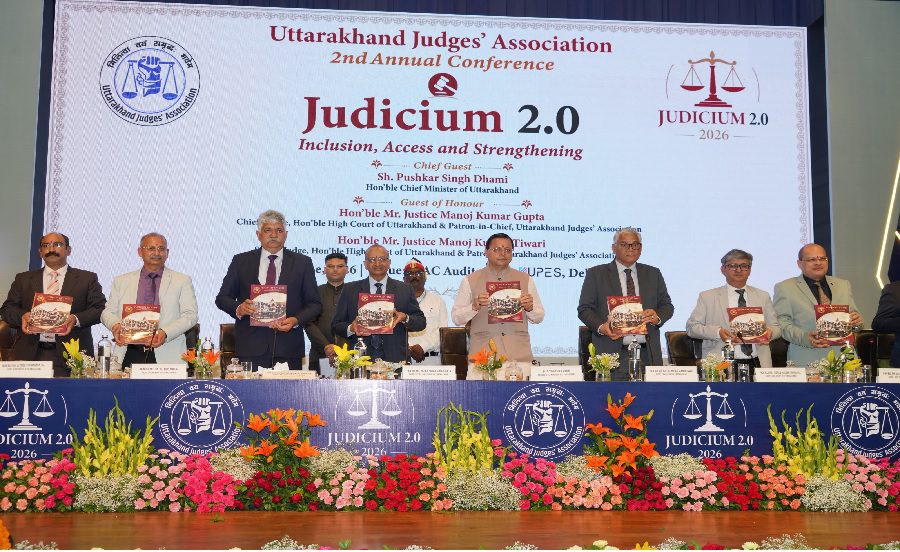
Dehradun: Uttarakhand chief minister Pushkar Singh Dhami highlighted the need to make the justice delivery system more inclusive, accessible, transparent, and effective while addressing the annual conference of the Uttarakhand Judges’ Association held in Dehradun.
The event, titled “Judiciary 2.0: Inclusion, Access and Strengthening,” was hosted at UPES, Bidholi, and brought together judges and senior judicial officials from across the state.
Justice as a Pillar of Good Governance
CM Dhami stated that an efficient justice system is central to good governance and public trust. He stressed that every section of society must have equal opportunity to access timely and fair justice.
He emphasized that geographical and economic barriers should not hinder access to courts, especially in a mountainous state like Uttarakhand where remote populations often face challenges in reaching judicial institutions.
Focus on Timely and Accessible Justice Delivery
The Chief Minister underlined that the true value of justice lies in its fairness and timeliness. Delays in judicial processes, he said, can weaken public confidence in the system.
He called for continued efforts to make judicial procedures more efficient and time-bound, ensuring faster resolution of cases and improved accountability within the system.
Strengthening Judicial Infrastructure and Digital Systems
CM Dhami praised ongoing national-level reforms under the leadership of Prime Minister Narendra Modi aimed at modernizing India’s legal framework.
He referred to key legal reforms such as:
- Bharatiya Nyaya Sanhita
- Bharatiya Nagarik Suraksha Sanhita
- Bharatiya Sakshya Adhiniyam
He also highlighted digital advancements including:
- E-Courts initiative
- National Judicial Data Grid (NJDG)
- Digital case management systems
- Video conferencing facilities for hearings
These developments, he said, have significantly improved transparency and efficiency in judicial functioning.
Uttarakhand’s Efforts Toward Modern Judiciary
The Chief Minister noted that the state government is actively working to strengthen judicial infrastructure, including:
- Development of digital courts
- Expansion of e-filing systems
- Promotion of virtual hearings
He also mentioned the use of revenue lok adalats to resolve long-pending disputes through amicable and timely settlement.
Law and Order Reforms in the State
CM Dhami reiterated the government’s zero-tolerance policy toward crime and highlighted several legal measures introduced in the state, including:
- Anti-copying law
- Anti-conversion law
- Anti-riot provisions
- Strong action against corruption and illegal encroachments
These steps, he said, have strengthened the rule of law in Uttarakhand.
Emphasis on Uniform Civil Code (UCC)
The Chief Minister described the implementation of the Uniform Civil Code (UCC) as a historic step toward women’s empowerment and equal justice for all citizens. He noted that the initiative has drawn national attention and debate.
Financial Support for Judges’ Welfare
During the event, CM Dhami announced a grant of ₹5 crore for the welfare fund of the Uttarakhand Judges’ Association.
He also released the association’s annual souvenir, marking the occasion.
Dignitaries in Attendance
The conference was attended by several senior judicial dignitaries, including Uttarakhand High Court Chief Justice Manoj Kumar Gupta, along with Justices Ravindra Maithani, Rakesh Thapliyal, Alok Mehra, Subhash Upadhyay, Siddharth Sah, Registrar General Yogesh Kumar Gupta, and other judges and officials.
The “Judiciary 2.0” conference reinforced the collective commitment toward building a more inclusive, technology-driven, and efficient justice system in Uttarakhand. CM Dhami reiterated that judicial reform and accessibility remain key priorities for sustainable governance and public trust.