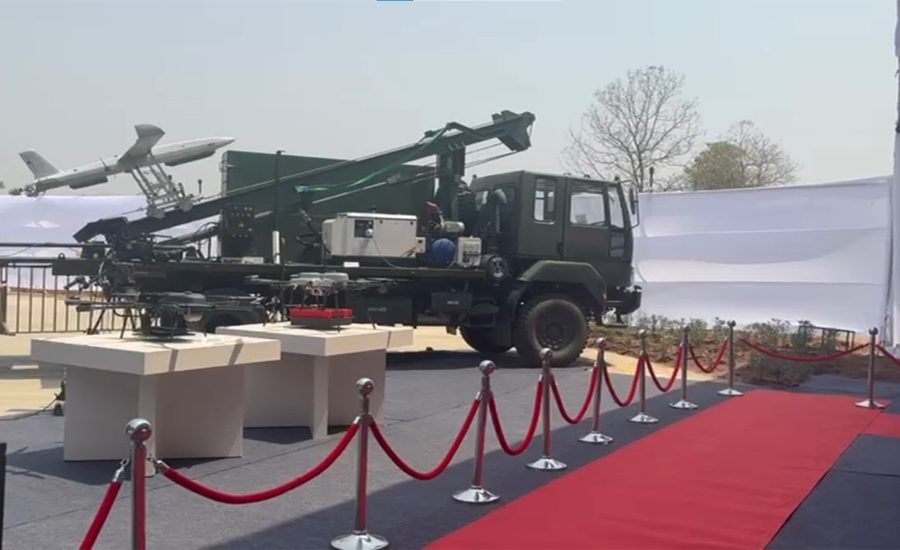
New Delhi: India’s Nagastra-3 loitering munition programme could become a major step in strengthening the country’s long-range precision strike capabilities.
Developed by Economic Explosives Limited (EEL), a subsidiary of Solar Industries, the upcoming system is expected to bridge the gap between frontline tactical drones and long-range guided weapons.
Reports indicate that the company is also exploring future loitering munitions with ranges of up to 500-700 km, creating a layered drone-based strike ecosystem for the Indian Armed Forces.
Key Highlights of Nagastra-3 Loitering Munition
- Solar Industries is reportedly developing Nagastra-3, a loitering munition with an expected range of around 100 km.
- The system is intended for brigade and divisional-level operations.
- The company is studying future variants capable of striking targets between 500 km and 700 km away.
- The project supports India’s push for defence self-reliance under the Make in India initiative.
- A layered drone architecture could provide multiple strike options at different operational levels.
Read also: DRDO Develops High-Tech Guidance Package To Make Indian Missiles Deadlier And More Accurate
What Is Nagastra-3?
Nagastra-3 is the next major evolution in Solar Industries’ loitering munition family.
Loitering munitions, often called “kamikaze drones,” can hover over a target area, identify targets, and strike with precision when required. Unlike traditional missiles, they offer surveillance and attack capability in a single platform.
According to available reports, Nagastra-3 is being designed to:
- Strike targets at around 100 km range.
- Support brigade and division-level military formations.
- Offer greater endurance and operational flexibility.
- Fill the capability gap between short-range tactical drones and long-range missile systems.
What is Layered Drone Strategy
The most significant aspect of Solar Industries’ vision is the creation of a layered loitering munition architecture.
Tactical Layer: Nagastra-1
The currently deployed Nagastra-1 provides frontline troops with immediate precision strike capability.
Key features include:
- Indigenous design and development.
- GPS-guided precision strikes.
- Reusable parachute recovery system.
- Day and night surveillance capability.
- Effective range of approximately 30-40 km depending on mission profile.
Intermediate Layer: Nagastra-2
Nagastra-2 is expected to provide enhanced endurance and anti-armour capabilities.
Reports suggest:
- Around 90 minutes endurance.
- Larger warhead options.
- Improved engagement range.
- Capability against armoured targets.
Deep-Strike Layer: Nagastra-3
The upcoming Nagastra-3 aims to extend operational reach to roughly 100 km, enabling attacks on:
- Command posts
- Logistics hubs
- Communication centres
- Supply routes
- High-value battlefield targets
Strategic Layer: Future 500-700 km Systems
The most ambitious part of the programme involves research into loitering munitions capable of reaching 500-700 km.
If developed successfully, these systems could:
- Conduct deep precision strikes.
- Target strategic infrastructure.
- Complement cruise missiles.
- Provide a lower-cost option for long-range attack missions.
Why Nagastra-3 Loitering Munition Matters
1. Faster Battlefield Response
Traditional artillery and air strikes often require significant planning and coordination.
Loitering munitions allow commanders to:
- Detecting targets.
- Track movement.
- Strike quickly.
This shortens the sensor-to-shooter cycle dramatically.
2. Cost-Effective Precision Warfare
Long-range missiles are expensive assets.
A loitering munition with hundreds of kilometres of range could:
- Reduce operational costs.
- Increase strike flexibility.
- Allow repeated deployment in high-intensity conflicts.
3. Lessons from Modern Conflicts
Recent conflicts have highlighted the growing importance of loitering munitions.
These systems have demonstrated effectiveness against:
- Air defence systems.
- Armoured vehicles.
- Command centres.
- Logistics infrastructure.
The global trend is pushing militaries toward drone-heavy warfare models.