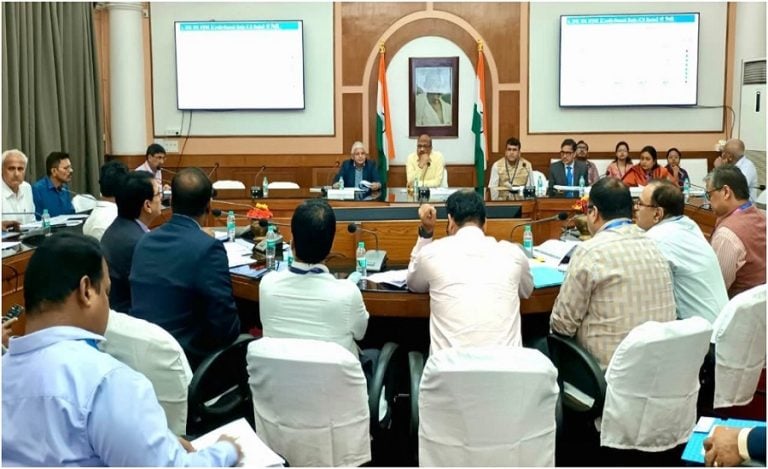
New Delhi: Field Commanders Financial Powers received a major boost after Defence Minister Rajnath Singh approved a two-fold increase in the financial ceiling for military commanders.
The decision is aimed at improving operational efficiency, speeding up procurement, supporting indigenous defence manufacturing, and enabling faster execution of military projects across the Army, Navy, and Air Force.
The revised financial delegation is expected to facilitate procurement worth more than ₹1.25 lakh crore through the revenue route during the current financial year.
Details of Delegation of Financial Powers
The Ministry of Defence has released a revised Delegation of Financial Powers (DFP) for Defence Services, including procurement, medical expenditure, and works projects.
Key Highlights
- Financial powers of field commanders increased by up to 100%.
- Some financial limits have been increased by more than double.
- Procurement worth over ₹1.25 lakh crore can now be processed faster through the revenue route.
- Financial powers for defence indigenisation and R&D have been doubled.
- New provisions added to encourage Joint Service Procurement.
- More financial authority delegated to commanders for urgent operational requirements.
- New Competent Financial Authorities introduced to decentralize procurement decisions.
Read also: How India Plans to Win Future Wars — Rajnath Singh Breaks It Down
Why Is Delegation of Financial Powers Important?
The Defence Ministry said the previous financial powers framework was notified in 2021. Since then:
- Military force levels have expanded.
- Operational expenditure has increased.
- Budgetary allocations have grown.
- Faster procurement has become critical due to evolving security challenges.
The revised framework is designed to reduce delays caused by lengthy approval processes and help commanders respond quickly to operational needs.
Major Benefits for the Armed Forces
1. Faster Decision-Making
Field commanders will be able to approve many purchases and projects without waiting for multiple layers of clearance.
2. Improved Operational Readiness
Critical equipment, maintenance items, and support services can be procured more quickly during emergencies or operational deployments.
3. Faster Project Execution
Infrastructure, medical, and operational projects can move forward without prolonged administrative delays.
4. Better Resource Availability
The armed forces can obtain required resources at the right time, improving overall preparedness.
Delegation of Financial Powers: Big Push for Atmanirbhar Bharat in Defence
One of the most significant aspects of the reform is the increase in financial powers related to:
- Indigenous defence production
- Research and Development (R&D)
- Import substitution programs
The government aims to reduce dependence on foreign defence manufacturers and strengthen India’s domestic defence ecosystem.
Experts believe the move will benefit:
- Indian defence startups
- MSMEs
- Defence Public Sector Undertakings (DPSUs)
- Private defence manufacturers
- Research institutions working on military technologies
The policy aligns with India’s long-term goal of becoming a major defence manufacturing hub.
Joint Service Procurement Gets a Boost
A new feature of the revised framework is the promotion of Joint Service Procurement.
What It Means
- One service can act as the lead procuring agency.
- Common requirements of Army, Navy, and Air Force can be purchased together.
- Procurement processes become faster and more cost-efficient.
This is expected to improve interoperability among the three services while reducing duplication of purchases.
Read also: No Room for Nuclear Blackmail: Rajnath Singh Sends Bold Message from South Korea