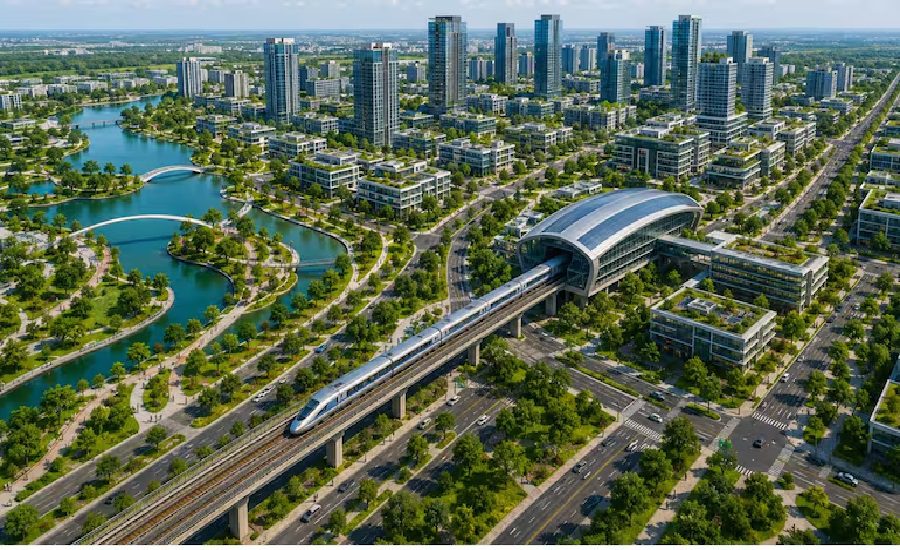
New Delhi: Delhi is preparing for a major shift towards vertical urban development as rising land prices, limited space, and increasing housing demand push the national capital towards high-rise buildings and large-scale redevelopment.
Recent policy changes, including an increase in Floor Area Ratio (FAR) limits and expansion of Transit-Oriented Development (TOD) zones, have created new opportunities for high-rise residential projects and mixed-use developments. However, urban planners and architects have warned that infrastructure readiness will be critical for the success of this transformation.
New Policies Encourage High-Rise Development in Delhi
With land availability becoming increasingly limited, the government has introduced policy reforms aimed at promoting better utilisation of urban space.
The revised approach focuses on:
- Higher FAR limits to allow more construction within available land.
- Development of high-rise residential towers.
- Expansion of TOD zones near metro corridors.
- Large-scale redevelopment of existing urban areas.
The objective behind TOD-based development is to encourage people to live closer to public transport networks, especially metro corridors, reducing dependence on private vehicles and easing traffic congestion.
Read also: Delhi CM Rekha Gupta Unveils ‘Mayur’ Mascot for Commonwealth Table Tennis Championship 2026
207 Sq Km Area Identified Under Transit-Oriented Development Plan
Under the TOD framework, around 207 square kilometres of Delhi’s area has been brought under consideration for planned development.
The zones are expected to support:
- Affordable housing projects.
- Office spaces.
- Studio apartments.
- Mixed-use developments.
Around 14 land parcels near important metro corridors, including Dwarka, Rohini, Peeragarhi, and Karkardooma, have been identified for development.
To speed up approvals, a single-window clearance system has also been introduced, allowing developers to obtain approvals related to agencies such as:
- Delhi Jal Board.
- Municipal Corporation of Delhi (MCD).
- Fire Department.
The Centre had approved the revised Transit-Oriented Development (TOD) Regulations and Charges 2026, which were notified on February 6, 2026.
Experts Raise Concerns Over Infrastructure Capacity
While experts support the idea of vertical growth, they have highlighted concerns regarding Delhi’s existing infrastructure capacity.
Urban planners and architects believe the main challenge is not the height of buildings but whether the city’s basic systems can handle the additional population.
Key areas requiring attention include:
- Road capacity.
- Water supply networks.
- Sewerage and drainage systems.
- Public transportation.
- Local civic infrastructure.
Experts have warned that without area-level planning, high-density housing projects could put additional pressure on already stressed neighbourhoods.
Development Should Focus Beyond Construction and Profit
Architect and former DDA Planning Commissioner Ashok Kumar Jain said Delhi is at an important stage of urban transformation.
He noted that increasing FAR and promoting TOD-based development is a natural response to rising land prices and limited space availability.
However, he cautioned that redevelopment should not focus only on additional construction capacity or economic benefits.
According to him, planners must also consider how new populations will impact local resources and existing communities.
Lack of Parallel Infrastructure Investment Could Create Challenges
Experts have stressed that vertical development must be accompanied by improvements in supporting infrastructure.
Without simultaneous investment in:
- Road expansion.
- Water pipelines.
- Drainage systems.
- Public amenities.
high-rise development could create new urban challenges, including:
- Water shortages.
- Traffic congestion.
- Flooding and waterlogging.
- Pressure on civic services.
They warned that poorly planned expansion could turn residential areas into dense concrete zones without adequate living conditions.
Delhi Needs Balanced Growth Model for Sustainable Urban Future
Urban experts believe Delhi can follow the example of global cities that have successfully adopted vertical development, but simply relaxing construction rules will not be enough.
For sustainable growth, the city will need a balanced approach where:
- Housing development matches infrastructure capacity.
- Public transport expands alongside population growth.
- Civic services are upgraded at the same pace as construction.
The success of Delhi’s high-rise development strategy will depend on integrating modern urban planning with strong infrastructure investment and citizen-focused development.
Read also: Delhi CM Rekha Gupta Launches AI-Powered Dust Portal 2.0 to Monitor Construction Pollution