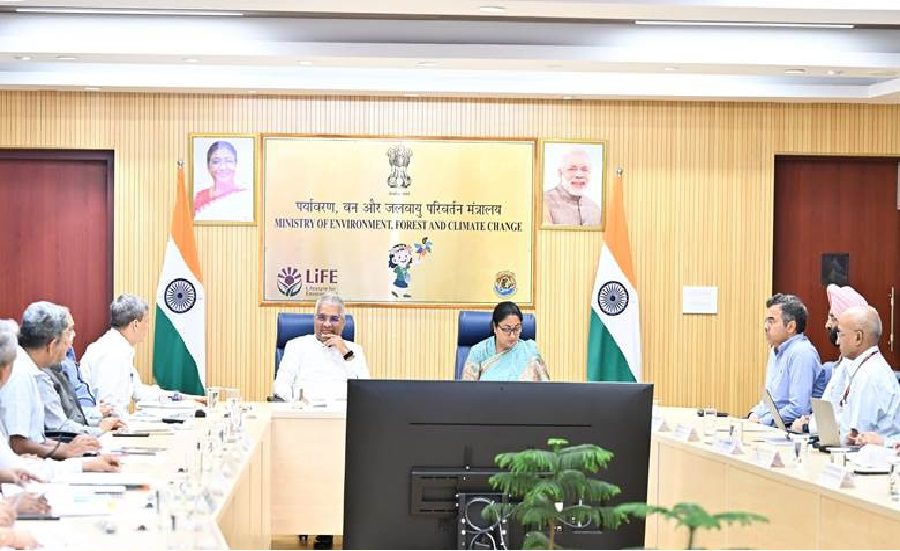
Delhi: The Union Minister for Environment, Forest and Climate Change, Mr. Bhupender Yadav, held a high-level review meeting with the Chief Minister of the National Capital Territory (NCT) of Delhi, Rekha Gupta, to assess ongoing efforts aimed at improving air quality in Delhi-NCR. The meeting focused on accelerating key pollution control measures ahead of the upcoming winter season, when air quality typically worsens.
Senior officials from both the Central and Delhi governments, along with agencies such as CPCB, DPCC, NDMC, Delhi Police, Delhi Metro, and PWD, also participated in the review.
Strong Push for Faster Implementation of Anti-Pollution Measures
Mr. Bhupender Yadav stressed that while several initiatives are underway, gaps in implementation must be urgently addressed. He called for a “mission-mode” approach to ensure timely completion of all planned interventions.
He emphasized that the coming months are critical for improving Delhi’s air quality and highlighted the need for strict enforcement, better coordination among agencies, and time-bound execution of projects.
Read also: Delhi Govt Signs MoU with IIT Kanpur’s AIRAWAT to Develop AI-Based Air Quality Monitoring System
Road Dust Control and Infrastructure Upgrades
Road dust was identified as one of the major contributors to air pollution in the capital. The Minister reviewed progress on road redevelopment and flagged delays in planning, tendering, and execution.
Key directions included:
- Completing pending road redevelopment works by October 2026
- Expanding roadside greening and plantation drives
- Finalising MoA with CRRI and SPA by May 2026
- Increasing deployment of mechanised road sweeping machines (78 MRSMs) and 1,000 litter pickers by September 2026
He also called for more intensive road cleaning and dust suppression measures as immediate interventions.
Push for Electric Mobility and Public Transport Expansion
The review placed strong emphasis on reducing vehicular emissions through cleaner transport solutions. Mr. Yadav urged the Delhi government to accelerate the procurement of electric buses and strengthen EV infrastructure across the city.
He also highlighted the need for:
- Faster expansion of EV charging stations
- Improved metro connectivity
- Better last-mile transport integration
- Coordinated EV adoption across the wider NCR region
These steps aim to reduce dependency on private vehicles and lower emissions.
Traffic Management, Parking, and Signal-Free Corridors
To reduce congestion and idling emissions, the Minister proposed a multi-pronged traffic management strategy. This includes:
- Development of 15 signal-free road stretches by September 2026
- Expansion of public parking infrastructure by December 2026
- Identification of major pollution hotspots for targeted decongestion measures
These interventions are expected to improve traffic flow and reduce pollution from vehicle stoppages.
Strict Action Against End-of-Life and Polluting Vehicles
The meeting also reviewed enforcement measures against end-of-life (EoL) vehicles. Authorities were directed to:
- Speed up issuance of No Objection Certificates (NOCs) for vehicle transfer outside NCR
- Install Automatic Number Plate Recognition (ANPR) cameras at all border entry points by September 2026
- Strengthen vehicle fitness testing systems for commercial transport
These steps aim to tighten control over high-emission vehicles entering and operating in Delhi.
Industrial and Construction Pollution Under Scrutiny
The Minister stressed strict monitoring of industrial emissions and construction-related pollution. He directed agencies to ensure:
- Proper functioning of emission monitoring systems (OCEMS)
- Regular inspections and strict action against non-compliant industries
- Removal or relocation of polluting units in non-conforming areas
- Intensified checks on diesel generator sets
For construction and demolition waste, he highlighted a processing gap of nearly 1,000 tonnes per day and called for:
- Expansion of waste processing capacity by December 2026
- Geotagging of transport vehicles by July 2026
- Monthly inspections of construction sites
Strong Focus on Solid Waste and Waste Burning Prevention
The review also covered municipal solid waste management. The Minister urged timely achievement of legacy waste clearance targets and faster commissioning of waste-to-energy facilities.
He also reiterated a zero-tolerance approach toward open waste burning, especially during winter months, and suggested stronger enforcement and worker support measures to discourage such practices.
Public Participation and Coordinated Action
Mr. Bhupender Yadav emphasized that effective air pollution control requires collective action from government agencies, institutions, and citizens.
He proposed:
- Large-scale greening and cleanliness drives
- Formation of task forces for hotspot monitoring
- Regular monthly reviews of pollution control efforts
- Strong public awareness campaigns under IEC frameworks
Coordinated Effort for Cleaner Air in Delhi-NCR
The Union Minister concluded that air pollution control in Delhi-NCR demands sustained, coordinated, and time-bound action across all sectors. He reaffirmed the Centre’s commitment to working closely with the Delhi government to ensure cleaner air and improved quality of life for residents.
The meeting marked a renewed push for accountability, faster execution, and stronger enforcement across all major pollution control areas.