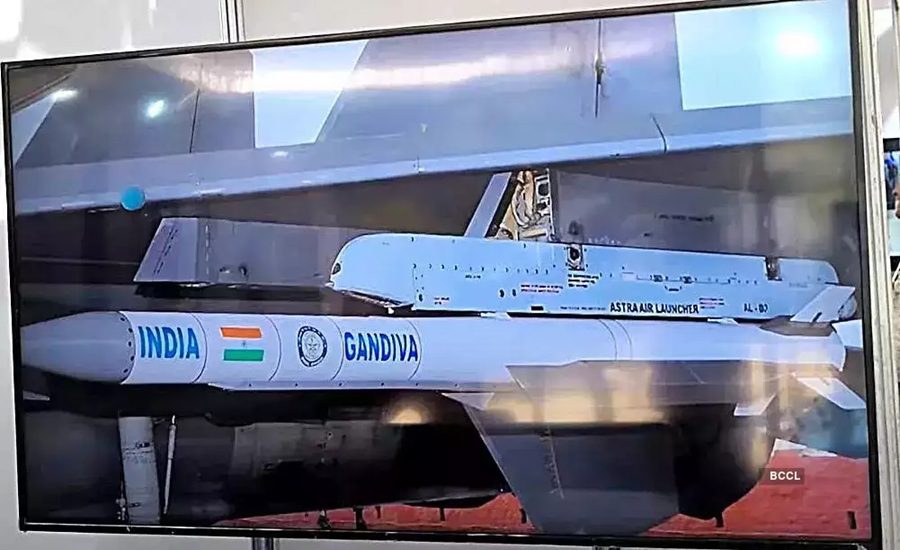
India’s Defence Research and Development Organisation (DRDO) is advancing steadily with the Astra Mk-3 missile, officially named ‘Gandiva,’ which is set to become the Indian Air Force’s (IAF) next-generation beyond-visual-range air-to-air missile (BVRAAM). The project, inspired by the legendary bow from the Mahabharata, aims to redefine India’s air dominance with cutting-edge propulsion and seeker technologies.
Ramjet Power for Extended Reach and Speed
The standout feature of Gandiva is its Solid Fuel Ducted Ramjet (SFDR) propulsion system. Unlike the solid rocket motors used in previous Astra variants, the SFDR system uses atmospheric oxygen during combustion. This makes the missile lighter and more fuel-efficient, allowing it to maintain supersonic speeds over a longer duration.
With speeds reaching Mach 4.5 and an engagement range that extends beyond 300 kilometers, Gandiva will rank among the world’s longest-range air-to-air missiles. The throttleable nature of the SFDR engine significantly expands the missile’s “no-escape zone,” making it highly lethal against fast, manoeuvring targets.
Recent ground tests of the SFDR engine have successfully validated its core performance parameters, laying a solid foundation for the upcoming live-fire trials.
Advanced AESA Seeker to Counter Stealth Threats
Initially, the Astra Mk-3 is being equipped with an Active Electronically Scanned Array (AESA) seeker based on Gallium Arsenide (GaAs) technology. This provides precision guidance and enables the missile to receive real-time target data from airborne platforms.
DRDO, however, is actively developing a next-generation AESA seeker using Gallium Nitride (GaN) components. GaN-based seekers offer several key advantages—superior heat resistance, greater power efficiency, and enhanced immunity to electronic jamming. This makes Gandiva more effective in detecting and tracking stealth targets and surviving modern electronic warfare environments.
The GaN seeker, being developed under India’s “Atmanirbhar Bharat” initiative, reflects India’s rising capability in mastering high-end defence electronics domestically.
Integration Trials and Platform Compatibility
The missile is currently undergoing captive carriage trials, mounted on IAF platforms like the Su-30MKI. These trials are focused on validating the missile’s integration with aircraft avionics and weapon systems.
Upcoming trials will test Gandiva across a wide performance envelope. Live-fire exercises will push the missile to operational extremes—validating its ability to neutralize manoeuvring, long-range, and high-value targets such as stealth aircraft and Airborne Warning and Control Systems (AWACS).
Once operational, the Gandiva is expected to become a mainstay in the IAF’s arsenal. It is being configured for deployment on several frontline aircraft, including the Su-30MKI and HAL Tejas. There is also potential for integration with Rafale and MiG-29 fighters, ensuring wide operational compatibility.
Strategic Edge Over Regional Rivals
The development of Gandiva is seen as a direct counter to regional threats, particularly China’s J-20 stealth fighters and the PL-15 long-range missile. The combination of long reach, supersonic speed, and electronic warfare resistance positions Gandiva as a significant force multiplier for the IAF.
The missile’s integration into Indian fighter squadrons will not only bolster deterrence but also signal a major leap in India’s indigenous defence capabilities.
Path to Production and Future Outlook
One of the key challenges ahead for DRDO is miniaturising the SFDR engine to suit the missile’s compact design without compromising performance. Despite this, the program is on track, with DRDO targeting full-scale production by 2030–2031.
If successful, the Gandiva will represent a generational leap in India’s missile technology, strengthening national defence and furthering India’s goal of technological self-reliance.
The Astra Mk-3 ‘Gandiva’ is poised to become a cornerstone of India’s future air combat capabilities—combining speed, range, and precision with cutting-edge indigenous innovation.
Also Read: India’s Hypersonic Leap: DRDO Tests Indigenous ET-LDHCM Under Project Vishnu