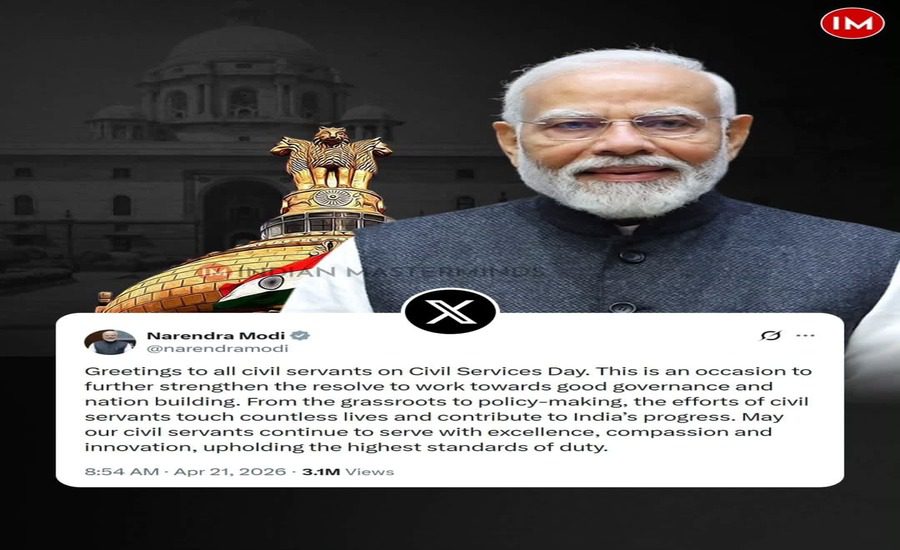
New Delhi: Prime Minister Narendra Modi on Tuesday extended greetings to civil servants across the country on the occasion of National Civil Service Day, underscoring their vital role in strengthening governance and driving nation building.
In his message, the Prime Minister highlighted the wide-ranging impact of civil servants, noting that their work—from grassroots implementation to high-level policy-making—touches countless lives and contributes significantly to India’s development trajectory.
PM’s Message: Call for Excellence, Compassion and Innovation
Taking to X (formerly Twitter), the Prime Minister reiterated the importance of the day as a moment of reflection and renewed commitment.
“Greetings to all civil servants on Civil Services Day. This is an occasion to further strengthen the resolve to work towards good governance and nation building. From the grassroots to policy-making, the efforts of civil servants touch countless lives and contribute to India’s progress. May our civil servants continue to serve with excellence, compassion and innovation, upholding the highest standards of duty,” Modi said.
His message emphasised not just administrative efficiency but also the need for empathy and innovation in public service delivery.
Historical Significance: Legacy of Sardar Vallabhbhai Patel
National Civil Service Day is observed every year on April 21 to recognise the contribution of India’s civil servants and celebrate the country’s administrative framework. The date holds historical importance as it marks the day in 1947 when India’s first Home Minister, Sardar Vallabhbhai Patel, addressed the first batch of civil servants at the All India Services training school in Metcalfe House, Delhi.
During his address, Patel famously described civil servants as the “steel frame of India,” highlighting their crucial role in maintaining unity, integrity, and administrative continuity in a newly independent nation.
Recognising the Backbone of Governance
The day serves as a tribute to the immense responsibilities carried by civil servants in policy implementation, governance, and public service delivery. It also aims to inspire officials to uphold transparency, accountability, and citizen-centric governance.
Civil servants are instrumental in ensuring the effective implementation of government schemes and welfare programmes. From maintaining law and order to managing disaster response and crisis situations, their responsibilities span across critical sectors.
They also play a key role in delivering essential public services such as healthcare, education, and infrastructure, often working in challenging environments at the grassroots level.
Evolving Role in a Changing India
With the advent of digital governance and increasing public expectations, the role of civil servants is undergoing a significant transformation. Modern bureaucracy is increasingly focused on data-driven decision-making, technological integration, and collaboration with private sector stakeholders and civil society organisations.
Operating across central, state, and district levels, civil servants continue to form the backbone of India’s governance architecture, ensuring continuity and stability in administrative processes.
Prime Minister’s Awards for Excellence
A key highlight of National Civil Service Day is the presentation of the Prime Minister’s Awards for Excellence in Public Administration. These awards recognise outstanding contributions by civil servants and districts that have implemented innovative and impactful initiatives for public welfare.
The awards serve as both recognition and motivation, encouraging officials to adopt best practices and deliver results-oriented governance.
A Reminder of Enduring Institutional Strength
National Civil Service Day stands as a reminder of the critical role played by India’s bureaucracy in shaping governance outcomes. Beyond policy formulation, it is the administrative machinery that ensures effective execution on the ground, maintaining continuity and stability in a rapidly evolving nation.
As India continues its journey of transformation, the contributions of civil servants remain central to achieving inclusive growth, responsive governance, and sustainable development.