Gandhinagar: Gujarat Chief Minister Bhupendra Patel has strongly supported the concept of ‘One Nation One Election’, stating that it aligns with Prime Minister Narendra Modi’s vision of ‘Ek Bharat Shreshtha Bharat’ and will strengthen governance efficiency across the country.
He made these remarks while addressing the Joint Parliamentary Committee (JPC) meeting held at GIFT City, Gandhinagar, which was convened to gather views and suggestions from states on the proposed electoral reform.
‘One Nation One Election’ to Improve Governance Efficiency
The Chief Minister said that frequent elections negatively impact the functioning of government machinery and reduce administrative efficiency.
He added that continuous election cycles lead to repeated deployment of administrative staff, affecting developmental work and increasing the burden on governance systems.
According to him, a synchronized election system would allow governments to focus more on development and policy implementation.
Impact on Labour and Industrial Productivity
Bhupendra Patel also highlighted that frequent elections force migrant labourers to return to their native places for voting, which impacts industrial productivity, especially in states like Gujarat.
He stated that such disruptions affect production output and create avoidable challenges for industries that depend on continuous labour availability.
India Had Simultaneous Elections in Early Years
The Chief Minister noted that for the first 15 years after independence, elections to the Lok Sabha and state assemblies were held simultaneously.
However, this system was disrupted due to political instability over time, leading to the current cycle of frequent elections.
Election Process Increases Administrative Burden
He further explained that elections require extensive logistics, manpower, and administrative resources.
As a result, a significant portion of government machinery remains engaged in election-related duties, while the cost of conducting elections also places a financial burden on the state.
Strengthening ‘Ek Bharat Shreshtha Bharat’ Vision
Bhupendra Patel said that reforms such as ‘One Nation One Tax’, ‘One Nation One Ration Card’, ‘One Nation One Grid’, and ‘One Nation One Subscription’ have already brought greater uniformity in governance.
He emphasized that ‘One Nation One Election’ would be another major step toward strengthening national unity and improving democratic participation.
Gujarat’s Engagement with Russia’s Astrakhan Region
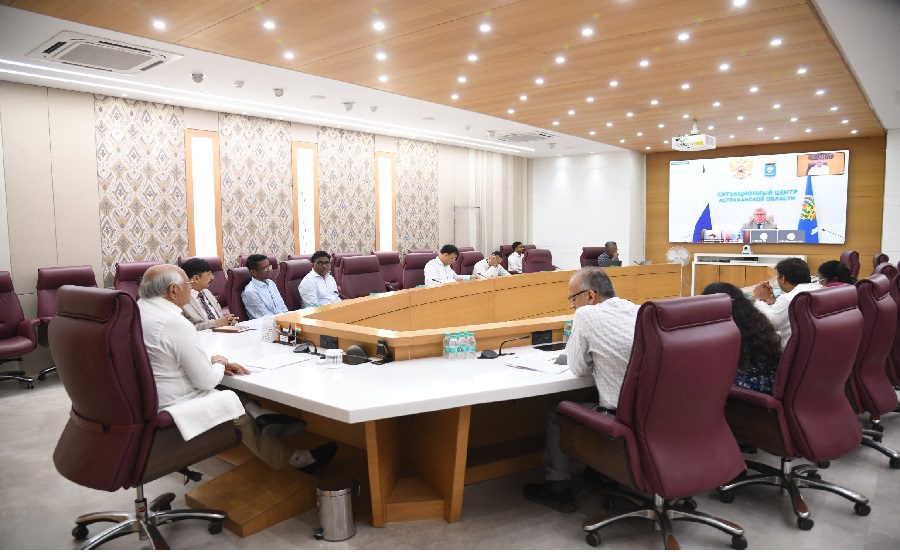
In a separate development, the Gujarat Chief Minister also held a virtual meeting with Igor Babushkin, Governor of Russia’s Astrakhan region, to discuss expanding bilateral cooperation.
The discussions focused on strengthening ties in:
- Trade and investment
- Education and academic exchange
- Shipbuilding and maritime cooperation
- Transport and logistics development
The meeting also highlighted opportunities within the International North-South Transport Corridor (INSTC), with Gujarat expressing readiness to contribute to logistics and transport infrastructure development.
Long-Standing Gujarat–Astrakhan Cooperation
Officials noted that a protocol agreement signed between Gujarat and Astrakhan in 2001 remains valid until November 6, 2026.
Earlier agreements initiated during Narendra Modi’s tenure as Gujarat Chief Minister in 2003 covered sectors such as oil and gas, pharmaceuticals, fisheries, food industries, education, and cultural exchange.
Both sides also reiterated their commitment to expand academic collaboration between universities and promote maritime training exchanges.
Senior Officials Present at the Meeting
The virtual meeting was attended by senior state officials, including Chief Secretary M.K. Das, Additional Chief Secretary (Industries and Mines) Mamta Verma, Principal Secretary to the Chief Minister Sanjeev Kumar, and Additional Principal Secretary Dr. Vikrant Pandey.
Focus on Governance Reform and Global Cooperation
The Gujarat government emphasized that electoral reforms like ‘One Nation One Election’ combined with international partnerships reflect a broader strategy of improving governance efficiency, economic growth, and global engagement.
Read also: Gujarat CM Bhupendra Patel Meets 8 IAS Probationers of 2025 Batch, Urges Focus on Public Welfare