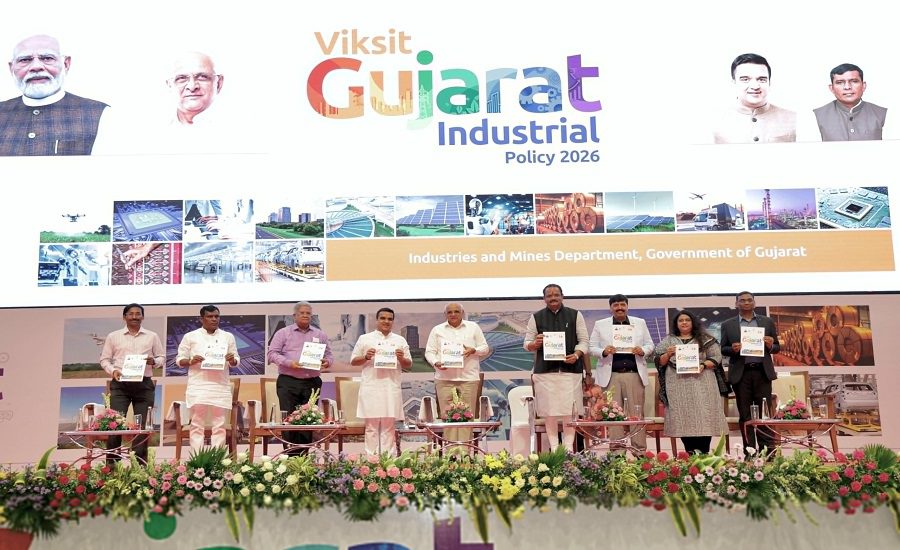
Ahmedabad: The Government of Gujarat has officially announced the Viksit Gujarat Industrial Policy 2026, a forward-looking framework aimed at transforming the state into a global hub for advanced manufacturing, innovation, and sustainable industrial growth. The policy was unveiled in Gandhinagar in the presence of Chief Minister Bhupendra Patel and Deputy Chief Minister Harsh Sanghavi, reinforcing Gujarat’s long-term vision of contributing significantly to Viksit Bharat @2047.
Framed as a comprehensive development roadmap, the policy focuses on investment attraction, job creation, innovation, MSME empowerment, and sustainability-driven industrial expansion.
A Strategic Step Toward Viksit Gujarat @2047
The Gujarat Industrial Policy 2026 has been designed as more than an incentive scheme—it is positioned as a strategic instrument for long-term transformation.
Chief Minister Bhupendra Patel described the policy as a holistic development document aligned with India’s national vision of becoming a developed nation by 2047 under the leadership of Prime Minister Narendra Modi.
Deputy CM Harsh Sanghavi emphasized that the policy will act as a growth catalyst, offering incentives ranging from 15% to 45%, depending on sector and investment category, to attract industries and generate large-scale employment.
Read also: CM Bhupendra Patel Inaugurates Hexaware Delivery Centre in GIFT City, Boosts Gujarat’s Tech Growth
Core Vision and Strategic Pillars
The policy is built on four foundational pillars:
- Investment and manufacturing expansion
- Innovation and research development
- Skill development and employment generation
- Sustainability and inclusive growth
It also aligns with global economic trends, including AI, green energy transition, and evolving supply chains, ensuring Gujarat remains future-ready.
Key Features of Gujarat Industrial Policy 2026
1. “Choose Your Incentive” Model
A major highlight of the policy is the introduction of a flexible incentive structure where investors can customize benefits based on their business needs.
2. Focus on Advanced Manufacturing & R&D
The policy prioritizes:
- Advanced manufacturing industries
- Research and development ecosystems
- Value-added production
- Sunrise sectors such as robotics, drones, and green energy
3. T.H.R.I.V.E. Project
A key initiative aimed at relocating industries away from congested urban areas, improving:
- Urban decongestion
- Ease of living
- Balanced regional development
4. MSME and Startup Empowerment
Strong emphasis is placed on:
- MSME scale-up support
- Startup ecosystem strengthening
- Women entrepreneurs and first-generation industrialists
- SC/ST and differently-abled entrepreneurs
5. Ease of Doing Business Reforms
The policy simplifies procedures through:
- Reduced paperwork
- Faster approvals
- Technology-driven governance systems
Incentive Structure Under the Policy
MSMEs
MSMEs remain at the center of Gujarat’s industrial strategy. With over 42 lakh MSMEs, the policy provides:
- Incentives of 35% to 45% of investment based on taluka category
- Flexible selection of capital subsidy, interest subsidy, or power tariff support
- Additional benefits for:
- Quality certification
- ZED certification
- Technology upgradation
- Patent registration
- Market development assistance
Large Industries (Above ₹125 Crore Investment)
- Thrust sector industries: 25% to 35% incentives
- General sector industries: 15% to 20% incentives
- Flexible incentive combination options based on project needs
Mega and Ultra Mega Projects
- Mega industries (₹1,000 crore+ investment, 250+ jobs): 30% to 35% incentives
- Ultra Mega industries (₹10,000 crore+ investment, 3,000+ jobs): 35% to 40% incentives
These large-scale projects are expected to act as growth anchors, strengthening supply chains and boosting employment.
Special Thrust Sectors (Up to 50% Incentives)
The highest incentive category (up to 45%–50%) is reserved for employment-intensive and strategic sectors such as:
- Toys manufacturing
- Sports goods and equipment
- Footwear industry
- Robotics manufacturing
- Drone technology
These sectors are expected to drive import substitution and export growth while generating large-scale employment.
Gujarat’s Industrial Strength and Economic Position
Gujarat continues to play a leading role in India’s industrial ecosystem:
- Contributes over 18% of India’s manufacturing output
- Accounts for nearly 33% of exports
- Handles around 40% of cargo movement
- Home to the highest number of MSME units in India
The state has also maintained top rankings in:
- Logistics Ease Across Different States (LEADS) Index
- National Startup Rankings (DPIIT)
Focus on Sustainability and Green Growth
The policy strongly integrates environmental sustainability through:
- Green industrial parks
- Zero liquid discharge systems
- Wastewater recycling initiatives
- Circular economy promotion
- Clean production technologies
This positions Gujarat as a leader in sustainable industrialization.
Investment Growth and Economic Expansion
Gujarat’s industrial progress has been marked by strong economic indicators:
- Significant rise in GDP contribution from 6.2% to 8.2% of India’s GDP
- Foreign Direct Investment increased from $2.2 billion (2015-16) to $60.6 billion (2025)
- Over ₹7 lakh crore cumulative investment since 2012
- Employment generation of 12.72 lakh jobs
The state continues to strengthen its ecosystem through GIFT City, Dholera SIR, and global industrial parks.
Future Roadmap: Building a Global Industrial Powerhouse
Officials emphasized that Gujarat aims to reach a $3.5 trillion economy by 2047, positioning itself as a global leader in manufacturing, innovation, and exports.
The policy also promotes the vision of “Vocal for Local, Local to Global,” encouraging industries to expand from domestic production to global competitiveness.
The Viksit Gujarat Industrial Policy 2026 represents a major milestone in the state’s industrial evolution. By combining flexible incentives, innovation-driven growth, MSME empowerment, and sustainability-focused development, the policy aims to transform Gujarat into a globally competitive industrial powerhouse.
With strong alignment to the national vision of Aatmanirbhar Bharat and Viksit Bharat @2047, Gujarat is positioning itself as a key driver of India’s long-term economic transformation.