New Delhi: In a landmark assessment that could reshape Asia’s geopolitical contours, India has been officially recognized as a “major power” for the first time by the Australia-based think tank Lowy Institute.
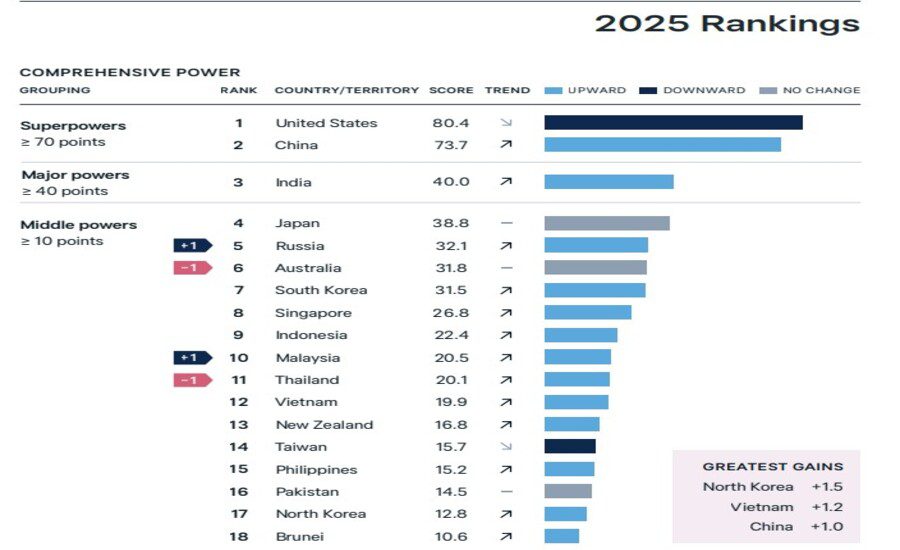
The 2025 edition of the Asia Power Index (API) places India as the third most powerful nation in Asia — trailing only the United States (US) and China — ahead of long-established powers such as Japan and Russia.
With a comprehensive power score of 40.0 in 2025, India crossed the threshold defined by the Index for “major powers,” thereby upgrading from its previous “middle power” status.
This development underscores India’s growing influence across economic, military, and strategic domains — and comes amid rising global interest in the country’s evolving role in Asia and beyond.
What is Asia Power Index
The Asia Power Index, compiled annually by the Lowy Institute since 2018, evaluates and ranks the relative power of Asian states based on a comprehensive framework.
Read also: Shock to China-Pakistan: India Now Owns Latest Israeli Air Lora & Ice Breaker Missile Technology
The methodology spans eight thematic measures, grouped under two broad pillars: Resources and Influence.
Resources — which include economic capability, military capability, resilience (e.g. economic resilience, domestic stability), and future resources (e.g. projected economic growth, demographics).
Influence — covering economic relationships, defence networks (alliances, partnerships), diplomatic influence, and cultural influence.
Each thematic measure aggregates data from multiple indicators (in total 131 individual indicators), producing a weighted composite score that seeks to estimate a country’s ability to shape outcomes in Asia.
Ranking criteria
- Countries scoring 70 or above are classified as “superpowers.”
- Countries scoring 40 or above but below the superpower threshold are “major powers.”
In previous years, India had hovered just below the 40-point threshold, making it a “middle power.” The new 2025 assessment — placing its score at exactly 40.0 — marks the first time it has officially entered the “major power” category.
Key Drivers Behind India’s Rise in Asia Power Index 2025
Economic and Military Gains: The 2025 Index credits significant improvements in India’s economic capability and military capability as the main drivers of its enhanced score.
India’s post-COVID economic recovery, steady GDP growth, expanding trade and investment relations, and growing global relevance in technology and demographics contributed to its economic strength.
On the military front, India’s performance in recent events proved decisive. In particular, the twin phenomena of increased defense readiness and demonstrable combat capability boosted India’s standing in the Index.
Impact of Operation Sindoor: The Lowy Institute report explicitly mentions Operation Sindoor — a military operation conducted by India in May 2025 — as a key determinant in the rise of India’s military capability score.
According to the report, the military gains were not just in hardware or force numbers, but also in combat experience, strategic strike capability, rapid deployment, and sustained warfare capacity — all of which enhanced the country’s assessed readiness and deterrence potential.
This real-world demonstration appears to have shifted regional perceptions, translating into quantifiable improvements under the Index’s methodology.
Regional Context: How India Overtook Japan & Russia
- Under the 2025 Asia Power Index, India occupies the third slot among Asian states, edging ahead of both Japan (ranked 4th) and Russia (5th).
- While both Japan and Russia continue to be influential regional actors, India’s ascent can be attributed to a combination of rising economic momentum, demographic advantage, expanding military capabilities, and growing global relevance.
- The report underscores that, despite crossing the “major power” threshold, India’s full potential remains unrealised — especially when compared with China, whose comprehensive score remains significantly higher at 73.7.
In short, India’s rise reflects not only climbing numbers, but also changing strategic dynamics in Asia — where traditional power hierarchies are being reshaped.
Mixed Signals: Strengths vs Limitations
The 2025 assessment paints a nuanced picture; while India has made concrete gains in resources and military capability, its influence — particularly in defense-networks and diplomatic relationships — has not risen at the same pace.
For example:
India’s defence networks ranking dropped, placing it behind several smaller Asian nations in terms of alliances and defense partnerships.
Similarly, in diplomatic influence and certain facets of soft power or cultural influence, growth has been modest.
Thus, while India’s hard power metrics have strengthened, the challenge remains to convert such capability into sustained regional influence and global sway.
The report calls this “a mixed picture”: gains in power, but gaps between ambition and influence.
Key Implications for Regional and Global Geopolitics
India’s elevation to “major-power” status has significant implications:
Geopolitical balancing in Asia: As a third major power after the US and China, India could play a more pivotal role in shaping regional alliances, trade networks, security architecture — particularly in the Indo-Pacific.
Strategic leverage: Improved military readiness and deterring capability could provide India greater leverage in regional flashpoints, border disputes, and negotiations with neighboring powers.
Economic & diplomatic pull: Recognition as a “major power” may boost investor confidence, trade ties, and India’s voice in multilateral forums.
Global perception shift: The new ranking could reinforce global perception of India as a rising global actor, beyond the traditional confines of being a “developing country.”
However, the limitations in defense networks and diplomatic influence remind policymakers that capability alone may not guarantee influence — and structured efforts will be needed to translate “power potential” into “power projection.”