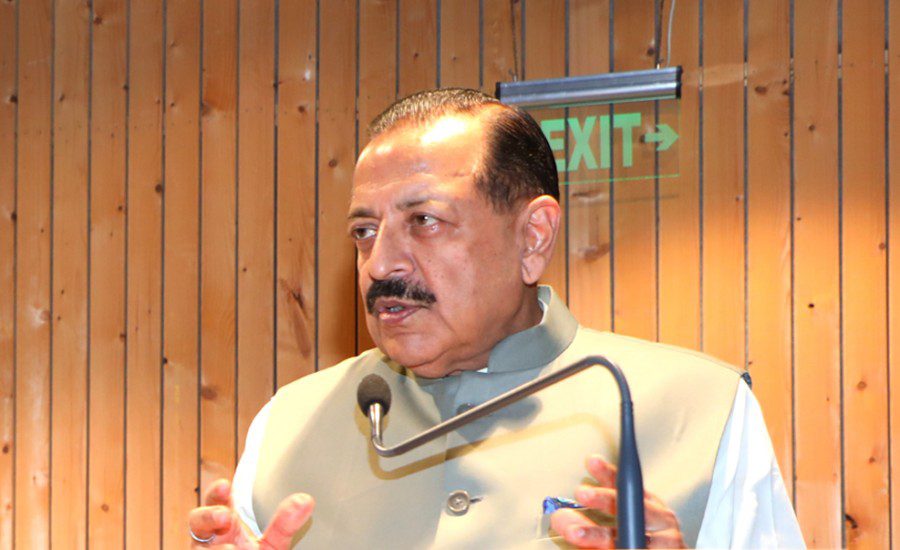
New Delhi: Marking 12 years of the Narendra Modi-led government at the Centre, Union Minister Jitendra Singh said India has undergone a profound transformation into an aspirational nation driven by opportunity, innovation, self-belief and merit-based governance.
Speaking to the media on Sunday, Dr. Singh described the change in public mindset as the most significant achievement of the past 12 years, arguing that governance reforms, technological democratization and citizen-centric policies have fundamentally altered how Indians view their future prospects.
The minister also projected strong growth for India’s space economy, stating that the sector, currently valued at nearly $9 billion, is expected to expand to around $45 billion over the next seven to eight years as the country progresses toward the goal of becoming a developed nation by 2047.
Reflecting on 4,399 Days of Narendra Modi as Prime Minister
Looking back on Prime Minister Narendra Modi’s 4,399 days in office as a continuously serving elected Prime Minister, Dr. Jitendra Singh highlighted several measurable outcomes achieved during the period.
According to the minister, India’s startup ecosystem has witnessed unprecedented growth. The number of startups has increased from approximately 350-400 in 2014 to more than 2.3 lakh today, creating nearly 24-25 lakh jobs across the country.
He pointed out that nearly half of these startups are located in Tier-II and Tier-III cities, indicating the spread of entrepreneurship beyond major metropolitan centres. Additionally, around 35-39 percent of the startups are women-led, reflecting increasing participation of women in India’s innovation economy.
Space Sector Witnesses Rapid Expansion
Dr. Singh highlighted the transformation of India’s space ecosystem as one of the most visible examples of the government’s reform agenda.
He noted that the number of space startups has grown from a single-digit figure a few years ago to nearly 400 today. One of these startups has already attained unicorn status, signaling the increasing maturity of India’s private space sector.
The minister stated that India’s space economy currently stands at approximately $9 billion and is projected to touch $45 billion within the next seven to eight years.
He also cited growing public engagement with scientific achievements, noting that a recent space launch attracted nearly 1,500 media personnel and around 10,000 spectators.
Governance Reforms Focused on Citizen Trust
According to Dr. Jitendra Singh, some of the earliest reforms introduced by the Modi government reflected a shift towards citizen-centric governance.
One such reform was the abolition of mandatory gazetted officer attestation for documents, allowing citizens to self-attest their certificates. The minister described this as a landmark decision that demonstrated trust in citizens, particularly young people.
He also referred to the removal of interviews for several categories of government recruitment. The reform, he said, reduced opportunities for favoritism, discretion and malpractice while strengthening merit-based selection processes.
These measures, he argued, reinforced confidence among citizens that success could be achieved through talent and hard work rather than recommendations or personal influence.
‘Mindset Change’ Biggest Achievement of the Last 12 Years
Dr. Jitendra Singh emphasized that the most important transformation during the Modi era has been psychological rather than merely administrative.
He said India has witnessed the emergence of a strong aspirational culture where individuals increasingly believe they can achieve success regardless of their social or geographic background.
“The change of mindset that has happened in the last 12 years under Prime Minister Modi is one of the biggest hallmarks,” he said.
According to the minister, this shift is reflected in the growing number of successful candidates from smaller towns and rural areas securing top ranks in competitive examinations, including the civil services.
He attributed this development to increased transparency, wider access to technology and greater equality of opportunity.
Chandrayaan Missions Inspired Public Participation in Science
The minister linked India’s scientific accomplishments with the broader societal transformation underway.
Referring to India’s successful lunar missions, including Chandrayaan-3 Moon Landing, he said the government has cultivated a culture where citizens increasingly identify with national scientific achievements.
Dr. Singh recalled how Prime Minister Modi encouraged scientists following setbacks and celebrated their achievements after successes, helping foster a culture where failure is viewed as a stepping stone to innovation.
He added that India’s successful landing near the Moon’s south pole significantly increased public interest in science and technology.
Opening Space and Nuclear Sectors to Private Players
A major institutional reform highlighted by the minister was the opening of strategic sectors such as space and parts of the nuclear ecosystem to private participation.
For decades, these sectors remained largely restricted to government agencies and institutions. However, recent policy changes have enabled entrepreneurs, startups and private companies to participate in research, development and commercial activities.
According to Dr. Singh, the move has expanded career opportunities for young Indians, accelerated innovation and aligned India’s scientific ecosystem with global best practices.
He said such reforms have created an environment where scientific advancement is no longer confined to government institutions but increasingly involves industry and startups.
Welfare Delivery Becoming More Transparent
The minister also highlighted improvements in welfare delivery systems.
According to him, government benefits under schemes related to housing and social welfare are increasingly being delivered without discrimination based on caste, religion or other affiliations.
He argued that greater transparency and technology-driven governance have strengthened public trust in institutions and improved service delivery outcomes.
Roadmap to Viksit Bharat 2047
Looking ahead, Dr. Jitendra Singh said India’s journey toward becoming a developed nation by 2047 would require deeper collaboration between government and industry, greater participation of women and youth, and continued expansion in emerging sectors.
He identified space technology, nuclear energy, quantum technologies and innovation-driven industries as key pillars of future growth.
The minister also stressed the importance of benchmarking India’s progress against global standards rather than limiting comparisons to domestic achievements.
Government’s Vision Beyond Economic Growth
Concluding his remarks, Dr. Jitendra Singh said the objective of the Modi government extends beyond economic expansion.
He stated that the broader vision is to create an empowered, confident and aspirational society capable of contributing meaningfully to the goal of a developed India by 2047.
According to the minister, the last 12 years represent not only a period of governance reforms and institutional transformation but also a shift from a culture of dependence and entitlement toward one centered on aspiration, merit and innovation.
Read also: From Access to Accountability: At Mission IAS Event, Jitendra Singh Redefines What It Means to Serve