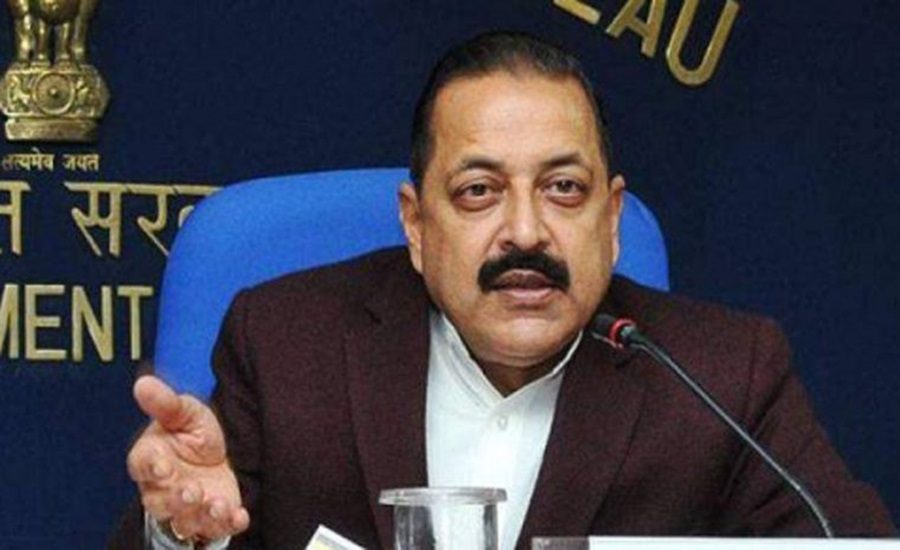
Jammu: Union Minister of State in the Prime Minister’s Office Dr. Jitendra Singh on Sunday said that India’s tier-2 and tier-3 cities are increasingly becoming the country’s leading centres for entrepreneurship and civil services success, marking a major socio-economic transformation driven by technology and digital connectivity.
Addressing a felicitation ceremony organised in Jammu to honour Class 10 and 12 toppers from various schools across the Jammu region, Singh said the trend reflects how opportunities once concentrated in metropolitan cities are now reaching smaller towns and districts across the country.
According to him, this transformation is equally visible in Jammu and Kashmir, where young people from remote districts are emerging as successful entrepreneurs, innovators and civil servants.
Small-Town India Driving Startup Growth
Highlighting India’s rapidly expanding startup ecosystem, Singh said nearly half of the country’s startups are now based in tier-2 and tier-3 cities.
“Out of around 2.30 lakh startups in the country, nearly 50 percent are based in tier-2 and tier-3 cities. This reflects the growing entrepreneurial spirit beyond metropolitan centres,” he said.
The minister noted that entrepreneurship is no longer confined to major urban centres such as Delhi, Mumbai, Bengaluru or Hyderabad. Instead, smaller cities and towns are becoming vibrant centres of innovation and business creation.
He further pointed out that women are playing a major role in this transformation.
“Over 35 to 40 percent of startups today are women-led,” Singh said, describing it as a significant indicator of increasing female participation in India’s innovation-driven economy.
UPSC Success No Longer Limited to Metro Cities
Drawing parallels with the startup ecosystem, Singh observed that a similar shift is visible in the field of civil services.
He said many of the country’s top-ranking candidates in the UPSC Civil Services Examination are now emerging from smaller towns and rural districts rather than traditional educational hubs.
Citing Jammu and Kashmir as an example, Singh said the border district of Poonch recently produced the candidate who secured the 11th All India Rank in the Civil Services Examination.
He also mentioned that candidates from districts such as Rajouri and Kishtwar have increasingly been achieving success in competitive examinations, demonstrating the growing reach of quality educational resources.
“This marks a significant departure from the earlier trend when metropolitan cities were regarded as the primary centres of elite educational and professional opportunities,” he said.
Digital Revolution Creating Equal Opportunities
The minister attributed much of this transformation to the rapid expansion of digital infrastructure and internet connectivity across India.
According to Singh, affordable smartphones and internet access have created a level playing field for students and aspiring entrepreneurs irrespective of where they live.
With more than 100 crore smartphone users in India, students now have unprecedented access to online learning resources, coaching material, mentorship opportunities and employment-related information.
“Technology has democratised opportunities and ensured that talent is no longer constrained by geography,” he said.
The widespread availability of digital tools has enabled students from remote areas to compete with their counterparts in major cities for prestigious examinations and professional opportunities.
Jammu & Kashmir Witnessing Rise of Startups and Entrepreneurs
Singh highlighted the growing entrepreneurial ecosystem within Jammu and Kashmir.
He cited examples of successful agri-startups and young entrepreneurs emerging from districts such as Doda and Budgam, indicating a shift in aspirations among the region’s youth.
The minister said these developments reflect a larger transformation taking place across the Union Territory, where young people are increasingly leveraging technology, innovation and government support mechanisms to build businesses and generate employment.
National Education Policy Empowering Students
Speaking about educational reforms, Singh praised the National Education Policy (NEP), stating that it has empowered students by giving them greater flexibility in choosing academic subjects aligned with their interests and strengths.
According to him, the policy promotes multidisciplinary learning and allows students to pursue diverse career paths based on aptitude rather than conventional academic streams.
He said such reforms are helping create a more dynamic and innovation-oriented education ecosystem.
Vigyan Jyoti Encouraging Girls in Science and Technology
The minister also highlighted the government’s Vigyan Jyoti mentorship programme, which encourages young girls to pursue careers in science, innovation and technology.
The programme provides mentoring, guidance and exposure to students, particularly from underrepresented backgrounds, helping them build confidence and explore opportunities in STEM fields.
Singh said initiatives like Vigyan Jyoti are helping unlock the potential of young women and preparing them to become future leaders in science, research and entrepreneurship.
Talent Flourishing Beyond Metropolitan India
Summing up the broader transformation underway in the country, Singh said talent and excellence are no longer restricted to metropolitan centres.
He noted that India’s smaller towns and districts are increasingly producing entrepreneurs, innovators, administrators and professionals capable of competing at national and global levels.
“The country is witnessing a socio-economic transformation where opportunities, innovation and success are spreading far beyond the traditional urban centres,” he said.
AYUSH Infrastructure Expanding in Jammu & Kashmir
Earlier during another event, Singh reviewed the progress made under the Department of AYUSH in Jammu and Kashmir and highlighted significant advancements in healthcare infrastructure.
He said three AYUSH colleges have been established in the Union Territory:
- Ayurvedic College at Akhnoor
- Unani College at Ganderbal
- Homoeopathy College at Kathua
The minister added that these institutions will strengthen education and healthcare delivery in traditional systems of medicine.
Over 500 AYUSH Dispensaries Upgraded
According to Singh, 523 AYUSH dispensaries in Jammu and Kashmir have been upgraded into Ayushman Arogya Mandirs under the National AYUSH Mission.
Additionally, five 50-bed AYUSH hospitals and two 10-bed AYUSH hospitals are being established to improve healthcare accessibility across the Union Territory.
He said these initiatives are strengthening preventive healthcare and expanding access to traditional medicine systems.
Yoga Key to Healthy Ageing and Vision 2047
Later in the day, while speaking at an International Yoga Day event in Jammu, Singh stressed the importance of yoga for healthy ageing and achieving India’s Vision 2047.
Referring to this year’s theme, “Yoga for Healthy Ageing,” he said the subject has become increasingly relevant as life expectancy rises and India moves towards becoming a developed nation.
He noted that the United Nations’ adoption of June 21 as the International Day of Yoga has transformed yoga into a global movement and strengthened India’s contribution to global wellness.
“The observance of International Yoga Day over the past 12 years coincides with the 12-year tenure of the Modi government and reflects India’s growing contribution to global healthcare and wellness,” he said.
Singh emphasised that maintaining physical and mental well-being is not merely a personal responsibility but also a national priority.
“Every citizen has a role to play in building a developed India by 2047. Yoga helps people remain physically fit, mentally resilient and capable of contributing meaningfully to society even as they age,” he said.
Large-Scale Yoga Celebrations Across Jammu Region
Hundreds of participants, including students, government officials, security personnel and members of civil society, took part in Yoga Day celebrations across Jammu and Kashmir.
Special yoga sessions were organised by the Army, Border Security Force (BSF), Central Reserve Police Force (CRPF) and Jammu & Kashmir Police.
One of the notable events took place at the iconic Anji Bridge in Reasi district, India’s first cable-stayed railway bridge on the Udhampur-Srinagar-Baramulla Rail Link project.
The Indian Institute of Management (IIM) Jammu also organised a special programme focusing on healthy ageing, inner harmony and lifelong wellness.
The celebrations reinforced the growing recognition of yoga as a tool for physical fitness, mental well-being and nation-building.
Read also: India’s Space Economy Set to Reach USD 45 Billion in Next Decade: Dr Jitendra Singh