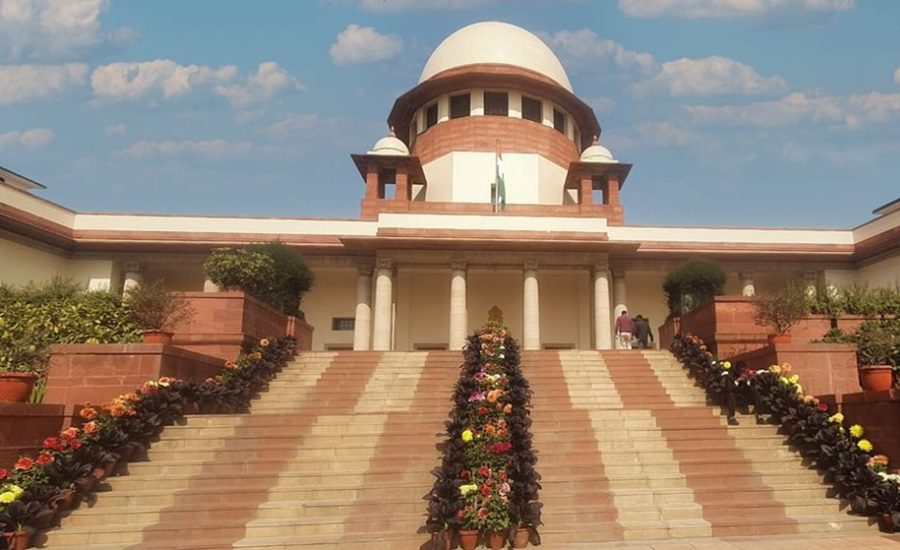
New Delhi: Supreme Court oral judgment became the focus of an important hearing on Tuesday after the apex court clarified that an oral pronouncement made in open court is not the final judgment. The Court said judges are free to make corrections, add reasons, or even re-hear the matter before the judgment is signed. The observation came while hearing a plea related to a Karnataka temple priest.
Legal Status of Oral Judgments in Open Court: What Did the Supreme Court Say
A Bench comprising Chief Justice of India Surya Kant, Justice Joymalya Bagchi, and Justice V. Mohana stated that an oral judgment announced in open court does not become legally complete until it is signed by the concerned judge or judges.
Read also: Karnataka High Court Confirms District Courts Will Hear First Appeals in Major Constitutional Ruling
Justice Joymalya Bagchi explained that after pronouncing a judgment, a judge may later notice important gaps, missing material, or legal issues that need to be addressed. In such cases, the matter can be listed again for further hearing before the final judgment is signed.
Background of the Case
The observations came during the hearing of a petition filed by Vidyadas Babaji, the head priest of Sri Anjaneya Temple in Koppal, Karnataka. The petitioner requested the Supreme Court to direct the Karnataka High Court to upload a judgment that had already been pronounced in open court.
According to the petitioner, the High Court had initially reserved its judgment in November 2025. Later, the matter was listed again for re-hearing on March 25, 2026, after which the judgment was reserved once more.
The judgment was reportedly pronounced in April 2026, and the online case status indicated that the writ petition had been allowed. However, even after several months, the written judgment had not been uploaded.
Legal Status of Oral Judgments in Open Court: Petitioner’s Argument
Senior Advocate Vishnu Shankar Jain, appearing for the petitioner, argued that once a court pronounces its judgment in open court, it becomes functus officio, meaning it has completed its role in deciding the case.
He submitted that the State had already provided the information sought by the High Court regarding pending criminal cases against the petitioner. Despite this, the written judgment was still unavailable.
Legal Status of Oral Judgments in Open Court: Supreme Court’s Response
The Supreme Court did not accept the petitioner’s argument at this stage. Justice Bagchi clarified that an oral pronouncement without the judge’s signature is not a complete judgment. Until the judgment is signed, judges retain the authority to revise the draft, include additional reasoning, or even restore the case for further hearing if necessary.
Chief Justice Surya Kant also orally remarked that there was “no case to entertain at this stage”, adding that the parties should wait for the final signed judgment. The petition was accordingly disposed of.
Why This Observation Is Important
The Supreme Court’s remarks reaffirm an important principle of judicial procedure:
- An oral pronouncement in court is not the final legally enforceable judgment.
- A judgment becomes complete only after it is signed by the concerned judge or judges.
- Before signing, judges may correct errors, strengthen legal reasoning, include additional material, or re-hear the matter if required.
- The signed judgment remains the final and authoritative version for legal purposes.
Earlier History of the Temple Dispute
The dispute relates to the management of Sri Anjaneya Temple in Koppal, Karnataka.
In 2018, district authorities reportedly removed the petitioner from temple management. The Karnataka High Court later granted interim protection in February 2023, restraining the authorities from taking coercive action against him.
In 2025, the petitioner alleged another attempt to replace him as the temple priest. The High Court, however, found no prima facie case supporting the allegation.
Earlier, the Supreme Court had also directed the Karnataka Government to allow the petitioner to continue performing religious duties and to reside in a room at the temple premises in accordance with the High Court’s interim order.
Read also: Big Relief for Ethanol Producers: Karnataka HC Directs Oil Companies to Review Allocation Decision