As Prime Minister Narendra Modi completes 12 years in office, attention has once again turned to Uttar Pradesh, a state that has witnessed significant changes in governance, infrastructure, welfare delivery, and investment over the past decade. With Modi now surpassing the tenure of India’s first Prime Minister, Jawaharlal Nehru, among elected prime ministers, supporters of the government point to Uttar Pradesh as one of the most visible examples of the Centre’s development agenda.
For years, Uttar Pradesh was viewed as a state with enormous potential but persistent challenges. Despite its large population, strategic location, and cultural significance, it struggled with issues ranging from inadequate infrastructure and industrial stagnation to law-and-order concerns. The state’s development trajectory began to shift after 2014 and gained further momentum following the formation of the Yogi Adityanath-led government in 2017.
Centre-State Coordination Drives Development
Observers credit much of the state’s recent progress to the alignment between the union government’s policy priorities and the state government’s implementation efforts. Since taking office, Prime Minister Modi has consistently emphasised Uttar Pradesh’s role in India’s economic growth and national development.
The Yogi Adityanath government sought to translate those priorities into ground-level execution. Law and order reforms, improved administrative monitoring, and a focus on infrastructure became key pillars of governance. The state government has maintained that creating a secure environment for citizens and investors was essential for long-term economic growth.
Supporters argue that this coordinated approach enabled faster implementation of projects and welfare schemes, helping bridge gaps that had persisted for decades.
Infrastructure and Cultural Projects Redefine the State
One of the most visible aspects of Uttar Pradesh’s transformation has been the rapid expansion of infrastructure. Major expressway projects, including the Purvanchal Expressway, Bundelkhand Expressway, and the under-construction Ganga Expressway, have improved connectivity and linked previously underserved regions to economic hubs.
Urban transportation has also expanded with metro rail projects in Lucknow, Kanpur, and Agra. Healthcare infrastructure received a boost through the establishment of institutions such as AIIMS Gorakhpur and other advanced medical facilities.
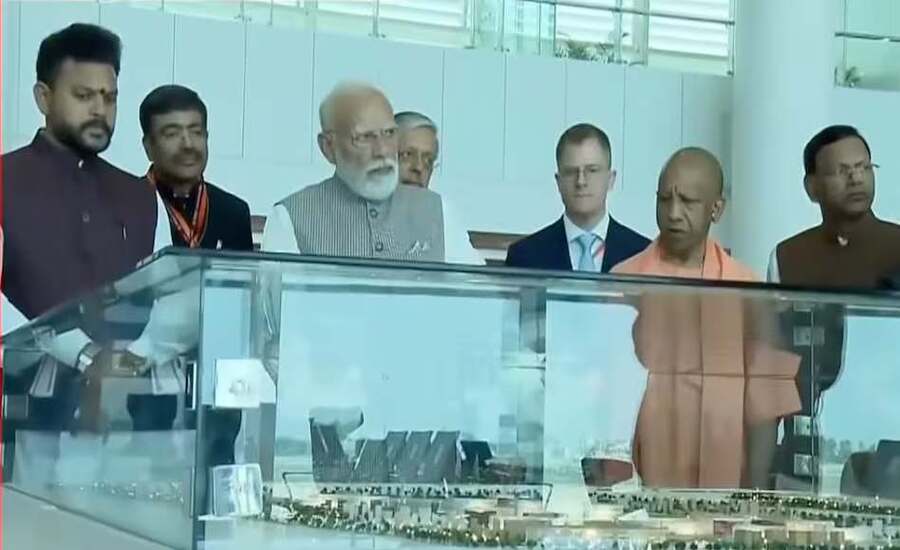
Alongside physical infrastructure, cultural and religious projects have reshaped the state’s tourism landscape. The redevelopment of the Kashi Vishwanath Dham Corridor in Varanasi and the construction of the Ram Temple complex in Ayodhya have become landmark initiatives. Ayodhya, in particular, has undergone large-scale urban development, including improved roads, tourism facilities, hospitality infrastructure, and the Maharishi Valmiki International Airport.
These projects have been presented as examples of how cultural heritage and economic development can progress simultaneously.
Investment, Welfare and Economic Aspirations
Uttar Pradesh has also emerged as a major destination for investment. The development of the defence corridor, industrial parks, data centers, textile hubs, pharmaceutical clusters, and food processing units has strengthened the state’s manufacturing and industrial ecosystem.
The upcoming Noida International Airport at Jewar is expected to play a crucial role in transforming the economic landscape of western Uttar Pradesh and the Delhi-NCR region. Once fully operational, it is projected to generate substantial employment and attract large-scale investments.
On the welfare front, Uttar Pradesh has been among the largest beneficiaries of several central government schemes. Millions of families have received housing assistance under the Pradhan Mantri Awas Yojana, while the Ujjwala Yojana expanded access to clean cooking fuel. Programmes such as Jal Jeevan Mission, PM-Kisan Samman Nidhi, and the free ration scheme have also reached a vast number of beneficiaries across the state.
As Prime Minister Modi completes 12 years in office, Uttar Pradesh’s development journey is frequently cited as an example of how coordinated governance can influence economic growth, infrastructure expansion, and welfare delivery. While challenges remain, the state’s transformation over the past decade has positioned it as a key player in India’s broader growth ambitions, with policymakers aiming to make it one of the country’s leading economic engines in the years ahead.