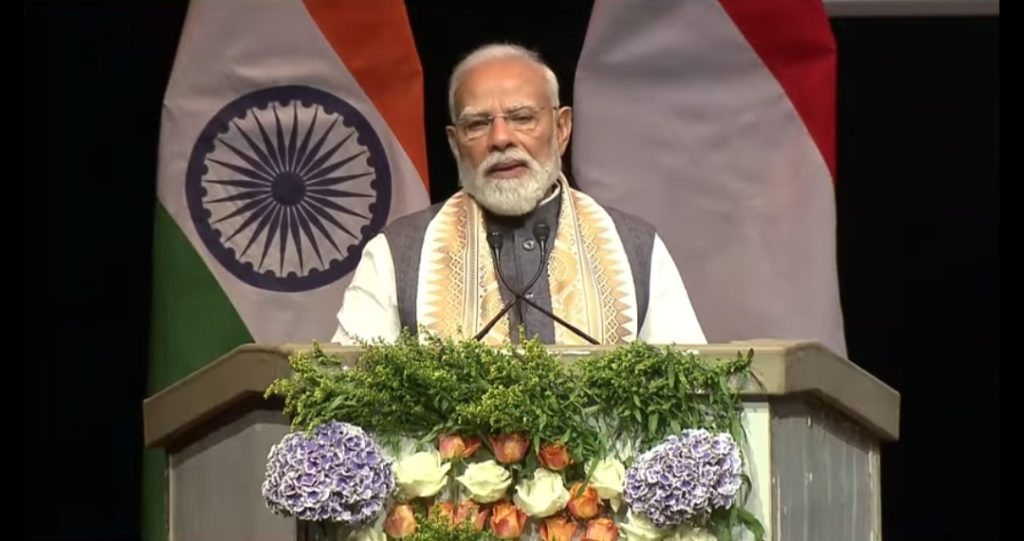
New Delhi: A day after chairing a meeting of the Union Cabinet, Prime Minister Narendra Modi on Thursday held his third high-level meeting with Secretaries to the Government of India, reviewing the future action agenda of ministries and departments dealing with infrastructure and connectivity, security and external affairs, and governance.
The meeting focused on strengthening coordination across government, adopting a long-term approach to policymaking, making better use of artificial intelligence and data, and bringing young people and academic institutions into the policymaking process.
Modi noted that deliberations had already been held with two groups of Secretaries and stressed that the exercise should go beyond addressing immediate administrative issues or examining statistics.
He called for officials to look at the larger, long-term picture and think about how India should shape its future.
PM Modi Calls for Long-Term Thinking in Governance
The Prime Minister emphasised that senior officials must not limit their approach to solving immediate problems.
He urged them to develop a long-term perspective on the country’s development and future evolution, while ensuring that present policies and decisions contribute to India’s larger national objectives.
The message to the senior bureaucracy was to combine data-driven assessment of current challenges with forward-looking thinking about emerging opportunities and risks.
Read also: PM Modi’s Free Coaching Push: Maharashtra Explores Online UPSC Training for 5,000 Students
‘Silos Are Not Just an Organisational Problem, But a Mindset’
A major focus of the meeting was the need to overcome departmental silos.
Modi said silos are not merely an organisational problem but also a problem of mindset. He pointed out that such silos can exist both horizontally and vertically, limiting coordination and preventing government departments from working towards common objectives.
He called upon officials to take greater ownership of their responsibilities while maintaining a strong sense of belongingness towards the larger government and national objectives.
The Prime Minister stressed that effective governance requires departments to work together rather than viewing their responsibilities in isolation.
Lessons From COVID-19 and West Asia Crisis
To underline the importance of inter-departmental coordination, Modi referred to the experience of the COVID-19 pandemic and the West Asia crisis.
During these situations, officials from different departments and institutions worked together to respond to complex and rapidly evolving challenges.
The Prime Minister said such coordination should not remain limited to emergencies.
Instead, mechanisms that enable departments to work collectively should become a natural part of the government’s regular work culture.
He also stressed the importance of informal interaction and team-building among senior officials to strengthen cooperation.
PM Modi Calls for Responsible Use of Artificial Intelligence
Artificial Intelligence was another key area discussed during the meeting.
Modi called for the effective use of AI in governance, while stressing that technology should not replace human intervention and judgement.
He encouraged Secretaries to explore innovative ways of combining the capabilities of AI with human expertise, particularly in areas where technology can improve efficiency, analysis and decision-making.
The Prime Minister’s message was that AI should be treated as a tool to augment administrative capabilities while keeping human judgement central to governance.
‘Data Is a National Asset’
The Prime Minister also highlighted the growing importance of data, describing it as a national asset and an important resource for the future.
He noted that the government invests substantial resources in collecting, storing and managing data. However, its full potential is not always realised because information remains divided between departments and systems.
Different government departments often collect and manage data according to their individual requirements, which can make it difficult to use the information across institutional boundaries.
Modi called for solutions that would enable greater interoperability between government data systems and facilitate more effective use of data for policymaking and governance.
Need to Bring Universities and Youth Into Policymaking
The Prime Minister also called for greater engagement between government departments, universities and young people.
He said interaction with universities and the younger generation could bring fresh and unconventional perspectivesinto policymaking.
The emphasis was on creating stronger links between the government, academic institutions and young minds so that policymakers can benefit from new ideas, research and emerging perspectives.
Such engagement, Modi suggested, can help the government look at longstanding challenges differently and develop innovative approaches to governance.
Focus on Research and Innovation
The meeting also covered the need for greater emphasis on research and innovation.
Modi stressed that India must strengthen its capacity for innovation across sectors and ensure that new ideas are translated into practical solutions.
Particular attention was given to the defence sector, where the Prime Minister called for further strengthening India’s defence industry and making it more competitive globally.
Strengthening India’s Defence Industry
The Prime Minister underlined the importance of developing a stronger domestic defence ecosystem.
He called for greater focus on research, innovation and human resource development in the defence sector so that India can build capabilities that are competitive at the global level.
He also stressed the need for innovative defence courses and stronger human-resource development mechanisms to create the skilled workforce required by the sector.
The emphasis was therefore not only on defence manufacturing but also on developing the knowledge, research and talent ecosystem needed to support India’s long-term defence ambitions.
Secretaries Share Views on Policies and Implementation Challenges
During the meeting, senior civil servants also shared their views on government policies and challenges encountered during their implementation.
The discussions provided an opportunity to assess the implementation of government initiatives while also identifying areas where greater coordination, innovation and institutional cooperation could improve outcomes.
The Prime Minister’s interaction with the Secretaries forms part of a broader effort to encourage senior government officials to adopt a more integrated and forward-looking approach to administration.
A Push for More Collaborative Governance
The meeting brought together several themes that are increasingly important to India’s governance framework—cross-departmental coordination, AI, data interoperability, youth engagement, research and innovation, and long-term policymaking.
Modi’s emphasis on breaking silos suggests a push towards a governance model in which departments work more closely on issues that cut across traditional administrative boundaries.
The experience of crises such as COVID-19 and the West Asia situation, he noted, demonstrates that government can mobilise effectively when departments work together. The challenge now is to make that collaborative approach a routine feature of governance rather than something triggered only by emergencies.
With India’s development trajectory increasingly dependent on technology, data, innovation and skilled human resources, the Prime Minister’s message to the senior bureaucracy was to think beyond departmental boundaries and prepare for the country’s long-term challenges and opportunities.