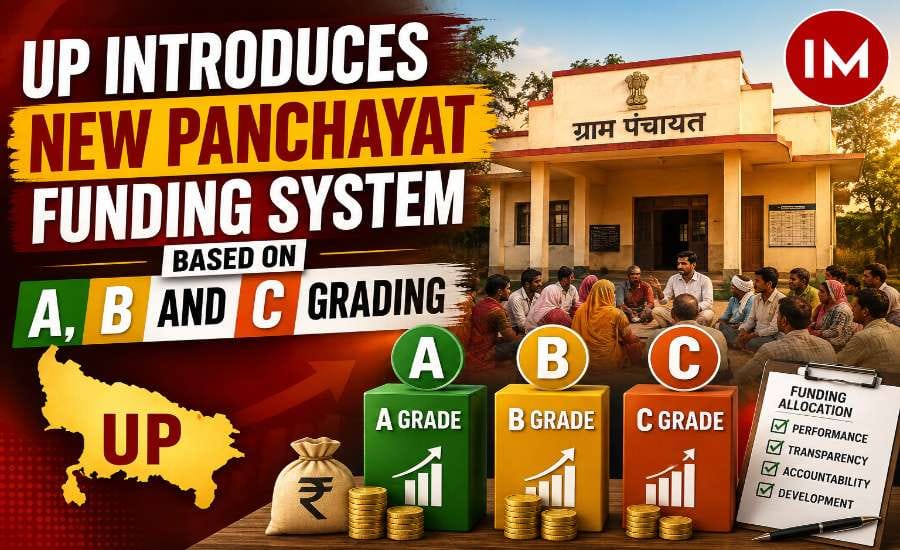
Lucknow: Uttar Pradesh has introduced a new system for allocating development funds to Gram Panchayats under the Viksit Bharat Guarantee for Rozgar and Aajeevika Mission (VB-G RAM G). The system will classify Panchayats into A, B and C categories based on their development status and use the grading to determine the funds they receive.
The approach aims to direct greater financial support towards villages that remain behind in development and have weaker access to infrastructure and employment opportunities.
Panchayat Advancement Index to Carry 70% Weightage
The Panchayat Advancement Index will account for 70% of the total assessment score. The Panchayati Raj Department will evaluate Panchayats against various development indicators before placing them in the appropriate category.
The system is designed to give greater weightage to Panchayats that face more significant development challenges. This means a Panchayat with weaker development indicators can score higher and become eligible for greater financial support.
Distance from the district headquarters will also form an important part of the assessment. Remote Panchayats and blocks will receive additional weightage because of the challenges associated with providing infrastructure and services in such areas.
Read Also: UP Defence Corridor Takes Shape as Kanpur Emerges as Major Manufacturing Hub
Backward Areas to Get Greater Funding Priority
The new funding mechanism reverses the conventional approach in which stronger performance can often translate into greater access to resources.
Under the new model, greater backwardness can result in a higher assessment score and consequently more development funding. The objective is to give villages that have fallen behind an opportunity to bridge existing development gaps.
Panchayats in relatively remote areas are also expected to benefit from the additional weightage assigned to distance and location.
Advance Funding to Help Start Projects
The system provides advance funds based on Panchayat category and proposed works, helping projects start faster. It also factors in employment generated over the past five years, with higher employment and person-days resulting in lower scores under this criterion.
Focus on Villages Left Behind
The grading-based system aims to distribute funds according to each Panchayat’s development needs. Remote areas, weaker infrastructure and lower indicators could attract more support, promoting data-driven rural development and better local infrastructure.
A Targeted Approach to Rural Development
The new funding mechanism under VB-G RAM G puts development need at the centre of Panchayat-level fund allocation. By combining the Panchayat Advancement Index with factors such as location, backwardness and past employment generation, the government aims to channel greater resources towards areas that need them most.
If implemented effectively, the approach could help narrow development gaps between better-connected Panchayats and remote villages while giving historically lagging areas a stronger financial push.