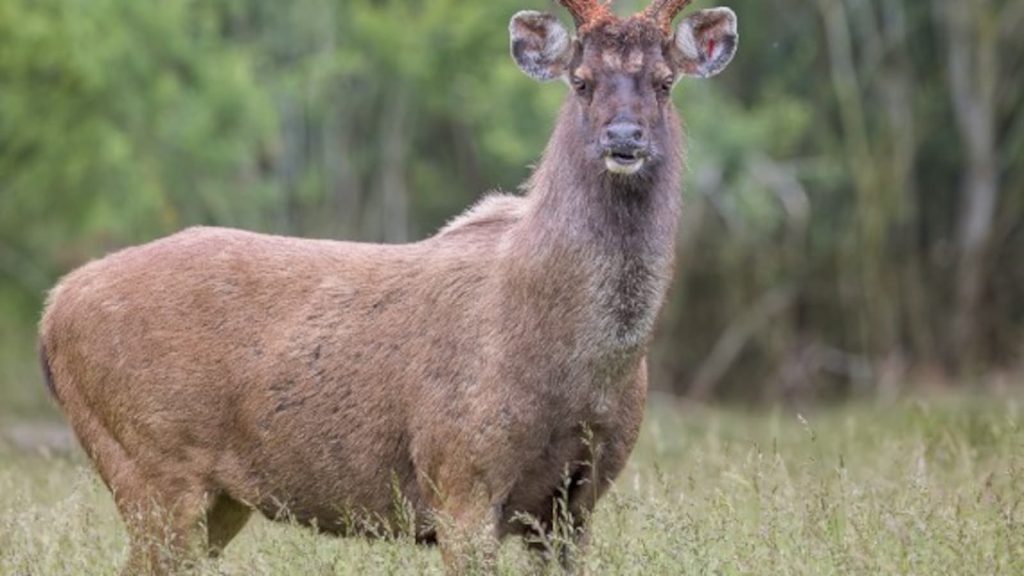
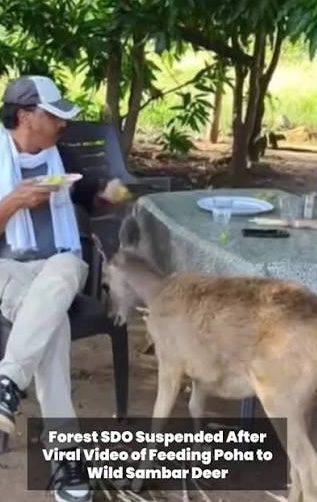
Bhopal: A Forest Department officer posted at Satpura Tiger Reserve in Madhya Pradesh has been suspended after a video showing him feeding poha to a wild sambar deer and petting the animal went viral on social media. The incident sparked widespread criticism from wildlife experts and conservationists, who argued that the officer’s actions violated established wildlife management principles and could also attract action under the Wildlife (Protection) Act, 1972.
The suspended officer is Vinod Verma, who is often mistakenly searched online as Vinod Sharma.
Who Is Vinod Verma?
Mr Verma is a State Forest Service (SFS) officer serving as the In-charge Assistant Director, Forest Department, Itarsi, while also holding the additional charge of Sub-Divisional Officer (SDO) and In-charge Superintendent of the Bori Range in the Satpura Tiger Reserve, Narmadapuram district of Madhya Pradesh.
His primary responsibilities include protecting wildlife habitats, supervising forest management, implementing anti-poaching measures, conserving biodiversity, and ensuring strict compliance with wildlife protection guidelines within one of India’s premier tiger reserves.
Why Was Vinod Verma Suspended?
The controversy erupted after a video, reportedly shared by Verma himself, surfaced on social media showing him sitting inside the Churna forest range and feeding poha, a popular Indian breakfast dish, to a wild sambar deer.
The video also showed him touching and petting the animal, which he reportedly had rescued earlier.
Wildlife experts strongly objected to the interaction, stating that feeding human food to wild animals and encouraging close human contact is contrary to scientific wildlife management practices.
Official Suspension Order
Following the viral video, Satpura Tiger Reserve Field Director Rakesh Nanda issued a suspension order placing Vinod Verma under immediate suspension.
According to the order, Verma displayed “inappropriate behaviour with a wild animal (a sambar deer)”, reflecting gross negligence and insensitivity while performing his official duties.
The order further stated that his conduct violated Rule 3 of the Madhya Pradesh Civil Services (Conduct) Rules, 1965.
Acting under Rule 9(1) of the Madhya Pradesh Civil Services (Classification, Control and Appeal) Rules, 1966, the Forest Department suspended him with immediate effect.
During the suspension period:
His headquarters have been shifted to the Office of the Assistant Director, Pipariya, Satpura Tiger Reserve.
He has been directed not to leave the headquarters without prior permission from the Field Director.
Why Wildlife Experts Objected
Wildlife conservationists argued that feeding wild animals is not an act of compassion but a violation of wildlife management protocols.
Experts explained that repeated human interaction can:
- Make wild animals dependent on humans for food.
- Reduce their natural fear of people.
- Increase the chances of animals entering villages and roads.
- Expose wildlife to poaching, road accidents and human-animal conflict.
- Negatively impact their health due to unsuitable human food.
Because of these risks, forest officials are expected to maintain minimal human interaction with wild animals except during authorised rescue, treatment or rehabilitation operations.
Wildlife Activist Demands Legal Action
Wildlife activist Ajay Dubey, who formally complained about the incident, welcomed the suspension and called it an important message for the Forest Department.
He said Principal Secretary Sandeep Yadav had taken prompt and strict action, demonstrating zero tolerance for negligence by officials entrusted with protecting forests and wildlife.
Dubey also questioned whether departmental action alone was sufficient and argued that Verma’s conduct should also be examined under the Wildlife (Protection) Act, 1972.
Public Reaction
The incident generated mixed reactions on social media.
While conservationists overwhelmingly supported the suspension, arguing that wildlife officers should uphold the highest conservation standards, some users defended Verma by claiming that the sambar deer had reportedly been rescued earlier and had become accustomed to forest staff.
However, wildlife experts maintained that regardless of the animal’s background, encouraging dependency on humans remains inconsistent with scientific conservation practices.
Read Also: Uttarakhand Wildlife Board Meeting: CM Dhami Pushes 10-Year Eco-Tourism and Forest Economy Plan