For decades, railway tracks cutting through elephant habitats have posed one of the biggest conservation challenges in India. In Tamil Nadu’s Madukkarai elephant corridor, where trains and wildlife frequently crossed paths, collisions often ended in tragedy.
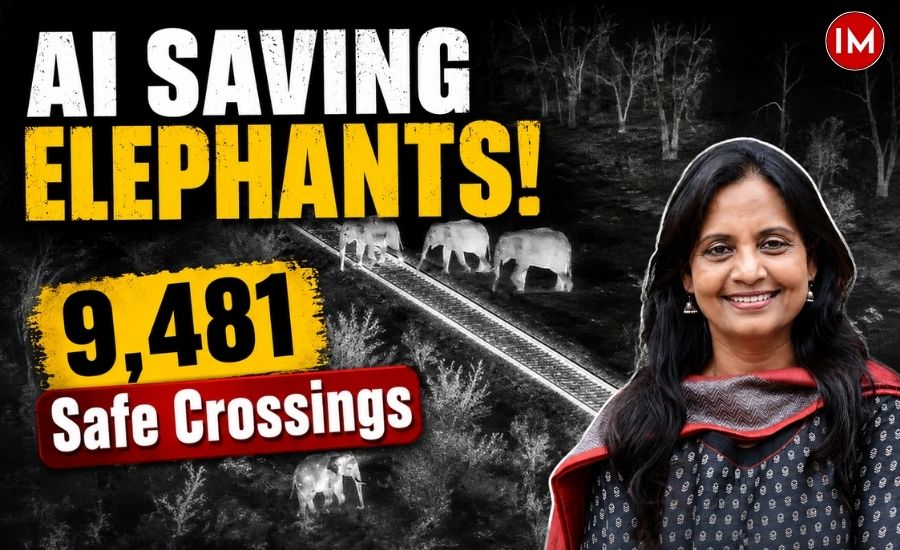
An AI-powered early warning system has changed that reality. Today, the technology has enabled more than 9,481 safe elephant crossings, giving railway authorities enough time to slow or stop trains before elephants reach the tracks.
The project, conceptualised under the leadership of senior IAS officer Supriya Sahu, has emerged as one of India’s most successful examples of combining artificial intelligence with wildlife conservation. Now serving as Additional Chief Secretary and Commissioner of the Entrepreneurship Development and Innovation Institute (EDII), Chennai, Ms Sahu has consistently promoted the use of technology to solve environmental challenges.
The system is proving that infrastructure development and wildlife conservation do not always have to compete. With the right technology, they can support each other.
A Problem That Needed More Than Manual Patrolling
The Madukkarai railway corridor in Tamil Nadu has long been recognised as one of the state’s most vulnerable stretches for elephant movement. Herds regularly cross the railway line while travelling between forest habitats, making encounters with speeding trains a recurring danger.
Traditional protection methods depended largely on forest staff manually patrolling the tracks. While effective to an extent, the approach had clear limitations. Monitoring large forest areas at night, during heavy rain or in poor visibility was extremely difficult, reducing the chances of spotting elephants early enough to warn approaching trains.
This challenge prompted officials to rethink the approach.
“The project was conceived with one clear objective: to prevent elephant deaths on railway tracks while ensuring uninterrupted and safe railway operations,” IAS officer Supriya Sahu told Indian Masterminds.
Instead of depending entirely on human observation, the idea was to build an automated system capable of continuously monitoring the railway corridor, detecting elephants before they reached the tracks and instantly alerting railway authorities.
How the AI System Works
The technology operates around the clock through a network of thermal and high-resolution visual cameras installed along vulnerable sections of the railway corridor.
The process begins with continuous surveillance. Thermal cameras monitor the area both during the day and at night, while visual cameras provide additional verification during daylight hours.
Whenever movement is detected, artificial intelligence immediately analyses the video feed. Rather than simply identifying movement, the AI evaluates several characteristics, including body shape, thermal signatures and distinguishing physical features.
This allows the system to determine whether the moving object is an elephant or another animal.
If elephants are detected approaching the railway tracks, the software automatically generates an alert that includes the exact geo-location and the nearest railway reference pillar number.
According to Ms Sahu, “The system is designed to detect elephants well before they reach the railway track, providing valuable advance notice. In most situations, the available response time is sufficient for railway authorities and loco pilots to take appropriate action by slowing down or stopping the train safely.“
From Detection to Action Within Minutes
Once the AI confirms the presence of elephants, multiple agencies are informed simultaneously.
The alert reaches railway control personnel, Forest Department officials and the central monitoring team. An audio-visual siren is activated inside the control room, ensuring operators immediately notice the warning.
The monitoring team then relays the information to the nearest station master and forest officials.
The station master communicates directly with the loco pilot over the railway communication network, providing the exact location of the elephants using railway reference pillar numbers.
Based on this information, the loco pilot follows established railway operating procedures by reducing speed or stopping the train until the elephants safely cross the tracks.
Meanwhile, forest personnel continue monitoring the movement of the herd. Once the corridor is clear, normal train operations resume.
This coordinated workflow allows technology and human decision-making to work together rather than replacing one another.
AI Learns to Recognise Elephants
One of the biggest challenges in wildlife monitoring is distinguishing elephants from other moving objects.
The AI model powering the system has been trained using thousands of thermal images and photographs collected under different environmental conditions.
Instead of reacting to any movement, it analyses multiple parameters before making a decision.
The software can differentiate elephants from humans, cattle, deer, gaur, leopards and even vehicles by studying body structure, heat signatures and several distinguishing characteristics.
The model also continues to improve over time.
Field validation, operational feedback and periodic retraining using real-world data have steadily enhanced the system’s performance over the past two and a half years.
While occasional false alerts remain inevitable because of dense vegetation, unusual animal positions or changing weather conditions, the design intentionally favours caution.
As Ms Sahu explains, “Like any AI-based system, no solution can claim 100% accuracy. However, after more than 2½ years of continuous operation, the system has demonstrated a high level of reliability under real field conditions. In wildlife conservation, it is generally preferable to generate an occasional precautionary alert rather than miss the presence of an elephant.“
Numbers That Reflect Real Conservation Impact
The project’s achievements extend far beyond technology demonstrations.
Over the past two and a half years, the system has recorded:
- 9,481 safe elephant crossings
- More than 7,116 alerts shared with railway authorities and loco pilots
- 3,821 instances where trains slowed down or stopped to allow elephants to cross safely
Every successful crossing represents a situation where both wildlife and railway passengers remained safe.
The system has also become a valuable source of ecological information. Thousands of detections involving deer, gaur and leopards have generated data that can support future wildlife management and conservation planning.
The results demonstrate how artificial intelligence can produce measurable outcomes when combined with close coordination between the Forest Department, Indian Railways and technology teams.
Working in a Forest is Far More Difficult Than Working in a City
Unlike urban AI applications, deploying technology inside forests presents a completely different set of challenges.
The cameras and software must function through dense vegetation, heavy rainfall, fog, extreme temperatures and constantly changing lighting conditions.
Wild animals move unpredictably, making detection significantly more complex than monitoring vehicles on highways or people in public spaces.
Another challenge involved integrating the AI platform with railway operations, where every alert must be timely, accurate and trusted by operational staff.
Maintaining reliability under such demanding conditions required continuous improvements based on real field experience.
A Model That Can Be Replicated Across India
India has numerous railway and highway corridors that intersect elephant habitats.
According to IAS officer Supriya Sahu, the Madukkarai model offers a framework that can be adapted to many of these locations.
Although every corridor has unique terrain, vegetation and operational requirements, the core technology remains applicable.
The combination of AI-powered computer vision, thermal imaging, geo-tagged alerts, secure communication systems and centralised monitoring can be customised for different landscapes.
As artificial intelligence continues to evolve, such systems could become an important part of India’s strategy to reduce human-wildlife conflict while allowing transport infrastructure to expand safely.
The Madukkarai project demonstrates that conservation does not always require choosing between wildlife and development. By detecting elephants before danger arises and giving railway staff enough time to respond, technology has transformed one of India’s most vulnerable railway corridors into a safer passage for both trains and elephants.
With thousands of successful crossings already recorded, the project offers a practical model for protecting wildlife through innovation—one that other elephant corridors across the country can adapt to local conditions while preserving one of India’s most iconic species.