In Jharsuguda, crime does not get much time to breathe. Cases move fast. Leads are chased quickly. And behind this pace is a quiet but firm leadership style. Shri Gundala Reddy Raghavendra, an Indian Police Service officer of the 2019 batch (Odisha cadre), is currently serving as Superintendent of Police, Jharsuguda. His approach is simple—use technology smartly, trust ground intelligence, and move faster than the criminals.
This industrial district comes with its own challenges. There is a mix of urban crime, cyber fraud, and organised networks. Add to that the district’s proximity to sensitive zones, and policing becomes a complex task. But under SP Raghavendra, the district police have built a system that is both sharp and adaptive.
POLICING WITH PRECISION: THE RISE OF TECH-LED INVESTIGATIONS
One of the defining features of his leadership is the strong use of technology in everyday policing. Surveillance systems, cyber tools, and national databases are not just support systems—they are central to operations.
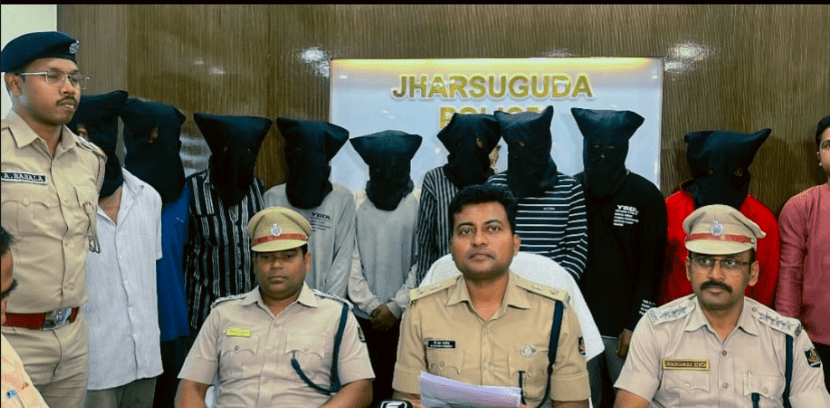
A striking example is a high-profile dacoity case that initially had no clear leads. It was what police call a “blind case.” Armed criminals had looted a businessman’s house, held the family hostage, and escaped with valuables worth over ₹1 crore.
But within just nine days, the case was cracked.
Also Read – From Guns to Growth: How Balaghat Turned the Tide Against Naxalism Through Community Power
The investigation relied on high-definition CCTV footage supported by intelligent video analytics. Facial recognition tools and Automatic Number Plate Recognition (ANPR) helped track the movement of the suspects. Even a fake number plate became a clue. Cyber forensics teams worked on IP tracking, call detail records, and mobile data.
Simultaneously, ground teams moved across multiple states. Raids were conducted in Odisha, Jharkhand, Bihar, Andhra Pradesh, Telangana, and even Goa. The result—eight accused arrested, stolen property recovered, and the entire network dismantled.
As SP Raghavendra puts it, “Technology gives us speed, but it is teamwork that gives us results.”
OPERATION CYBER KAVACH: BREAKING THE DIGITAL CRIME CHAIN
Cybercrime is one of the fastest-growing threats, and Jharsuguda has seen its share of complex fraud networks. To tackle this, the state government launched Operation CYBER KAVACH, a focused drive against organised cybercrime. Jharsuguda has performed the best in the initiative
In one major crackdown, police exposed an interstate and cross-border cyber fraud syndicate. The network used mule bank accounts and cryptocurrency platforms to launder money. The scale was massive—transactions linked to fraud exceeding ₹14 crore.
The operation began with suspicious transaction alerts. Accounts were receiving large deposits and immediately transferring them across multiple layers. This layering was meant to hide the money trail.
Investigators followed the digital footprints. The trail led to places like Delhi, Ghaziabad, and even Nepal. Victims were often trapped through online gaming offers and fake reward schemes. Small initial returns were used to build trust before large amounts were siphoned off.
The syndicate worked like a chain. Money first entered mule accounts opened in the names of unsuspecting villagers. It was then routed through RTGS and NEFT transfers. Finally, it was converted into cryptocurrency using platforms like Binance and Bybit.
Police arrested key accused, including the mastermind. They also seized mobile phones, laptops, SIM cards, ATM cards, and bank documents.
“Cybercrime today is organised like a business. We have to be equally organised in response,” the SP noted during the investigation.
Operation CYBER KAVACH not only led to arrests but also disrupted the financial backbone of such networks.
OPERATION NETRA: WATCHING CRIME BEFORE IT GROWS
While CYBER KAVACH focuses on digital threats, Operation NETRA is aimed at controlling local crime through surveillance and targeted action.
This Jharsuguda-specific initiative focuses on habitual offenders, anti-social elements, and narcotics networks. It combines human intelligence with constant monitoring.
In one case under Operation NETRA, police acted on specific intelligence about drug activity. A raid was conducted in the early morning hours. Three individuals were arrested, and brown sugar, mobile phones, cash, and a vehicle were seized. The operation followed all legal procedures, ensuring strong prosecution.
But NETRA is not just about arrests. It is about presence. Increased surveillance, better visibility, and continuous tracking create pressure on criminal elements.
As SP Raghavendra explains, “Prevention is always stronger than reaction. NETRA helps us stay one step ahead.”
HUMAN INTELLIGENCE STILL MATTERS
Despite the heavy use of technology, SP Raghavendra strongly believes that machines cannot replace human insight.
In many cases, digital identities appear clean. But the real person behind them tells a different story. It is local intelligence, informers, and field-level understanding that bring depth to investigations.
Technology helps in scaling operations. It creates speed and reach. But human intelligence provides context and accuracy.
This balance has been crucial in both cybercrime cases and anti-Naxal operations during his earlier tenure in Nuapada. There, he led multiple successful operations, busted Maoist hideouts, and recovered arms and explosives.
LEADERSHIP UNDER PRESSURE
Handling crime is one part of the job. Managing pressure is another.
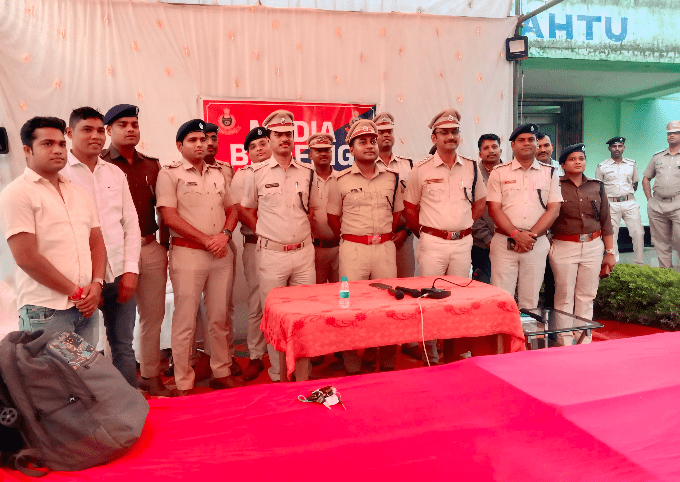
Jharsuguda has seen several high-profile visits, including those of the Prime Minister, the President of India, and other top dignitaries. Each visit requires multi-layered security planning, route management, and coordination between agencies.
Under SP Raghavendra, all such events were conducted without any untoward incidents.
His leadership style remains calm and field-oriented. He focuses on clear communication, quick decisions, and team coordination.
“In policing, every minute matters. You have to stay steady, even when the situation is not,” he says.
A SYSTEM THAT WORKS
From cracking major dacoity cases to dismantling cybercrime syndicates, the results in Jharsuguda point to one thing—a system that works.
It is a system built on technology, but grounded in human effort. It is fast, but also careful. And most importantly, it is consistent.
Shri Gundala Reddy Raghavendra represents a new generation of police leadership. Officers who are as comfortable with data as they are in the field. Officers who understand that crime is evolving—and policing must evolve faster.
In Jharsuguda, that evolution is already visible.
Also Read – How Strategy and Trust Ended Naxalism in Nuapada