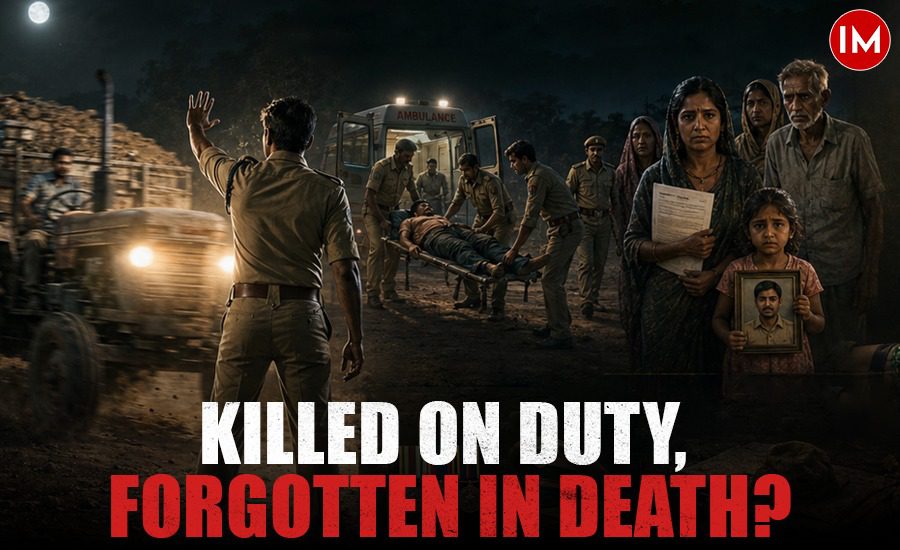
On the night of January 7, 2026, 42-year-old Forest Guard Jitendra Singh Shekhawat was on duty at Jhiri checkpoint in Rajasthan when he tried to stop a tractor-trolley involved in illegal mining. It was close to midnight. The vehicle rammed into him deliberately. He later succumbed to his injuries in a Jaipur hospital.
Barely three months later, on April 8, 2026, in Morena district of Madhya Pradesh, another Forest Guard, Harikesh Singh Gurjar, met a similar fate. He was run over by a tractor at Ranpur Tiraha while attempting to intercept illegal mining activity. He was declared dead at the district hospital.
In both cases, the families were left devastated—not only emotionally, but financially as well. Stepping in at a critical moment was the Indian Forest Service Benevolent and Welfare Trust (IFSBWT), which has been revived this year with a renewed focus on supporting forest personnel. The Trust extended financial assistance of ₹1.35 lakh to the family of Shekhawat, and ₹3 lakh to Gurjar’s family, including a fixed deposit for his five-year-old daughter—small sums perhaps in the face of such loss, but immediate relief when it was needed most.
These incidents are not isolated. Across India, forest guards, watchers, and range officers routinely find themselves on the frontlines against organised forest crime—illegal mining, timber smuggling, poaching, and encroachments—often without adequate protection or recognition. Ironically, while they serve as the first line of defence for the country’s ecological wealth, their sacrifices rarely receive the same institutional backing as those in uniformed forces like the police.
While both lay down their lives for the country, a slain police officer’s family receives ex-gratia compensation of Rs 1 crore, that of a forest guard is given anything from 2 lakh to Rs 20 lakh depending upon the state he served.
Recognising this gap, the IFSBWT has expanded its mandate since its revival in early 2026. The Trust now aims to provide immediate financial assistance not only to the families of personnel who lose their lives in the line of duty but also to those who suffer serious injuries, disabilities, or critical illnesses while protecting forests. It also seeks to support broader welfare measures for their families.
The scale of the challenge is sobering. On average, 15 to 20 forestry frontline personnel lose their lives or suffer grievous injuries every year in the line of duty. Yet, compensation from state mechanisms is often delayed and insufficient, leaving families vulnerable to sudden financial distress.
Operating currently with limited resources, the Trust has raised around ₹6.11 lakh from over 275 donors since its revival. Much of this support has come from serving and retired forest officers, with recent outreach efforts expanding to service associations across states. Even within these constraints, the Trust has managed to assist at least two bereaved families in the past three months.
Behind these numbers lies a larger message—of an institution trying to fill a systemic void. The Trust is now appealing to individuals, corporates, and institutions to contribute to its corpus, positioning every donation as a tribute to those who protect India’s forests at great personal risk.
For many of these “green warriors,” recognition may remain limited. But initiatives like IFSBWT are attempting to ensure that when tragedy strikes, their families are not left entirely alone. The Trust hopes to generate more funds now with liberal contribution from individuals and corporates, willing to help out the patriotic uniformed personnel, said a senior Trust owner.
Also Read – How V. Srinivas Is Redefining Governance In Rajasthan