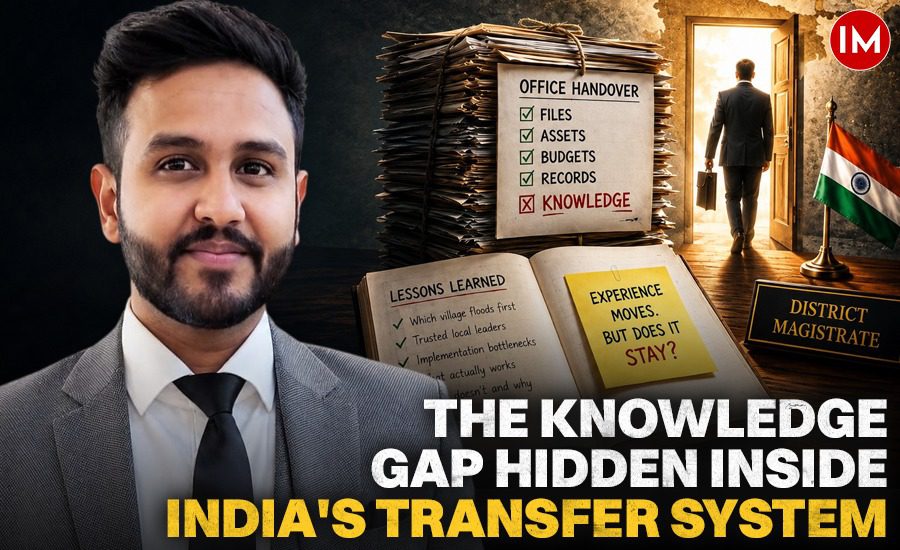
Every few months, somewhere in India, a District Magistrate hands over charge to a successor.
The office changes hands seamlessly. Files are transferred. Government vehicles remain parked in the same compound. The official residence is allotted. Ongoing projects are listed. Budgets, pending matters and administrative records are handed over with precision.
Everything that belongs to the office is transferred.
Everything except its most valuable asset, “knowledge”.
Not the knowledge contained in files or manuals, but the knowledge earned through experience: the understanding of local realities, trusted community leaders, recurring administrative bottlenecks, seasonal risks, implementation challenges and the unwritten lessons that only emerge from governing people, not paperwork.
Also read: Artificial Intelligence Needs Human Judgment, Not Blind Trust
This silent loss happens every day across India’s administrative system. Yet unlike financial losses, infrastructure gaps or project delays, it is almost never measured.
For a country that has invested heavily in building digital infrastructure, strengthening public service delivery and modernising governance, this may be one of the most overlooked challenges of all.
We often debate whether India’s bureaucracy needs more reforms, more technology or more accountability. These are important conversations. But perhaps we are overlooking a more fundamental question.
How does the Government preserve what it learns?
The Knowledge That Doesn’t Exist on Paper
Public administration is often perceived as a system driven by rules, regulations and documentation. In reality, effective governance depends just as much on judgment, relationships and context.
Every experienced civil servant develops an understanding that cannot easily be captured in an office file.
Which village consistently faces flooding before official alerts are issued.
Which contractor delivers quality work without constant supervision.
Which community organisation genuinely enjoys public trust.
Which government scheme repeatedly encounters implementation hurdles and why.
Which local leader can build consensus during conflict.
This is not classified information. Nor is it confidential.
It is simply experience.
And experience is one of the most valuable assets any institution can possess.
Unfortunately, institutions often preserve documents far better than they preserve experience.
India’s Greatest Governance Asset
India is frequently described as one of the world’s largest democracies.
Less frequently acknowledged is that it is also one of the world’s largest laboratories of governance.
Across hundreds of districts and thousands of administrative units, officers solve remarkably complex problems every single day. Some design innovative nutrition programmes. Others improve learning outcomes in government schools. Some develop successful water conservation models. Others create community policing initiatives or transform public grievance systems.
Many of these innovations receive awards. Some are recognised nationally. Most remain local success stories. Their greatest limitation is not quality. It is continuity.
When officers move, retire or assume new responsibilities, much of the practical knowledge behind these innovations moves with them. The next district facing an identical challenge often begins from the beginning, unaware that another officer has already discovered what works—and perhaps more importantly—what does not.
Governments cannot afford to keep paying twice for the same lesson.
The Difference Between Information and Wisdom
Modern governments collect enormous quantities of data. We know how many roads have been built. How many houses have been sanctioned. How many beneficiaries have received assistance. How many schools, hospitals and anganwadis exist. Information is increasingly available. Wisdom is not.
Data tells us what happened. Experience explains why it happened. Technology can preserve information. Institutions must consciously preserve judgment. That distinction may define the next phase of governance reform.
A System Designed to Remember
This article is not an argument against transfers.
Transfers bring fresh perspectives, reduce complacency and broaden administrative experience. They are an essential feature of public administration.
Nor is this a criticism of individual officers.
Indian civil servants repeatedly demonstrate remarkable adaptability by taking charge of entirely new departments, districts and policy domains.
The question is different.
Can the system reduce the cost of transition? Imagine if every incoming District Magistrate inherited not only files but also a structured knowledge dossier prepared by the outgoing officer. Not merely pending work. But lessons learned. Major implementation risks.
Stakeholder mapping. Successful interventions. Failed experiments and why they failed. Seasonal administrative patterns. Critical local relationships. Recurring citizen concerns.
Instead of spending months rediscovering local realities, officers could begin improving them from day one. That would not replace experience. It would accelerate it.
Beyond Digital Governance
India has rightly earned global recognition for building digital public infrastructure.
Digital identity.
Digital payments.
Digital service delivery.
These achievements demonstrate that India can build systems of extraordinary scale.
The next frontier is not simply digitising governance.
It is preserving governance knowledge.
Imagine a national platform where district administrations voluntarily contribute implementation lessons.
Where officers searching for solutions to recurring problems can learn from colleagues across the country.
Where successful innovations become searchable instead of forgotten.
Where failures are documented honestly so they need not be repeated elsewhere.
Private sector organisations invest heavily in knowledge management because they recognise that institutional learning creates long-term value.
Governments have an even greater responsibility.
Unlike businesses, governments do not compete for customers.
They serve every citizen.
Every lesson learned through public administration has already been paid for through taxpayer resources, administrative effort and citizens’ patience.
Losing those lessons represents a hidden public cost.
A New Way to Think About Reform
India’s governance debate often revolves around legislation, budgets and technology.
These are essential.
But perhaps another question deserves equal attention.
How can institutions become better at remembering?
The answer does not necessarily require massive financial investment.
It requires a cultural shift.
Knowledge should no longer be viewed as the personal achievement of individual officers.
It should become institutional property.
Every innovation should strengthen the system, not merely the career of the person who introduced it.
Every successful experiment should become easier to replicate.
Every failure should become a lesson for others rather than an experience they must repeat.
The National Governance Memory Mission
India could consider creating a structured framework for administrative knowledge continuity.
Such a framework could encourage every district and department to maintain a living knowledge repository that captures practical implementation experience alongside official records.
It could include:
- Major local challenges and recurring issues.
- Successful policy interventions.
- Lessons from unsuccessful initiatives.
- Stakeholder networks.
- Seasonal administrative calendars.
- Implementation playbooks.
- Transition notes for incoming leadership.
Over time, artificial intelligence and search tools could help officers identify relevant experiences from across the country, making decades of administrative learning accessible within minutes.
The objective would not be to replace individual judgment.
It would be to strengthen it.
Remembering Is Also Governance
India does not lack capable civil servants.
Every day, officers across the country solve problems that rarely make headlines.
The challenge is ensuring that those solutions become permanent assets of the Republic rather than temporary assets of individuals.
Roads can be rebuilt.
Buildings can be renovated.
Budgets can be replenished.
Technology can be upgraded.
Lost administrative wisdom cannot.
As India prepares for the next generation of governance reforms, perhaps the most important question is not how we build smarter governments.
It is how we build governments that remember.
Because every time the system forgets, the nation pays the price twice.
And perhaps the true measure of a mature administrative system is not merely how effectively it governs today but how well it enables tomorrow’s leaders to begin where yesterday’s leaders left off.
Also read: Why India Needs a Digital Public Infrastructure for the Built Environment