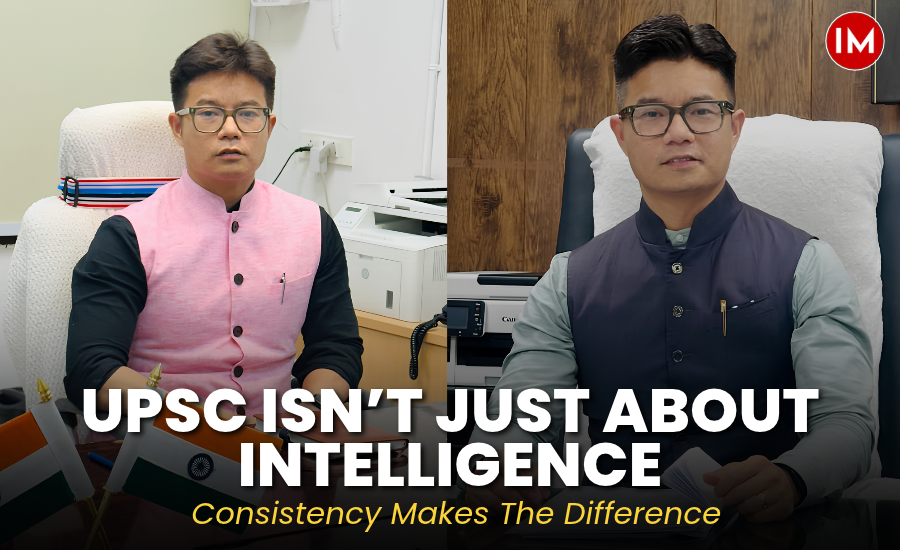
Success does not always begin with confidence. Sometimes, it begins with the willingness to attempt something you never thought you were capable of.
For Lokesh Datal, an officer of the Indian Audit and Accounts Service (IA&AS), the journey to civil services was as much about overcoming his own limitations as it was about clearing a competitive examination. His experiences with academics, martial arts and the demands of a career in public service have shaped a perspective that goes beyond conventional ideas of success.
In this exclusive Q&A with Indian Masterminds, he talks about his upbringing in Uttarakhand, his journey into civil services, the role of fitness in his life, and why he believes that success depends less on extraordinary talent and more on what we do every single day.
1. Could you tell us about your background? Where are you from, and what are your educational qualifications?
I come from a middle-class family in Uttarakhand. Our roots are in a remote village, where my grandfather was a shepherd. My father worked his way up from that humble beginning to become a government servant, and my mother was a primary school teacher. We never lacked the essentials, but ours was certainly not a life of abundance.
Academically, I was never a topper. I was an average student, far better at sports than in the classroom, and quite introverted. Public speaking made me extremely uncomfortable, and language was never my strength. Social Studies was one of my weakest subjects; I even failed it in Class 8.
I went on to study B.Tech in Computer Science at NIT Tiruchirappalli after securing a good rank in the engineering entrance examination. Even there, I remained an average and at times below-average student, with supplementary examinations in several semesters. But I noticed something about myself: I may not have been the best performer in the room, but when it really mattered, I could push myself to deliver. By the time campus placements came, I had cleared every pending paper and secured a job through campus recruitment.
The biggest influence on my personality, however, was karate, which I took up in college and in which I eventually earned a black belt. The training, competitions, losses, injuries and gruelling practice sessions taught me what academics never could: discipline is not about doing something when you feel like it; it is about showing up even when you don’t.
Those years shaped who I am today, both as a civil servant and as a fitness enthusiast.
2. Why did you choose UPSC as your career? Was serving in the government always your dream, or was there a particular inspiration?
I grew up connected to a very remote part of Uttarakhand, where even basic amenities were scarce. In such places the government is highly visible because there is hardly any other institutional or market presence. As a child, I heard about District Magistrates and SPs who brought development to remote areas, solved people’s problems and made a tangible difference to ordinary lives.
My father, being a government servant, often spoke about the responsibilities of an IAS officer, the respect the position carried and the scope it offered to serve society. I was in awe of that stature, but it was never a childhood dream. As an introverted child with low confidence, I simply didn’t believe I could aspire to something like that.
That changed in college. At NIT Tiruchirappalli I met people from across the country with excellent academic backgrounds and very high aspirations. Being among them made me realise that we often limit ourselves more than our circumstances do, and that there is nothing wrong with aiming high and punching above your weight. Martial arts did the rest. Pushing through physical and mental discomfort in training slowly built my confidence, and somewhere along the way I began to think, “Maybe I can do this too.”
I seriously considered the civil services only in my final year. About a week before I was due to join my campus job, I decided to take the risk and prepare for UPSC instead. It was one of the biggest bets I have ever placed on myself.
I knew I did not want a career spent in a cubicle simply to earn a living. I wanted my work to have a larger purpose: to be in public service, contribute to nation-building and make a difference in the lives of ordinary people.
To be honest, prestige and social stature were also part of my motivation when I started. Looking back, that was a somewhat immature reason, but it was real. Over time my understanding of public service deepened. Today, what matters far more to me is the responsibility the profession carries: the chance to work on issues that affect people and to create something meaningful beyond myself.
3. In which attempt did you clear the exam? If there were multiple attempts, how did you stay motivated?
I cleared the examination in my fourth attempt. Like many aspirants, I had my share of setbacks, and each unsuccessful attempt taught me something about preparation, patience and self-awareness.
The biggest lesson I learnt was that motivation is temporary, but discipline is dependable. There were many days when I felt no motivation at all, yet I kept going because I had committed myself to the process. Looking back, consistency mattered far more than occasional bursts of inspiration.
I also knew I was not the smartest person in the room, but I was relentless. Once I set my eyes on a goal, I was prepared to give it everything I had. That belief carried me through three failures to success in the fourth attempt.
4. Apart from your professional life, you are passionate about fitness. What role does fitness play in your life today?
Fitness is not a hobby for me; it is a way of life.
Civil service involves long working hours, mental pressure and considerable responsibility. Fitness keeps me physically energetic, mentally calm and emotionally resilient. I start every day with an early-morning workout, and it keeps me positive, energetic and efficient through the rest of the day.
The discipline the gym demands is remarkably similar to the discipline life demands. Progress comes from showing up every day, even when results are not immediately visible. I often say that muscles are only a by-product; the real transformation happens in the mind.
5. You have built a strong presence on social media and inspire thousands of people online. How do you view this growing influence?
I never started posting on social media to become an influencer. I simply wanted to share my journey honestly and encourage people to believe that discipline can transform anyone’s life.
Part of it comes from my own experience. While growing up, I always felt the need for guidance and was often left wanting. In those days, guidance came mostly through personal contacts, and I remember how helpless that felt. Today, the internet and social media have transformed mentoring and made it far easier for people to connect. Being able to guide someone gives me immense satisfaction.
Many people who first reached out to me as strangers have gone on to succeed in their exams. One young aspirant I guided from his Mains preparation onwards is now in the IPS. Moments like that make every effort worthwhile.
If someone watches one of my videos and decides to study for another hour, wake up early, hit the gym or simply not give up, that is enough for me. With influence comes responsibility, and I want people to see consistency, not perfection.
6. How do you balance your official responsibilities with content creation, fitness and personal life?
Planning and discipline make it possible. My official responsibilities always come first. Fitness is part of my early-morning routine, content creation happens in my personal time without affecting office work, and evenings are reserved for my family.
I don’t believe in finding time; I believe in making time for the things that truly matter. Even one hour used consistently every day can create remarkable results over the years.
7. What does a typical day in your life look like? What are your key responsibilities, and what aspects of the role do you enjoy the most?
My day begins early with meditation, followed by a workout. That morning routine sets the tone for everything else. Office hours run from 9 to 6. In the evening, I have an early dinner, spend quality time with my family and go to bed early.
I am an officer of the Indian Audit and Accounts Service, currently posted as Senior Deputy Accountant General in the Office of the Principal Accountant General (A&E), Bihar. The office compiles the accounts of the Government of Bihar and handles entitlements such as pension and provident fund for state government employees. Among my responsibilities, I look after the Works wing and the Divisional Accountant cadre and serve as Head of Office.
The role involves administrative leadership, financial oversight and ensuring accountability in public systems. It calls for problem-solving, decision-making and coordination with many stakeholders.
The most satisfying part of my work is knowing that, even though much of it happens behind the scenes, it contributes to stronger governance and better management of public money.
8. What are some common mistakes UPSC aspirants make? Could you share practical tips?
One common mistake is constantly changing resources instead of mastering a limited set of books. Another is comparing one’s journey with others; every aspirant has a different pace and background.
My practical suggestions:
• Keep your resources limited.
• Revise far more than you read.
• Write answers regularly.
• Analyse your mistakes honestly.
• Protect your physical and mental health.
• Stay consistent, especially on days when motivation is low.
UPSC is not a test of intelligence alone. It is a test of consistency over a long period.
9. Finally, what message would you like to share with UPSC aspirants?
Don’t measure success by how motivated you feel today. Measure it by whether you kept your promise to yourself.
There will be days when you feel like quitting. There will be setbacks, failures and self-doubt. But if you keep showing up every single day, you become stronger than those passing emotions.
I failed social studies in Class 8, struggled through engineering and did not clear this exam until my fourth attempt. If I could make it, so can you.
Remember: dreams don’t change lives; daily habits do. Focus on becoming the kind of person who cannot be stopped by discomfort, and success will eventually follow.
Conclusion
Not everyone begins with confidence, and not every journey follows a straight path. What matters is the willingness to keep learning, to confront one’s shortcomings and to keep working towards a goal even when the outcome remains uncertain.
Lokesh Datal’s experiences offer a perspective worth carrying beyond UPSC Preparation: success is not reserved for those who have always excelled. Sometimes, it belongs to those who are willing to work on themselves, one day at a time.
As he reminds aspirants, dreams alone cannot change lives. The everyday choices we make, the discipline we practise and the promises we keep to ourselves are what move us forward.