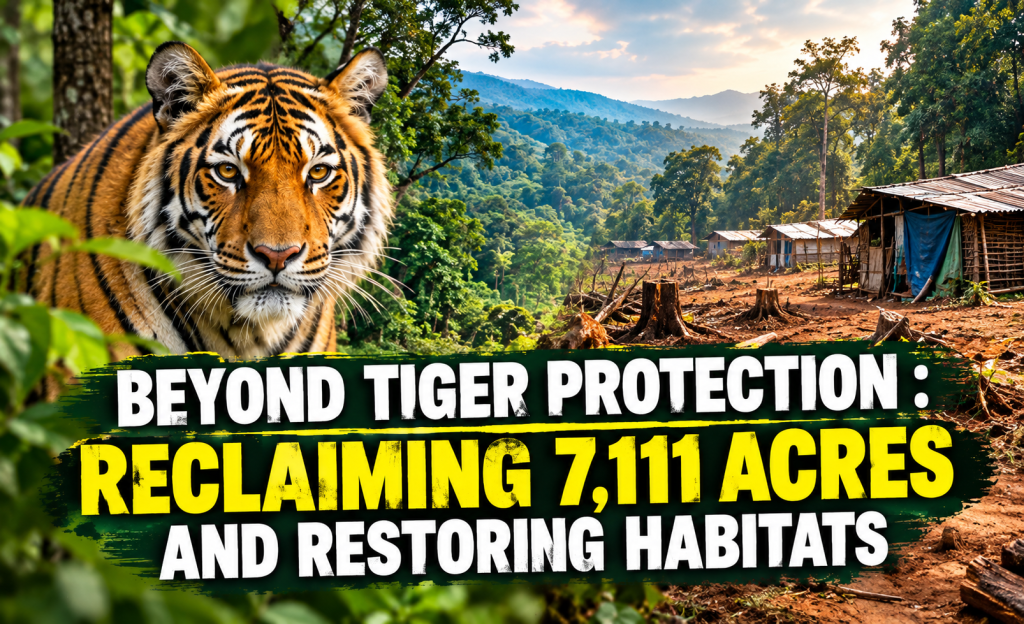
A tiger reserve is protected not merely by drawing boundaries around a forest, but by resolving the human, ecological and administrative challenges that exist within and around it. In the Srivilliputhur-Megamalai Tiger Reserve (SMTR) in Tamil Nadu, a series of interventions has demonstrated how forest restoration can go hand in hand with rehabilitation, community development, habitat protection and long-term planning.
At the centre of these efforts is S. Anand, an IFS officer of the 2017 batch, who is currently posted as Conservator of Forests and Field Director, Srivilliputhur-Megamalai Tiger Reserve (SMTR), Madurai. His work has focused on addressing some of the reserve’s longstanding challenges while creating solutions that combine conservation with the needs of local communities.
Reclaiming Forest Land Through Rehabilitation
One of the major challenges in SMTR was the presence of forest encroachments. Instead of treating eviction as an isolated enforcement exercise, the department adopted a Rehabilitation and Resettlement approach based on the dependence of encroachers on forest land.
Those who were solely dependent on the forest land for their habitation were rehabilitated in ready-built houses provided through the Tamil Nadu Urban Habitation Development Board. This process resulted in the eviction of encroachments from 111.63 hectares, or about 275 acres, allowing the reclaimed land to return to sustainable forest management.
The approach demonstrated that forest protection and rehabilitation could be pursued together, creating a pathway for restoring ecologically important land while addressing the immediate housing needs of affected families.
Securing a Critical Wildlife Corridor
Another significant intervention involved a bottleneck in a wildlife corridor in the Megamalai Division. A total of 38.52 acres of strategically important land was acquired from seven farmers at a cost of ₹2.83 crore under the Right to Fair Compensation and Transparency in Land Acquisition, Rehabilitation and Resettlement Act, 2013.
The acquired land was registered in the name of the Tamil Nadu Forest Department, securing an important stretch for wildlife movement. Interestingly, the initiative also encouraged voluntary participation. Following the intervention, 60 farmers voluntarily came forward to hand over 850 acres, creating an opportunity for further consolidation of the wildlife corridor.
Winning Back Land Lost for Decades
Some of SMTR’s conservation challenges were not recent. In one major case, 7,111 acres of forest land had remained under litigation for 71 years, with claims based on allegedly fake records.
The dormant court proceedings had remained inactive for seven years. The department revived the proceedings and pursued the matter, eventually resulting in the restoration of the land to the Forest Department. The recovery of such a large tract represents an important step towards bringing fragmented and disputed forest areas back under formal conservation management.
Another long-pending issue involved Highwavys, or Megamalai. Around 7,000 acres (2,186 hectares) had remained pending for nearly 62 years for declaration as Reserved Forest because the relevant land records were missing. By retrieving records from archives and other sources, the department was able to complete the process and notify Highwavys as a Reserved Forest, increasing the area under recorded forests.
Conservation That Reaches Tribal Settlements
For Anand, conservation also extends to the communities living in and around the reserve. At Notchiodai, a Paliyar tribal settlement located 31 km inside the core area, an offline solar-grid project brought electricity to all 18 households comprising 76 people.
The settlement had previously been among the country’s unelectrified habitations. The electrification project was integrated with Elephant Proof Trench (EPT) protection, helping address both basic energy needs and human-wildlife conflict.
At Paliyankudi, another Paliyar settlement with a population of 175, essential infrastructure was developed, including roads, solar street lights, an overhead drinking-water tank with a distribution network, a community hall and a study-cum-knowledge centre. Dual boundary protection through EPT and fencing was also created to reduce crop damage and the risk of loss of life caused by wild animals.
Education and Conservation Go Together
Recognising that conservation also depends on the future of tribal children, a dilapidated building at Paliyankudi was renovated into Parazh, meaning “Tiger Cub” in Tamil. The community tribal students’ study centre aims to reduce school dropout rates and provide children with a dedicated space for learning. It is the only centre of its kind in the state.
The interventions show how conservation administration can extend beyond forests and wildlife to education, infrastructure and the everyday needs of communities living alongside protected areas.
Building a Fire-Ready and Plastic-Free Reserve
SMTR has also focused on strengthening its preparedness for environmental threats. Theni district became the only district in the state with a District Forest Fire Management Plan, published in 2024 using 21 years of fire data. The long-term data provides a basis for understanding fire patterns and planning preventive and response measures.
At the Thenpalani Forest Check Post, the gateway to Megamalai and Highwavys, the department established a Plastic Screening Forest Check Post and designated it as a plastic collection centre. Single-use plastic collected there is sold at ₹17 per kg, with the proceeds credited to the Tiger Conservation Foundation. So far, 738 kg of plastic has been collected, supporting the objective of making Megamalai a plastic-free tourism destination.
Restoring Grasslands With Local Germplasm
Habitat restoration has also received attention through the conservation of grass species. SMTR is the only Tiger Reserve in Tamil Nadu with a germplasm of more than 10 grass species. Seeds produced through this germplasm have been used for grassland restoration at Indira Nagar, covering 25 hectares, and Thalaioothu, covering 10 hectares.
Together, these initiatives reflect a conservation approach that looks beyond protecting existing forests. Under S. Anand, IFS (TN 2017), the focus has been on reclaiming forest land, securing wildlife corridors, resolving long-pending land issues, restoring habitats, preparing for forest fires, reducing plastic pollution and improving the lives of communities living within the landscape.
The story of SMTR is therefore not just about protecting a tiger reserve. It is about rebuilding the relationship between forest, wildlife and people—one restored acre, protected corridor, empowered community and recovered habitat at a time.
Also Read – How IFS Sarthak Parasher Turned Around Nahan’s 70-Year-Old Forest Factory And Reinvented Forest Governance