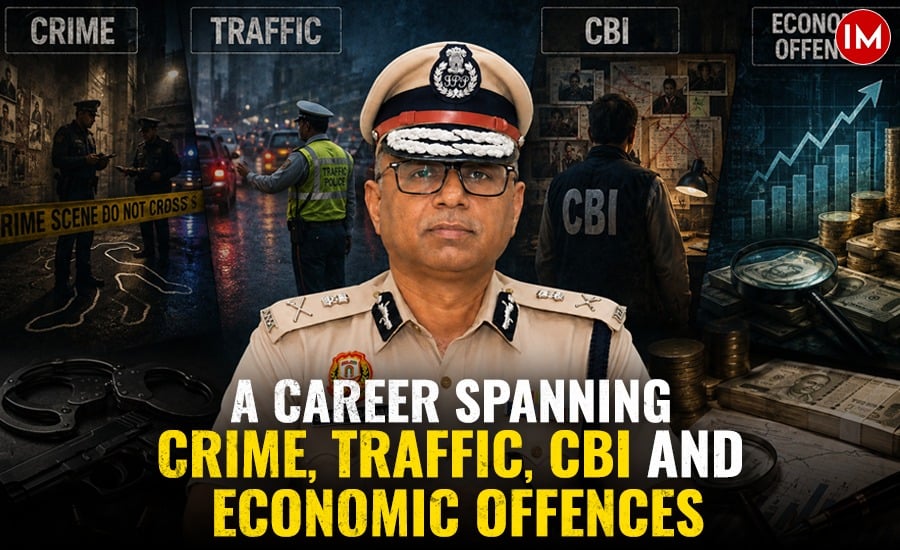
Some police officers spend much of their careers mastering one domain. Sharad Agarwal, IPS, has done almost the opposite. Over nearly three decades, his assignments have taken him from handling labour unrest and high-profile public events to tackling radioactive-material cases, modernising traffic systems, investigating major crimes with the CBI and dealing with complex economic offences.
A 1997-batch IPS officer of the AGMUT cadre, Mr. Agarwal has worked across field policing, administration, investigation and institutional reform. Each posting has brought a different challenge — and required him to adapt to a new policing environment.
Today, as the Director General of Police (DGP), Mizoram, he brings this wide-ranging experience to a state with its own distinctive policing and security challenges. His career offers a look at how an officer’s ability to learn, adapt and lead across diverse assignments can shape nearly three decades in uniform.
FROM ENGINEERING TO THE IPS
Mr. Sharad Agarwal hails from Uttar Pradesh and has an academic background that combines technology and law. He holds a B.Tech in Civil Engineering and an M.Tech in Water Resources Engineering from IIT Delhi, along with an LLB from Goa University.
Also Read – How IFS Rajesh Kumar Won Villagers’ Trust to Protect Nagaland’s Forests
This combination of engineering, law and policing has shaped his approach to public service. After joining the IPS through direct recruitment in 1997, he began a career that would take him through several challenging policing environments across the AGMUT cadre, Delhi Police and the Central Bureau of Investigation.
His first major field assignment came in December 1999, when he became Superintendent of Police, South Puducherry.
EARLY YEARS IN FIELD POLICING
As SP, South Puducherry, Agarwal handled widespread labour agitations and strikes involving major industrial establishments. He also supervised law-and-order arrangements during the Shani Peyarchi Festival at Karaikal, an event that attracted lakhs of devotees. He subsequently served in different districts of Delhi between 2001 and 2004. As an Additional Deputy Commissioner of Police, he dealt with elections, public demonstrations, protests and law-and-order situations.
His responsibilities also included preventive action against known criminals. During his posting as DCP, Trade Fair, in 2002, he was involved in security planning for the India International Trade Fair at Pragati Maidan, one of Delhi’s biggest public events.
These assignments gave him an early grounding in crowd management, preventive policing and crisis response.
A RADIOACTIVE SOURCE THAT TRIGGERED NATIONAL ATTENTION
One of the most challenging episodes of his Delhi career came later. As DCP West and South-West District between 2008 and 2011, Agarwal played a key role in handling the discovery of an orphan radioactive source in the scrap market at Mayapuri Industrial Area.
The incident created widespread public concern and attracted national and international attention because radioactive material had entered the public domain. The investigation and response required close coordination and careful handling.
During the same period, Agarwal was also instrumental in the arrest of more than 500 proclaimed offenders, including individuals wanted in serious criminal cases.
FROM POLICING TO POLICE ADMINISTRATION
Mr. Agarwal’s career then expanded beyond conventional field policing.
As DIG (Administration), Andaman & Nicobar Police, from 2011 to 2014, he focused on strengthening the organisation itself. He worked on filling vacant posts, ensuring timely promotions and implementing the MACP scheme. He also contributed to improving police infrastructure and establishing a Central Police Canteen in the islands.
His next assignment was with the Delhi Traffic Police, where he served as Additional Commissioner and Joint Commissioner between 2014 and 2016. There, his work included traffic modernisation, road engineering improvements and enforcement measures. He was also involved in planning traffic arrangements for the 3rd India-Africa Forum Summit in 2015, which brought 54 Heads of State and Heads of Government to New Delhi.
THE CBI YEARS
In June 2016, Mr. Agarwal joined the Central Bureau of Investigation as DIG. He was promoted and inducted as Joint Director in January 2018.
His CBI tenure became an important chapter of his career. He supervised investigations into sensational murder cases, corruption involving senior public servants and major bank frauds.
He also headed the CBI Special Investigation Team in Manipur, constituted by the Supreme Court to investigate alleged fake encounter cases. His assignments included leadership roles in the Special Task Zone, Bank Security & Fraud Zone, Lucknow Zone and Patna Zone.
These postings exposed him to cases where investigations involved large sums of money, influential individuals and complicated legal questions.
BUILDING STRONGER INVESTIGATIVE SYSTEMS
As Joint Director (Training) at the CBI Academy, Ghaziabad, Agarwal shifted his attention from individual cases to institutional capacity. He worked on expanding training and knowledge-building programmes. He also promoted CFE certification and improved access to handbooks, standard operating procedures and other learning material through online platforms.
The emphasis was on making professional knowledge more accessible to investigators and strengthening investigative standards across the organisation. Later, as Special Commissioner of Police, Economic Offences Wing, Delhi Police, he supervised complicated economic crime cases involving real estate fraud, chit funds, Ponzi schemes, banks and NBFCs.
He also focused on clearing long-pending investigations and ensuring that complainants received patient, direct hearings. His tenure saw significant disposal of old cases.
NOW, LEADING MIZORAM POLICE
In July 2025, Mr. Agarwal took charge as DGP, Mizoram, bringing with him nearly three decades of experience across field policing, investigation, administration and institutional leadership. The assignment comes with a different set of priorities. Mizoram’s policing landscape requires attention to public safety, border-related coordination, narcotics and smuggling, organised crime, law and order and police modernisation.
His experience across different parts of the country gives him a broad understanding of how policing must adapt to local conditions.
A CAREER BUILT ON ADAPTABILITY
Mr. Agarwal’s career is notable not because it followed a single track, but because it did not. He moved from industrial unrest in Puducherry to public-order challenges in Delhi, from radioactive material at Mayapuri to traffic management, from police administration in the Andaman and Nicobar Islands to complex CBI investigations and economic offences.
Along the way, he received the President’s Police Medal for Meritorious Service in 2013 and the President’s Police Medal for Distinguished Service in 2023, besides the Hard Area Medal. Now, as DGP Mizoram, he enters another important phase of his career. His own message captures the approach expected from a senior police leader: “Professional policing is built on integrity, discipline, and service to the people.”
For Mr. Sharad Agarwal, the uniform has travelled through many roles and many challenges. His latest responsibility in Mizoram adds another chapter to a career built on professionalism, investigation, institutional improvement and public service.
Also Read – Devesh Pandey: The IFS Officer Giving a Fighting Chance to the Himalayan Newt in Darjeeling Hills