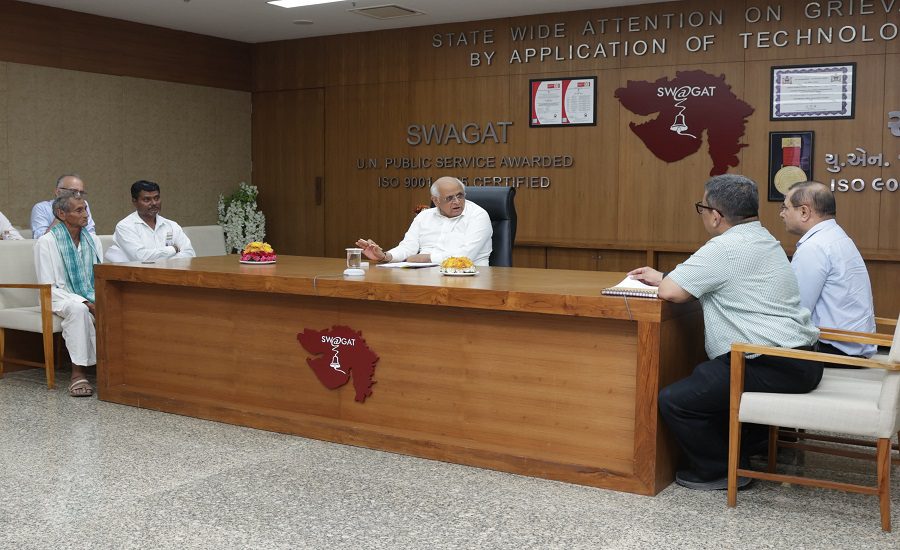
Gandhinagar: Gujarat Chief Minister Bhupendra Patel conducted the State SWAGAT Programme for June 2026 and issued strict directions to district-level officers to ensure timely, transparent, and effective resolution of public grievances at the local level.
The Chief Minister emphasized that citizens should not face unnecessary delays and instructed officials to thoroughly examine applications and resolve issues within their respective jurisdictions wherever possible.
Focus on District-Level Grievance Redressal
During the programme, the Chief Minister directed that:
- District officers must take decisions on applications at the district level itself
- Cases under state jurisdiction should be promptly forwarded to the government
- Citizens should not be made to wait unnecessarily for administrative decisions
- District Collectors must take the lead in grievance resolution
He reiterated that district administration is the first and most important point of contact for public grievance redressal.
Over 5,200 Representations Reviewed
The State SWAGAT Programme, usually held on the fourth Thursday of every month, was conducted on June 22 in view of the upcoming Shala Praveshotsav scheduled from June 23 to 25.
Key figures from the session include:
- Over 120 applicants present in person at the Chief Minister’s Office
- More than 5,200 total representations received
- 2,228 applications under District SWAGAT
- 2,854 applications under Taluka SWAGAT
All applications were forwarded to the concerned departments for further action.
Key Issues Raised by Farmers
Farmers from Chhota Udepur and Mehsana districts presented grievances related to:
- Rehabilitation land allotment delays
- Encroachment on gauchar land
- Discrepancies in land re-survey measurements
The Chief Minister took serious note of the issues and issued time-bound directions for resolution.
Strict Orders on Land Allotment and Survey Disputes
Rehabilitation Land Case (Chhota Udepur)
A farmer from Chhota Udepur raised concerns regarding delayed allotment of alternative land after his original land was submerged due to an irrigation project.
The Chief Minister directed:
- Immediate allotment of alternative land within 30 days
- Coordination between district collectors and the Irrigation Department
- Accountability assigned primarily to the Irrigation Department
Land Re-Survey Correction (Mehsana)
In another case involving land area reduction due to survey discrepancies, the CM instructed:
- Immediate land measurement
- Completion of corrective action within 15 days
- Strict responsibility assigned to the ILR office
- Improved coordination between Mamlatdar and ILR offices
He also directed that unnecessary correspondence between departments should be avoided.
Action Against Gauchar Land Encroachment
In a case from Visnagar taluka, where encroachment on gauchar land remained unresolved despite earlier district-level decisions, the Chief Minister ordered:
- Immediate removal of encroachment
- Strict enforcement of district-level decisions without delay
He stressed that District Collectors must act proactively to resolve such issues.
CM Emphasizes Citizen-Centric Governance
The Chief Minister reiterated that grievance redressal is a key pillar of citizen-centric governance. He instructed officials to prioritize efficiency, coordination, and accountability in all public service matters.
He also stated that District Collectors must take leadership responsibility in ensuring timely solutions to public issues.
Senior Officials Present
The programme was attended by senior administrative officials, including:
- Principal Secretary to the Chief Minister Sanjeev Kumar
- Secretary Dr. Ajay Kumar
- OSD Dhiraj Parekh
- OSD Rakesh Vyas
- Senior departmental secretaries
District Collectors and officials joined via video conferencing and provided updates on ongoing cases.
The State SWAGAT Programme highlighted the Gujarat government’s continued focus on fast-track grievance redressal and administrative accountability. The Chief Minister’s directives aim to ensure quicker decisions, reduced bureaucratic delays, and stronger coordination between departments for effective public service delivery.