Raipur: Chhattisgarh Chief Minister Vishnu Deo Sai has called for strengthening gram panchayats and developing villages as self-reliant centres of social transformation, economic growth and rural prosperity. He said the vision of a developed Chhattisgarh can be achieved only when villages across the state become comprehensively developed, empowered and self-sufficient.
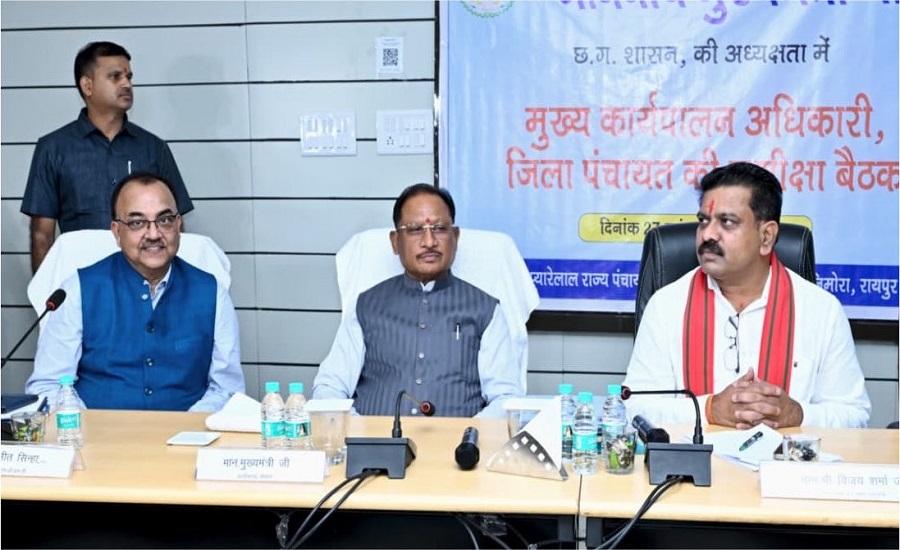
The Chief Minister made the remarks while addressing a high-level review meeting and workshop of the Chief Executive Officers (CEOs) of all district panchayats held at the SIRD campus in Nimora, Nava Raipur, on Monday.
During the meeting, he issued detailed directions on the effective implementation of rural development schemes, increasing public participation and ensuring that government benefits reach the last person.
Gram Panchayats Must Become Centres of Rural Transformation
CM Vishnu Deo Sai said gram panchayats should not be limited to implementing government schemes. Instead, they must evolve into centres of social change, economic prosperity and self-reliant rural economies.
He said the overall development of Chhattisgarh would become possible only when:
- Gram panchayats are strengthened.
- Villages become economically self-reliant.
- Rural residents actively participate in the development process.
- Government schemes reach eligible beneficiaries without discrimination.
- Local resources are effectively utilised.
The Chief Minister urged officials to work with sensitivity, honesty and a spirit of service, saying that winning the trust of rural communities is one of the administration’s biggest responsibilities.
Read also: Chhattisgarh CM Vishnu Deo Sai Announces Major Welfare Measures at Historic Amleepadar Rath Yatra
CM Calls for Model Villages Based on Local Resources
The Chief Minister said the success of a government scheme should not be measured only by its implementation but by whether its benefits actually reach the eligible person.
He directed officials to identify villages in every district where local resources, public participation and effective implementation of government schemes can be combined to create ideal development models.
According to CM Sai, successful models developed in such villages could become an inspiration for other parts of Chhattisgarh.
He also called for district-specific development models based on local conditions, available resources and the needs of communities.
Focus on Rural Jobs, Infrastructure and the Developed India GRAM G Scheme
CM Sai said the Viksit Bharat GRAM G Yojana, which came into effect on 1 July, is an important initiative capable of giving fresh momentum to the rural economy.
He directed officials to use the scheme to create new employment opportunities and develop quality rural infrastructure alongside durable community assets.
Priority areas under the initiative, as outlined by the Chief Minister, include:
- Water conservation
- Agriculture
- Rural infrastructure
- Livelihood promotion
- Creation of community assets
He placed particular emphasis on the quality of construction work and made it clear that no compromise on quality would be acceptable.
Rural Development Must Go Beyond Construction
The Chief Minister said rural development should not be restricted to building physical infrastructure.
He stressed the importance of:
- Water conservation
- Soil health
- Agricultural productivity
- Animal husbandry
- Fisheries
- Scientific use of local natural resources
He directed all districts to prepare water conservation plans suited to their local conditions, with a special focus on rainwater harvesting and groundwater recharge.
According to him, scientific management of natural resources and sustainable agricultural practices are essential for creating a strong foundation for long-term rural development.
Government Targets More ‘Lakhpati Didis’ in Chhattisgarh
Highlighting women’s empowerment, CM Sai said significant efforts have been made under the leadership of Prime Minister Narendra Modi to strengthen women’s economic independence.
He said more than 10.40 lakh women in Chhattisgarh have already become Lakhpati Didis.
The government now aims to help a larger number of women become financially successful through entrepreneurship, skill development and self-employment opportunities.
The Chief Minister directed district panchayat CEOs to:
- Identify eligible women.
- Connect them with self-help groups.
- Expand access to skill development programmes.
- Promote livelihood activities.
- Link women with opportunities available under the state’s new industrial policy.
He said these efforts should help women increase their incomes on a sustained basis.
Special Focus on Development in Bastar’s Remote Areas
CM Sai gave specific instructions to officials in the Bastar division to prioritise development works in remote and difficult-to-reach areas.
He said basic facilities are now reaching villages that were previously difficult to access.
These include:
- Roads
- Electricity
- Housing
- Ration
- Drinking water
- Education
- Healthcare
The Chief Minister said the government’s objective is to ensure that the benefits of development reach the last person and that no region remains outside the mainstream of development.
Faster Implementation of PM Awas Yojana and Welfare Schemes
The Chief Minister directed officials to speed up construction under the Pradhan Mantri Awas Yojana and ensure that all eligible beneficiaries receive houses on time.
He also stressed that payments under social security pensions and other welfare schemes should not be delayed.
To strengthen accountability, he called for effective monitoring mechanisms at the panchayat level and emphasised transparency in the implementation of government programmes.
CM Pushes Solar Energy and PM Surya Ghar Scheme
Highlighting the importance of energy self-reliance, CM Sai said the PM Surya Ghar Muft Bijli Yojana should be widely promoted at the panchayat level.
He directed officials to encourage more families to adopt solar energy and launch special campaigns to ensure that farmers and rural households receive maximum benefits from:
- Solar pumps
- Rooftop solar systems
- Other solar energy schemes
The initiative is aimed at expanding the use of renewable energy and supporting energy self-reliance in rural areas.
CM Sai Highlights Hivare Bazar Model of Rural Development
During the workshop, CM Sai referred to the development model of Hivare Bazar, developed by Padma Shri awardee Popatrao Pawar.
He said the experience of Hivare Bazar demonstrates that determined leadership, public participation and strong willpower can transform a village.
The Chief Minister recalled meeting Pawar in 1999, when he was invited to guide young MPs after Sai was elected to Parliament for the first time.
He said the story of Hivare Bazar’s transformation, which Pawar had shared at the time, has now become an example of an ideal village development model for the country.
Hivare Bazar Overcame Water Crisis and Migration
During the workshop, Popatrao Pawar shared the development journey of Hivare Bazar.
According to him, the village was struggling with water scarcity, migration, unemployment and several social challenges in 1989.
Through public participation, discipline, water conservation and scientific management of natural resources, the village underwent significant transformation.
Pawar said that today:
- Migration from Hivare Bazar has completely stopped.
- The village has no BPL families.
- Around 5,000 litres of milk are collected every day.
- The village’s per capita income has reached approximately ₹9 lakh.
The example was highlighted as a demonstration of how community participation and sustainable resource management can contribute to long-term rural prosperity.
CM Cites Other Successful Rural Development Models
CM Sai also referred to the village development model created by Nanaji Deshmukh through the Deendayal Research Institute in Chitrakoot.
He also highlighted the work of Dr Achyut Samanta in Odisha, particularly his contribution to social transformation through education.
The Chief Minister urged district officials to learn from such successful examples and develop their own models according to the specific conditions and requirements of their respective districts.
He said such locally designed models could help ensure sustainable and inclusive development across Chhattisgarh.
CM Urges Officials to Treat Public Service as Nation Building
CM Vishnu Deo Sai said public life should not be viewed merely as the fulfilment of administrative responsibilities.
Instead, he urged officials to see their work as an opportunity to create positive social change that future generations would remember.
Drawing inspiration from Prime Minister Narendra Modi’s approach to public service, he called upon officials to consider their responsibilities as an opportunity to contribute to nation-building and social development.
The workshop focused on strengthening grassroots governance, improving implementation of rural schemes, increasing public participation and building self-reliant villages as a foundation for the development of Chhattisgarh.
Senior Officials Attend High-Level Rural Development Workshop
The high-level meeting and workshop was attended by Deputy Chief Minister Vijay Sharma, Additional Chief Secretary Richa Sharma, Panchayat and Rural Development Department Secretary Bhim Singh, Director Priyanka Rishi Mahobiya, and retired Indian Administrative Service officer Amarjeet Sinha.
Chief Executive Officers of district panchayats from across Chhattisgarh and senior officials from the concerned departments were also present.