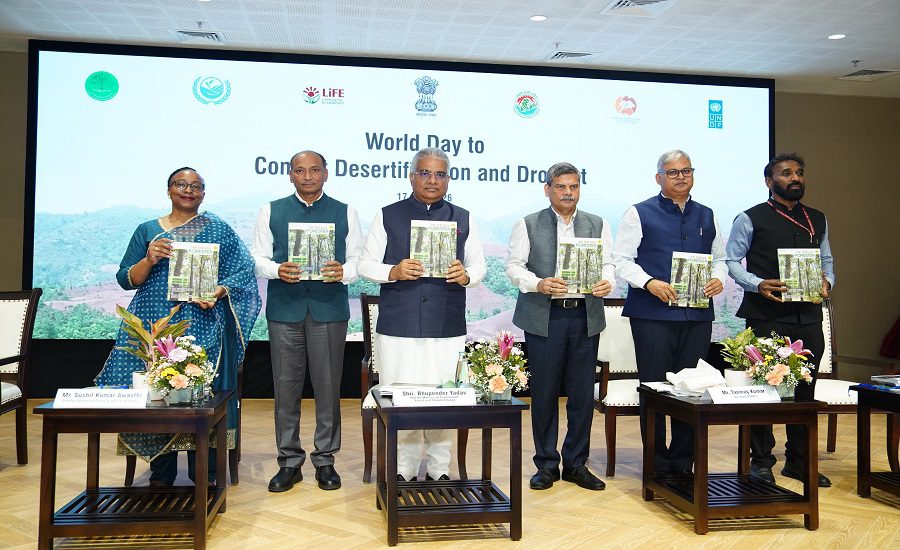
New Delhi: India land restoration efforts have achieved a significant breakthrough, with 21.76 million hectares of degraded land restored against the national target of 26 million hectares by 2030 under the Bonn Challenge. The announcement was made by Union Environment Minister Bhupender Yadav during the observance of World Day to Combat Desertification and Drought 2026 in New Delhi. This means India has already achieved nearly 84% of its restoration commitment, placing it among the leading countries working to reverse land degradation and strengthen climate resilience.
India Land Restoration Efforts: Quick Facts
- Land restored so far: 21.76 million hectares
- Bonn Challenge target: 26 million hectares by 2030
- Progress achieved: Around 84%
- Employment generated: 1.22 billion person-days
- Saplings planted under Ek Ped Maa Ke Naam: 266 crore+
- Watershed area treated: 27 million hectares
- Geo-tagged natural resource assets created: 61.3 million+
What Is the Bonn Challenge
The Bonn Challenge is a global initiative launched in 2011 to restore degraded and deforested landscapes worldwide. The global target is to restore 350 million hectares by 2030. India committed to restoring 26 million hectares of degraded land by 2030, making it one of the world’s largest restoration pledges.
How Much Land Has India Restored Under the Bonn Challenge
India has restored 21.76 million hectares of degraded land against its target of 26 million hectares by 2030, achieving approximately 84% of its Bonn challenge commitment.
Why India Land Restoration Efforts Matters
Land degradation affects agriculture, forests, water resources, biodiversity, and rural livelihoods. According to official assessments, nearly 29.77% of India’s geographical area is affected by land degradation or desertification, making restoration critical for food security, climate action, and sustainable development.
Benefits of Land Restoration
- Improves soil health
- Increases agricultural productivity
- Conserves biodiversity
- Enhances groundwater recharge
- Creates rural employment
- Helps fight climate change
- Reduces drought risks
India Land Restoration Efforts: Key Achievements
1. Massive Employment Generation
Restoration activities have created approximately 1.22 billion person-days of employment. This demonstrates how environmental projects can support economic growth while protecting natural resources.
2. Watershed Development Success
Under the Watershed Development Component of PMKSY:
- More than 27 million hectares are treated.
- Over 61.3 million geo-tagged assets created.
3. Green India Mission Progress
Major achievements include:
- 1.7 lakh hectares restored under Green India Mission.
- 3.20 lakh hectares afforested through CAMPA.
- 1.21 lakh hectares brought under agroforestry.
- Bamboo plantations expanded across nearly 60,000 hectares.
Aravalli Green Wall Initiative Exceeds Annual Target
The Aravalli Green Wall Initiative surpassed its annual target during FY 2025-26. The project aims to:
- Restore degraded landscapes.
- Improve ecosystem health.
- Increase forest cover.
- Prevent desertification.
- Enhance biodiversity conservation.
Ek Ped Maa Ke Naam Campaign Records Massive Participation
Bhupender Yadav said that more than 266 crore saplings have been planted across India under Prime Minister Narendra Modi’s “Ek Ped Maa Ke Naam” campaign.
The government is also using advanced digital platforms including:
- Bhuvan
- VEDAS
- Yuktdhara
These technologies help monitor restoration projects through scientific and satellite-based methods.
World Day to Combat Desertification and Drought 2026 Theme
The 2026 global theme is:
“Rangelands: Recognize. Respect. Restore.”
The theme focuses on protecting rangelands, which cover more than half of Earth’s land surface and play an important role in:
- Food security
- Water conservation
- Biodiversity protection
- Climate resilience
- Rural livelihoods
Read also: Daspara: India’s First Modified Bio-Village Leading the Charge in Sustainable Development