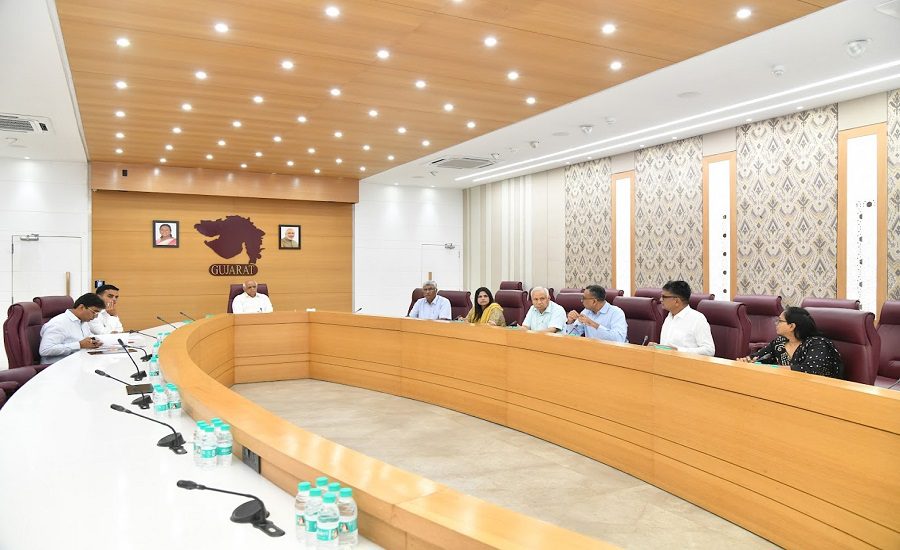
Gandhinagar: Under the guidance of Chief Minister Bhupendra Patel, the Gujarat government has announced comprehensive preparedness measures to address potential El Niño-related challenges. Spokesperson Minister Jitu Vaghani stated that the state administration has activated coordinated planning across multiple departments to safeguard farmers, livestock, and drinking water security.
The high-level review meeting included senior officials from the Agriculture, Irrigation, Water Supply, Narmada, and Revenue departments.
Extensive Multi-Department Planning to Tackle Climate Risks
The state government has initiated detailed micro-planning across key departments to prepare for possible climate variations linked to El Niño conditions, as forecast by the India Meteorological Department.
According to the government, the focus areas include:
- Water resource management
- Agricultural contingency planning
- Livestock fodder security
- Real-time monitoring and district coordination
Officials emphasized that all departments are working in close coordination to ensure timely response mechanisms.
Read also: Gujarat CM Bhupendra Patel Targets 100% School Enrolment Under Shala Praveshotsav 2026 Campaign
Major Decision to Expand Narmada Pipeline Lake-Filling Coverage
One of the key announcements includes a significant expansion of the Narmada pipeline lake-filling policy.
Previously, only lakes within a 3-kilometre radius of the pipeline were covered. Now, the coverage has been extended to 7 kilometres, enabling a much larger number of water bodies to receive Narmada water.
Under this decision, more than 300 lakes across North Gujarat will be filled under the Sujalam Sufalam Yojana. Additionally, several reservoirs and dams in Saurashtra will be prioritized under the SAUNI Yojana to strengthen drinking water availability.
Priority Focus on Drinking Water Security Across Gujarat
The government has directed the Water Resources and Water Supply departments to ensure uninterrupted drinking water supply throughout the state.
Special emphasis has been placed on:
- Filling reservoirs in drought-prone regions
- Strengthening water storage systems
- Coordinated management of the Sardar Sarovar Narmada Dam network
Officials confirmed that long-term planning is being implemented to ensure water security even under adverse climate conditions.
Agricultural Contingency Plan for Farmers
To protect farmers from potential El Niño impacts, the Agriculture Department has introduced a comprehensive “Contingency Crop Planning” strategy.
Key components include:
- Guidance on alternative short-duration crops
- Promotion of low-water-consuming farming practices
- Continuous soil moisture and crop health monitoring
- Satellite-based agricultural assessment systems
The government stated that adequate stocks of seeds and fertilizers for the Kharif 2026 season are already available across the state.
AI-Based Krushi Pragati Portal to Support 50 Lakh Farmers
The state is leveraging digital agriculture tools through the AI-based Krushi Pragati Portal, which is providing real-time weather updates and farming advisories.
Over 50 lakh farmers are receiving direct SMS alerts and guidance on crop management, weather conditions, and advisory measures to minimize risk and improve productivity.
Strong Fodder Security for Livestock
The government has also prioritized livestock welfare as part of its climate preparedness strategy.
At present, Gujarat maintains fodder reserves sufficient for two years, ensuring strong buffer stock in case of adverse conditions.
The Forest and Animal Husbandry departments have been instructed to:
- Maintain continuous fodder supply chains
- Strengthen buffer stock systems
- Ensure uninterrupted availability of animal feed
Revenue Department Monitoring and District-Level Coordination
The Revenue Department has been directed to maintain continuous coordination with district collectors and ensure round-the-clock monitoring of the situation.
Officials will oversee:
- Real-time district updates
- Emergency response readiness
- Ground-level implementation of contingency plans
Government Cites Historical El Niño Data
The government highlighted that Gujarat has experienced eight Kharif-season El Niño years between 2000 and 2026. Officials noted that El Niño conditions do not always result in deficient rainfall.
Citing past data, the government pointed out that despite severe El Niño conditions in 2006 and 2023, the state recorded 117% of normal rainfall. Citizens and farmers have been urged not to panic or rely on rumors.
Top-Level Administrative Coordination
The meeting was attended by senior officials including:
- Principal Advisor to the Chief Minister Dr. Hasmukh Adhia
- Managing Director of Narmada Nigam Mukesh Puri
- Principal Secretaries of key departments
- Senior advisors and administrative officers
The government emphasized that scientists from agricultural universities are also contributing to planning and risk assessment.
The Gujarat government has positioned its response strategy as a multi-layered, technology-driven, and coordination-based approach to manage potential El Niño challenges. With expanded water management systems, AI-driven agricultural advisories, and strong fodder reserves, the state aims to ensure stability for farmers, livestock owners, and citizens even under uncertain climatic conditions.