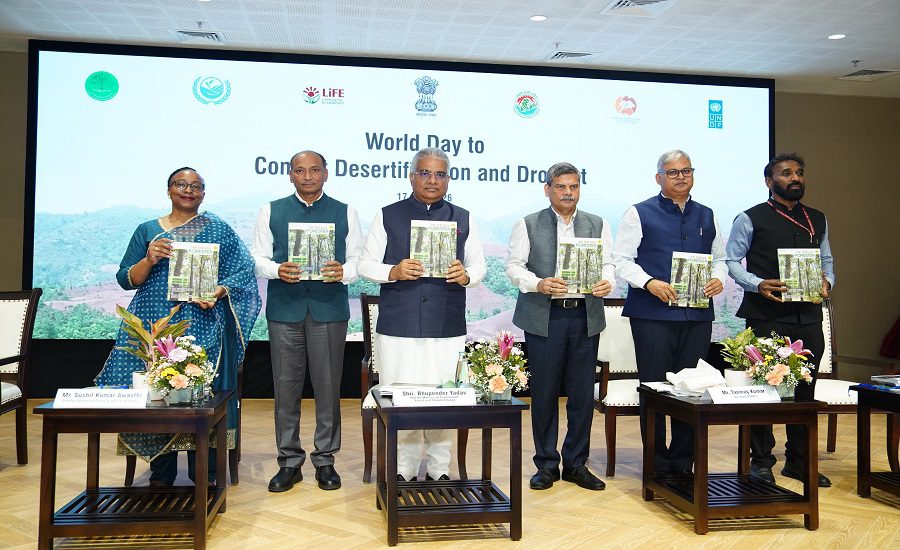
New Delhi: India marked the World Day to Combat Desertification and Drought 2026 with a high-level event held at Indira Paryavaran Bhawan, New Delhi, where Union Minister for Environment, Forest and Climate Change Mr. Bhupender Yadav highlighted the country’s significant progress in land restoration and ecological conservation.
The event, observed annually on 17 June under the United Nations Convention to Combat Desertification (UNCCD), focused on global action against desertification, land degradation, and drought, with this year’s theme being “Rangelands: Recognize. Respect. Restore.”
India Restores 21.76 Million Hectares Under Bonn Challenge
Speaking at the event, Mr. Bhupender Yadav announced that India has already brought 21.76 million hectares of degraded land under restoration efforts, against its ambitious target of 26 million hectares by 2030 under the Bonn Challenge.
The Bonn Challenge, launched in 2011, is a global initiative aimed at restoring 350 million hectares of degraded and deforested landscapes by 2030. India reaffirmed its position as a key global contributor to this effort, advancing sustainable land management through policy action and community participation.
The Minister noted that restoration activities have also generated approximately 1.22 billion person-days of employment, demonstrating strong socio-economic benefits alongside ecological recovery.
Read also: Bhupender Yadav Chairs Key Wildlife Meeting, Focus on Rivers and Grasslands
Major Government Programmes Driving Land Restoration
Mr. Yadav highlighted several national initiatives contributing to land restoration and environmental resilience:
- Over 27 million hectares treated under the Watershed Development Component of PMKSY
- More than 61.3 million geo-tagged natural resource management assets created
- Around 1.7 lakh hectares restored under the Green India Mission
- Approximately 3.20 lakh hectares afforested through CAMPA-supported activities in the last five years
- Over 1.21 lakh hectares brought under agroforestry
- Nearly 60,000 hectares covered by bamboo plantations outside forests
He also emphasized the success of the “Ek Ped Maa Ke Naam” campaign, under which more than 266 crore saplings have been planted across India.
Aravalli Green Wall Initiative Shows Strong Progress
The Minister noted that the Aravalli Green Wall Initiative has exceeded its annual targets in the financial year 2025–26. The initiative plays a crucial role in restoring degraded landscapes across the Aravalli range and improving ecological balance in the region.
Additionally, the government has set a target to restore 54,000 hectares of mangrove ecosystems by 2028 under the MISHTI programme, strengthening coastal resilience and biodiversity conservation.
India’s Land Degradation Challenge
Mr. Yadav highlighted that India’s dryland regions cover approximately 228 million hectares, playing a vital role in agriculture, livestock rearing, and rural livelihoods.
Citing the India Desertification and Land Degradation Atlas, he stated that 97.85 million hectares (29.77% of India’s geographical area) are currently affected by land degradation and desertification.
He stressed that addressing this challenge requires:
- Landscape-level restoration
- Science-based monitoring
- Community participation
- Nature-based solutions
- Innovative financing mechanisms
Rangelands and Grasslands in Focus
This year’s theme placed special emphasis on rangelands and grasslands, which the Minister described as essential for:
- Biodiversity conservation
- Livestock-based livelihoods
- Water cycle regulation
- Carbon sequestration
- Climate resilience
He reiterated that restoring these ecosystems is central to achieving Land Degradation Neutrality (LDN) in India.
Technology and Policy Tools Supporting Restoration
Mr. Yadav highlighted the role of advanced digital and geospatial platforms in supporting environmental planning and monitoring, including:
- Bhuvan
- VEDAS
- Yuktdhara
He also noted that more than 260 million Soil Health Cards have been issued, supporting sustainable agricultural practices and preventing land degradation.
India Releases Bonn Challenge Progress Report and Indian Forester Special Issue
On the occasion, the Union Minister released:
- A Special Issue of Indian Forester
- India’s Second Progress Report on the Bonn Challenge (2011–2020)
Prepared in collaboration with IUCN, the report provides a detailed assessment of India’s restoration progress across states and Union Territories. It highlights ecological improvements, socio-economic benefits, and India’s continued commitment to ecosystem restoration and Land Degradation Neutrality.
The Special Issue brings together scientific research, policy insights, and field experiences, with a special focus on rangelands and grasslands, in preparation for upcoming global environmental forums including UNCCD COP-17 and the International Year of Rangelands and Pastoralists.
Institutional and International Participation
The event witnessed participation from around 200 delegates, including representatives from:
- Central and State Governments
- Research institutions
- International organisations
- Development partners
- Civil society groups
Key speakers included Director General of Forests Mr. Sushil Kumar Awasthi, Secretary MoEFCC Mr. Tanmay Kumar, and UNDP Resident Representative Dr. Angela Lusigi, who praised India’s leadership in ecosystem restoration and nature-based solutions.
Commitment Towards Sustainable Land Management
Concluding the event, stakeholders reaffirmed the importance of coordinated action among governments, communities, researchers, and international partners to achieve long-term restoration goals.
India reiterated its commitment to:
- Expanding landscape restoration
- Strengthening drought resilience
- Enhancing ecosystem-based livelihoods
- Promoting sustainable land management practices
The event concluded with a renewed pledge to accelerate restoration efforts and secure a greener, more resilient future for coming generations.