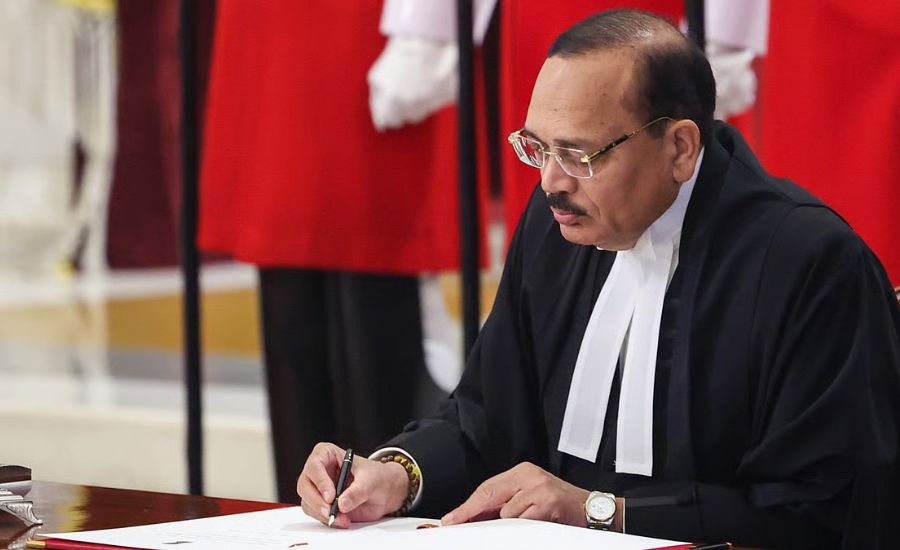
Moscow: India–Russia judicial cooperation got a major push after CJI Surya Kant signed an MoU with Russia’s Supreme Court in Moscow. The agreement is aimed at improving cooperation between the two apex courts in court technology, judicial training, exchange of best practices, and capacity-building. It also highlights India’s growing focus on digital justice tools such as virtual hearings, translation software, and AI-based court support systems.
The MoU is important because it moves India–Russia legal ties beyond diplomacy and into practical court-to-court collaboration. Officials said the partnership will focus on making courts more efficient, modern, and accessible while also improving professional training for judges and court staff.
Details of CJI Surya Kant Russia Supreme Court MoU
The Supreme Court of India and the Supreme Court of the Russian Federation signed a Memorandum of Understanding (MoU) in Moscow. The MoU was signed by:
- Chief Justice of India Surya Kant
- Igor Krasnov, Chairman of the Supreme Court of the Russian Federation
The agreement was signed during an official visit by the Indian judicial delegation to Russia.
Read also: Women Lawyers to Get Stronger Support: CJI Surya Kant Promises Measurable Reforms
What is the MoU about
The MoU aims to create a formal system for cooperation between the top courts of India and Russia.
Main areas of cooperation
- Technology-enabled court administration
- Exchange of judicial experience and best practices
- Professional training and skill development
- Capacity-building for judges and court staff
- Knowledge-sharing on modern court management
According to reports, both sides discussed how technology can improve judicial work and how training can help courts handle new legal and administrative challenges better.
What is the Importance of CJI Surya Kant Russia Supreme Court MoU
This is not just a symbolic agreement. It can have practical value for how courts work.
Better use of technology in courts
India has been expanding digital tools in the justice system. During the interaction, CJI Surya Kant highlighted India’s push in areas such as:
- Digitisation of court records
- Virtual hearings
- Video conferencing
- Online access to court information
- AI-assisted legal research and support tools
He also referred to SUVAS, the Supreme Court’s translation tool, and Su Sahy, an AI-powered chatbot designed to help litigants, lawyers, and the public with court-related information.
Training and capacity-building
The MoU gives importance to judicial education and advanced training. This can help both countries share ideas on:
- handling large case loads
- improving court administration
- training judges and staff in new technologies
- strengthening access to justice systems
Judicial diplomacy
The agreement also shows that India is using its judiciary as a channel for international cooperation. Instead of limiting ties to trade, defence, or politics, India is also building links in the legal and judicial space.
What did CJI Surya Kant say
CJI Surya Kant said India and Russia may have different legal traditions, but both face a common challenge: how to keep public trust in the justice system while adapting to fast technological and social change.
He stressed that technology is becoming a key part of modern justice delivery, but he also made an important point:
AI can help, but judges must still decide
According to the reports, CJI Surya Kant said AI can help with:
- organising information
- improving court administration
- making research easier
- speeding up support processes
But AI cannot replace judicial decision-making. It cannot fully judge witness credibility, assess evidence like a human judge, or exercise judicial discretion in the same way.
Read also: Chief Justice of India Surya Kant Responds Strongly After Fake Caste Comment Spreads Online