New Delhi: NIDAR 2.0 has been launched by the Ministry of Electronics and Information Technology (MeitY) in partnership with Drone Federation India (DFI) to strengthen India’s indigenous drone ecosystem. The national innovation challenge encourages students to develop advanced autonomous drones powered by India’s own VEGA processor. The initiative aims to promote self-reliance in drone technology, semiconductor design, and next-generation autonomous systems while supporting the government’s vision of Atmanirbhar Bharat.
What is NIDAR 2.0
The National Innovation Challenge for Drone Application and Research (NIDAR) 2.0 is the second edition of the national drone competition under the SwaYaan initiative for 2026-27.
Read also: What is BHAVYA Portal? How It Will Give Wings to Atmanirbhar Bharat Goal
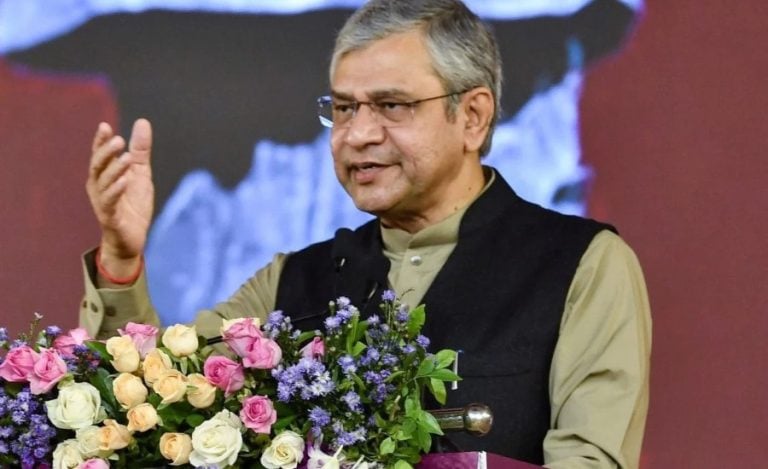
The programme was officially launched at Electronics Niketan in New Delhi in a hybrid format, bringing together students, researchers, government officials and industry experts from across India.
Why NIDAR 2.0 Is Important
Unlike the first edition, which mainly focused on drone applications, NIDAR 2.0 shifts attention towards:
- Autonomous drone systems
- Indigenous avionics
- Flight control technologies
- Core drone components
- AI-powered drone intelligence
- Indian-designed semiconductor technology
The goal is to help students build not just drones but the technology that powers them.
VEGA Processor Becomes the Heart of the Challenge
A major highlight of NIDAR 2.0 is the use of the VEGA processor, India’s indigenous processor family developed by C-DAC under MeitY’s Digital India RISC-V (DIR-V) programme.
According to MeitY Secretary S. Krishnan, India wants students to move from simply flying drones to creating the “brain” of drones using Indian-made processors. This will reduce dependence on foreign chip designs and strengthen India’s semiconductor ecosystem.
NIDAR 2.0: Two Competition Tracks
NIDAR 2.0 has been divided into two major tracks.
1. Drone Innovation Track
Students will design fully autonomous drones capable of:
- Disaster response
- Survivor detection
- Medical supply delivery
- GPS-denied navigation
- Swarm drone operations
2. Component Innovation Track
Teams will build:
- Indigenous flight controllers
- Autopilot systems
- Drone control electronics
- VEGA processor-based embedded systems
The top 100 shortlisted teams will receive VEGA processor development kits for testing and integration.
Bigger Rewards for Student Innovators
Compared to the previous edition, NIDAR 2.0 offers significantly higher benefits. Winning teams will receive:
- Prize pool of over ₹65 lakh
- Startup incubation support
- Cloud computing credits
- Software development support
- Corporate internships
These benefits aim to help students convert their ideas into real products and startups.
Success of the First Edition
The first NIDAR competition, launched in 2025, attracted:
- 3,448 students
- Participants from 22 States and 4 Union Territories
- 109 cities
- 93 finalist teams
- 24 winning teams
- ₹40 lakh in prize money
Students developed autonomous drone solutions for disaster management and precision agriculture, laying the foundation for this expanded edition.
About the SwaYaan Initiative
NIDAR is part of the SwaYaan programme, approved by MeitY in 2022 with an investment of nearly ₹89.87 crore. The initiative works through a network of premier institutions, including IISc, IITs, IIITs, NITs, C-DAC and NIELIT, to build skilled manpower for India’s drone industry. More than 51,000 people have already been trained under the programme.
What is the Importance of NIDAR 2.0 for India
The launch of NIDAR 2.0 reflects India’s growing focus on indigenous drone technology, semiconductor manufacturing and autonomous defence systems.
By encouraging students to build drone hardware and software using Indian technology, the government aims to strengthen both civilian and defence applications while reducing dependence on imported electronics.
Read also: Indian Navy 2035 Vision: Inside the 200 Warships Induction Under Atmanirbhar Bharat Plan