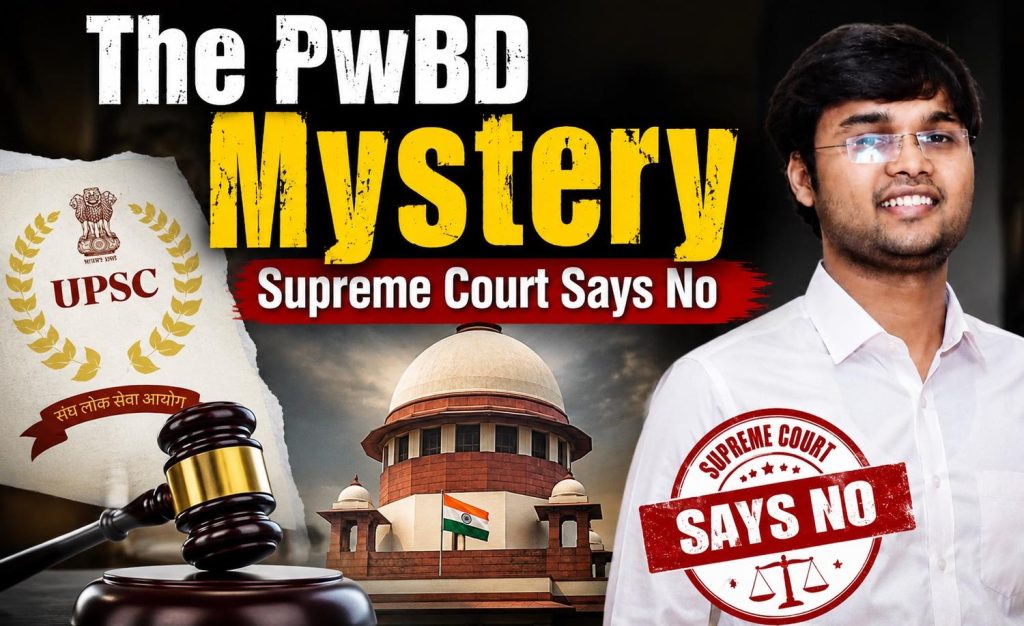
New Delhi/Lucknow: A recent Supreme Court judgment in the high-profile disability quota dispute involving Civil Services Examination (CSE) 2024 candidate Shubham Agarwal has now triggered demands for scrutiny of his appointment in the Uttar Pradesh government. A formal complaint has been submitted to the Chief Secretary of Uttar Pradesh seeking an independent inquiry into the disability certificates and records relied upon by Agarwal while securing appointment as a Nayab Tehsildar through the Uttar Pradesh Public Service Commission (UPPSC).
The representation, submitted by Delhi-based complainant Ashish Gupta, follows the Supreme Court’s May 22, 2026 verdict in Union of India & UPSC vs Shubham Agarwal, in which the apex court allowed the appeals filed by the Union Government and the Union Public Service Commission (UPSC), set aside a Delhi High Court order, and ruled that UPSC was not obligated to appoint Agarwal under the Persons with Benchmark Disabilities (PwBD) category in Civil Services Examination 2024.
While the Supreme Court verdict does not declare any disability certificate forged or fraudulent, nor does it direct action against Agarwal’s existing service in Uttar Pradesh, the judgment has renewed questions regarding the medical records that formed the basis of his claims under disability categories.
Indian Masterminds has examined the complete set of court orders, medical assessments, official representations and related records available in the matter, and this report is based on those documents.
Complaint Submitted to UP Government
Ashish Gupta has urged the Uttar Pradesh government to conduct a high-level inquiry into Agarwal’s disability status and service eligibility.
The complaint requests:
- Verification of disability certificates used during recruitment.
- Examination of medical records relied upon for reservation benefits.
- Review of eligibility criteria under which appointment was secured.
- Determination of whether any irregularities occurred during the recruitment process.
- Appropriate action if discrepancies are established through inquiry.
The matter is now before the Uttar Pradesh government, which will decide whether any further verification or investigation is required.
How the Controversy Began
The roots of the controversy date back to 2016 when the Chief Medical Officer (CMO), Ghaziabad, issued a disability certificate to Shubham Agarwal.
The certificate recorded:
- 40 percent permanent physical disability.
- Post-polio residual paralysis in a limb.
- Condition described as non-progressive.
- Hearing ability reported as normal.
The term “non-progressive” indicated that the disability was not expected to worsen significantly over time.
At that stage, there was no recorded hearing impairment.
UPSC Medical Evaluations Consistently Reported No Significant Hearing Disability
The dispute intensified because multiple medical examinations conducted over several years reportedly found little or no hearing impairment.
UPSC Civil Services Examination 2017
During the medical examination process linked to the Civil Services Examination 2017, records reportedly showed:
- Hearing impairment assessed at 0 percent.
- Candidate considered ineligible for the PwBD hearing disability category.
UPSC Civil Services Examination 2018
The outcome remained unchanged.
Medical evaluation again recorded:
- Hearing impairment at 0 percent.
- PwBD eligibility claim not accepted.
Selection as Nayab Tehsildar in 2019
In 2019, Mr Agarwal was selected as a Nayab Tehsildar through the UPPSC under the physically disabled quota.
The appointment subsequently became a point of debate because UPSC medical assessments had repeatedly found him ineligible for disability reservation benefits linked to hearing impairment.
Questions were raised regarding how disability-related eligibility was assessed in different recruitment processes.
Subsequent Medical Records Raised Further Questions
2020 Assessment
Medical records reportedly measured hearing impairment at only 8.64 percent.
This remained significantly below the 40 percent benchmark generally required for recognition under the Persons with Benchmark Disabilities category.
2022 AIIMS Evaluation
The controversy continued when the AIIMS BDEP panel assessed Agarwal.
The findings reportedly showed:
- Hearing impairment at 0 percent.
- Candidate again considered ineligible for the relevant disability category.
2023 Assessment
No new assessment was recorded because Agarwal reportedly remained absent during the disability evaluation process.
Dramatic Change in 2025 Assessment
The case took a dramatic turn during the Civil Services Examination 2024 medical process, the results of which emerged in 2025.
AIIMS Findings in January and May 2025
AIIMS examinations reportedly recorded:
- Hearing impairment at approximately 1 percent.
Army Hospital Assessment in July 2025
Just two months later, an Army Hospital assessment reportedly found:
- Hearing impairment at 67.84 percent.
The finding was significant because it crossed the benchmark disability threshold and made Agarwal eligible for consideration under the PwBD category.
The sharp difference between AIIMS findings and the Army Hospital report became the central issue in the dispute.
Observers questioned how a condition repeatedly assessed between 0 and 1 percent over several years could suddenly be measured at nearly 68 percent.
DoPT Flags the Matter
The Department of Personnel and Training (DoPT) reportedly took note of the unusual variation and initiated a review under Rule 23.
The extraordinary gap between medical assessments led to concerns regarding the reliability and consistency of the reports.
Delhi High Court Notes ‘High Magnitude Discrepancy’
When the matter reached the Delhi High Court, the court reportedly observed that the variation between medical findings represented a “high magnitude discrepancy.”
The court ordered the constitution of a fresh and independent medical board to resolve the conflicting conclusions.
The issue also attracted attention from several authorities, including:
- UPSC
- DoPT
- UPPSC
- Central Vigilance Commission (CVC)
- District administration
The objective was to understand the reasons behind the substantial differences in medical assessments.
Matter Reaches Supreme Court
Following proceedings before the Delhi High Court, the case reached the Supreme Court in Union of India and UPSC vs Shubham Agarwal.
The apex court examined the conflicting reports and concluded that a final independent assessment was necessary because the discrepancies were too significant to permit a definitive conclusion.
Supreme Court Orders Fresh Medical Examination in Chennai
To settle the dispute, the Supreme Court directed that Agarwal undergo a fresh evaluation at Rajiv Gandhi Government General Hospital, Chennai.
The hospital was tasked with conducting an impartial and conclusive assessment of the claimed hearing disability.
The examination was scheduled for May 20, 2026.
Medical Board Says Examination Was Not Completed
According to records submitted before the court, Agarwal appeared before the medical board and underwent preliminary examination.
However, the hospital later reported that:
- He left the premises stating that he needed medication.
- He did not return to complete the audiology assessment.
- Doctors repeatedly attempted to contact him.
- Calls allegedly went unanswered.
- The board waited until 5:45 PM on the examination day.
- The board also allowed additional time before closing the process.
The hospital’s report stated that:
- No abnormality was observed in the external or middle ear during preliminary examination.
- A final disability assessment could not be made because the audiology test remained incomplete.
Request for Another Opportunity Rejected
Following submission of the hospital report, counsel representing Agarwal reportedly requested another opportunity for medical examination.
The Supreme Court declined the request.
The court observed that permitting repeated opportunities in such circumstances would undermine the integrity of the judicial process.
Supreme Court’s Final Verdict
On May 22, 2026, the Supreme Court delivered its final verdict.
The Court:
- Allowed the appeals filed by the Union of India and UPSC.
- Set aside the Delhi High Court order dated November 24, 2025.
- Held that UPSC and the Central Government were not obligated to appoint Shubham Agarwal under the PwBD category for Civil Services Examination 2024.
The judgment effectively ended Agarwal’s claim for appointment under the disability quota in the UPSC recruitment process.
What the Supreme Court Did Not Say
Importantly, the Supreme Court judgment did not:
- Declare any disability certificate fake or forged.
- Hold Agarwal guilty of fraud.
- Cancel his UPPSC appointment.
- Direct disciplinary action against him in Uttar Pradesh service.
- Order termination from government employment.
Any decision regarding his appointment as Nayab Tehsildar would require an independent examination by the competent state authorities.
Fresh Questions Over UPPCS Appointment
The complaint submitted to the Uttar Pradesh government has now shifted attention to Agarwal’s appointment through the UPPSC.
The representation seeks verification of:
- Disability certificates used during recruitment.
- Medical assessments submitted before authorities.
- Eligibility under the reservation category.
- Compliance with applicable recruitment rules.
Whether any inquiry will be initiated remains a decision for the state government.
Why the Case Matters
The case has drawn national attention because it touches upon the credibility of disability certification systems and reservation benefits meant for genuinely eligible candidates.
The Supreme Court’s intervention has been viewed as a significant development in ensuring transparency in disability-based recruitment processes.
The matter has also sparked broader discussions about:
- Consistency in medical assessments.
- Verification mechanisms for disability certificates.
- Recruitment safeguards under reservation policies.
- Protection of opportunities meant for genuine Persons with Benchmark Disabilities.
For now, the UPSC dispute has concluded with a Supreme Court verdict in favour of the Union Government and UPSC. However, the complaint before the Uttar Pradesh government may open a new chapter in the controversy if authorities decide to initiate further scrutiny.
Timeline of the Case
- 2016 – CMO Ghaziabad issues 40% physical disability certificate; hearing reported normal.
- 2017 – UPSC medical examination records 0% hearing impairment.
- 2018 – UPSC again records 0% hearing impairment.
- 2019 – Selected as Nayab Tehsildar through UPPSC under disability quota.
- 2020 – Hearing impairment reportedly measured at 8.64%.
- 2022 – AIIMS BDEP panel records 0% hearing impairment.
- 2023 – No disability assessment due to absence.
- January-May 2025 – AIIMS records approximately 1% hearing impairment.
- July 2025 – Army Hospital reports 67.84% hearing impairment.
- November 2025 – Delhi High Court notes “high magnitude discrepancy” and orders fresh medical board.
- May 20, 2026 – Supreme Court-directed examination at Chennai hospital remains incomplete.
- May 22, 2026 – Supreme Court allows UPSC appeal and sets aside Delhi High Court order.
- June 2026 – Complaint submitted to Uttar Pradesh government seeking inquiry into UPPSC appointment.