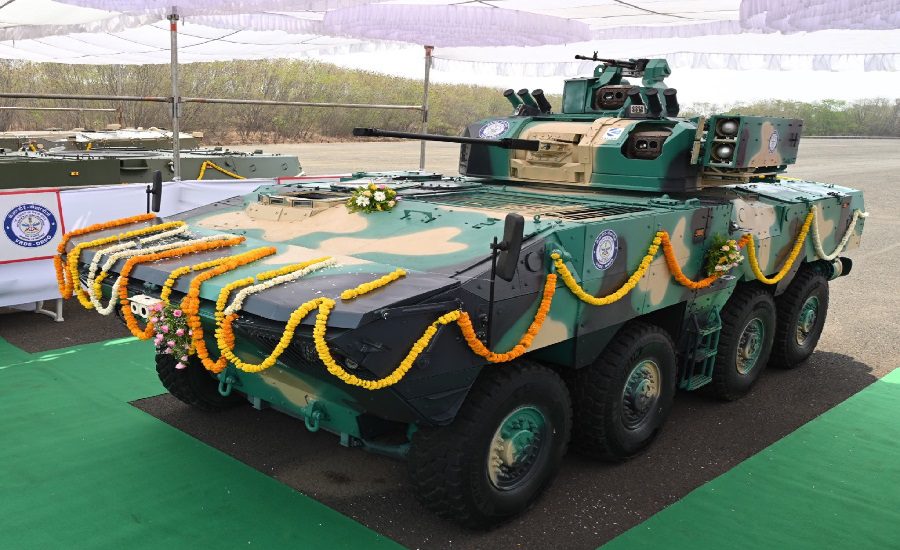
New Delhi: India’s Vikram VT-21 has reached a major milestone by achieving STANAG Level 5 protection, marking a significant step in indigenous defence innovation.
Developed as part of India’s effort to modernize its ageing BMP-2 fleet, the Vikram VT-21 showcases advanced composite armour technology designed within the country.
This achievement highlights India’s growing capability in building high-protection, lightweight combat vehicles using homegrown solutions under the DRDO ecosystem.
Details of Vikram VT-21
India is steadily reducing its dependence on foreign military technology. The Vikram VT-21 is a clear example of this shift.
The vehicle has been developed as a next-generation tracked combat platform. It is intended to replace Soviet-era BMP-2 vehicles currently used by the Indian Army.
According to the official updates, the vehicle has successfully met STANAG Level 5 protection standards, which means it can withstand high-intensity threats such as heavy ballistic impacts and explosive blasts.
What is STANAG Level 5 Protection?
STANAG standards are defined by NATO to measure protection levels of military vehicles.
- Level 5 protection ensures resistance against:
- Large-calibre armour-piercing rounds
- High-intensity blast effects
- It represents one of the highest protection levels for infantry combat vehicles
Achieving this standard is not easy, especially while maintaining a low vehicle weight.
Indigenous Composite Armour: The Key Breakthrough
The biggest success behind Vikram VT-21 is its fully indigenous composite armour system.
This system was developed by the Combat Vehicles Research and Development Establishment (CVRDE) under DRDO.
Materials Used:
- Glass Fibre Reinforced Plastic (GFRP)
- Carbon Fibre Reinforced Plastic (CFRP)
- PVC foam core structures
- Aluminium foam
- Aluminium honeycomb
These materials are layered strategically to absorb and disperse energy from impacts.
Vikram VT-21: Advanced Manufacturing Using VARTM
The armour panels were produced using Vacuum Assisted Resin Transfer Moulding (VARTM) technology.
Why VARTM is Important:
- Eliminates air gaps and structural weaknesses
- Improves strength and durability
- Ensures uniform quality
- Reduces production cost
India has built this manufacturing capability completely in-house, which is a major achievement.
Lightweight Yet Highly Survivable
One of the biggest challenges in armoured vehicle design is balancing weight and protection.
The Vikram VT-21 solves this problem effectively.
- Total weight remains under 25 tonnes
- High survivability against battlefield threats
- Improved mobility and speed
- Easier transportability
This makes the vehicle suitable for both land combat and amphibious operations.
Cost-Effective Defence Innovation
Another key highlight is the cost efficiency of this project.
- VARTM facility setup cost: approx. ₹3.1 lakh
- Complete composite panel suite: approx. ₹19.7 lakh
In the global defence sector, such advanced armour systems usually cost much more. This shows India’s strength in frugal engineering.
Firepower and Combat Capabilities
Despite its lighter structure, the Vikram VT-21 does not compromise on firepower.
It is expected to be equipped with:
- 30mm cannon (crewless turret)
- Anti-Tank Guided Missiles (ATGM)
- Advanced targeting and surveillance systems
This combination makes it a strong battlefield asset.
What is the Importance of Vikram VT-21
The Vikram VT-21 is part of the Advanced Armoured Platform (AAP) programme.
Why it matters:
- Replaces outdated BMP-2 fleet
- Strengthens “Make in India” in defence
- Enhances operational readiness
- Reduces import dependency
This development is crucial for future mechanised warfare capabilities of India.