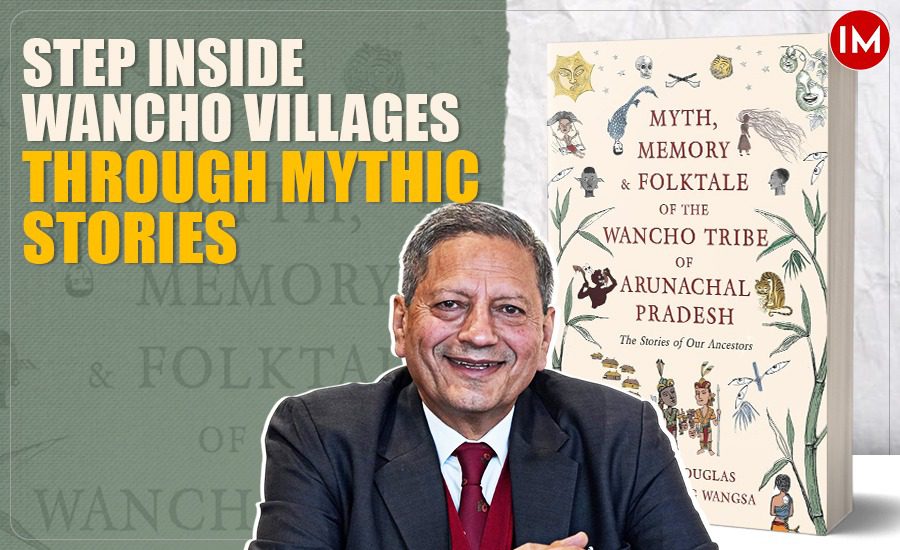
Niyogi Books has done a commendable job of publishing a fine, illustrated book, replete with QR codes featuring videos of Wancho songs to give the reader an actual feel of being in one of the remote Wancho villages. This includes Kamhua Noknu, Nysia, Longchan, Nyinu, Jagan, and Kaimoi with the storytellers Jatwang Wangsa, Wangjay Losu, Ganchai Wangsa, Paman Pansa, Hokai Wangsa, Ngamchai Wangsa, Wangchan Losu, Phawang Wangham, Tangkaam Phe-am, Chailai Pansa, Panmai Pansa, Gampang Pansa, Tochai Wangham, and Nyaiwang Wangsa. The book under review this week, Myth, Memory & Folktale of the Wancho Tribe of Arunachal Pradesh: The Stories of Our Ancestors by Tara Douglas and Jatwang Wangsa, is on the VoW Longlist for Young Adults!
What gives VoW and this reviewer even greater pleasure is the fact that both endorsements on the back cover are also by distinguished authors who have been on VoW’s select list in 2022 and 2023, respectively. Anvita Abbi’s book, Voices from the Lost Horizon, on the near-extinct languages of the Greater Andaman Islands, is now widely regarded as a classic. She writes, ‘This book happens to be the first ever documenting the oral wonders of the Wancho community. Amazing fluidity flows between the myths, fables, folktales, and oral history that inform us of their beliefs, values, migration, history, sustenance, and vitality as narrated by the members to Tara Douglas and Jatwang Wangsa.’ Peggy Mohan, the well-known linguist and the author of Wanderers, Kings, Merchants: The Story of India Through Its Languages (VoW shortlist) and Father Tongue, Motherland: The Birth of Languages in South Asia, says, ‘One gets a sense of field notes, which includes asides by storytellers and pictures of the way things were not so very long ago in the Wancho tribe. One goes along, hearing about ghosts, with no disclaimers, and in a sense is drawn into the way these old storytellers saw the world.
Let’s begin by sharing with the readers the geography and demographics of the Wancho tribe. This population of 58,866 souls is spread over 144 villages, of which 73 are located in the Longding and Tirap districts of Arunachal, 39 in Nagaland, 4 in Assam, and 23 across the Myanmar border. They are making the transition from subsistence farming to an active engagement with the market economy. Their belief system, in which ‘consciousness and sentience are not the exclusive preserve of the ‘homo sapiens’ but extend to other animals and plants and geographic features such as mountains and rivers, as also our ancestors and other sublime energies of the natural world,’ is under threat from the growing influence of Christian outreach from the surrounding districts. However, as Tara Douglas points out, while they do share some affinities with the Konyak (Naga), they are quite firm in asserting their own identity and do not wish to have the ‘Naga’ tag associated with them.
The trope that places the Wancho as a head-hunting warrior tribe can be traced to the single recorded history of the Nyinu massacre of 1875, in which 80 members of a survey party were killed in a surprise attack. After this, the area was declared excluded, and they were left largely to their own devices. Even the missionaries who reached the last of the Naga villages and the highlands of Manipur were advised to keep a safe distance from them. This is how many of the stories have been preserved.
Let’s now delve into the thirty-three stories spread over eight sections: mythological, folk tales, migration and war, of villages and their relationships, tales of doomed love, stories of the ‘hunt,’ acts of exceptional bravery, mankind and the animal world, and last, but not least, fables connected with flying foxes, cobras, porcupines, and tortoises. I will exercise my discretion in choosing one tale from each section to share a representative sample from each – a tough task, but one that has to be done, for a review, by its very nature, is an invitation to read the full-length book.
We begin with the mythological tale of how God settled the earth. The two brothers, Ganghan the elder and Katgong the younger, came to occupy the realms of the sky and the earth, but finally the younger Katgong stayed in heaven and became the God, while the elder Ganghan became the leader of the people. The folk tale of Cicada (nyonu) is about two sisters, Chujas, the lazy elder, while Mangling, the younger, worked hard in the millet fields. While taking turns on the swing, Chujas pushed the younger one so hard that she could not come down to save her baby, who was attacked by the crows and vultures, and she let out the cry Koiye Koiye—the call of self-pity.
In stories of migration and war, we learn about how the Kamhua Noknu village was settled because of the kam (blue beads) and hua (valley), the valley of blue beads. In the section on inter-village relationships, The War between Kaimoi and Lanu – narrated from the perspective of Kaimoi—we learn how the warrior Wangsai Chingtan cut the right lobe of each of his victims to identify the ‘heads’ hunted by him: they came to a total of 160, and each was buried under a stone.
The tragic love story of Wakka village is about the Phading Pansa, who chose to jump off a cliff to be with her true love, Gannat Gangsa, rather than accept the advances of the village chief. The brave heroes of Kamoi—Pongki and Chanyai—showed exceptional courage in killing a tiger, and their daring made everyone believe that they indeed had special magical powers. The story of Tiger, Man, and Cicada takes us back to a time when Tiger (Cha-nu/Tha-nu Pa) and Man were friends and shared everything, but only the tiger knew how to start a fire. Man sought the help of Cicada to probe Tiger’s secret, but in a strange twist to the tale, Tiger started eating raw meat but warned Man that if he ever told a lie, his dead body would be devoured by the tiger. These were the times when tigers roamed the wild in abundance, and the Christian practice of burying the dead had not taken strong root. The last story is about the competition between the python (pinu) and cobra (pujam) on who was more poisonous. Cobra emerged as the winner, and from that day, the python gave up its poison forever!
Before closing, one has to acknowledge the illustrators Srijit Gupta, Ishita Suvartha Nandy, Choimai Pansa, Manlem Losu, Phenym Losu, Kamjuing Losu, Phoway Losu, Akanksha Sharma, Pratham Sharma, Mikhel Mathews, and Mathees and the Shrishti Manipal Institute of Art Design and Technology, besides, of course, Tara Douglas herself for conceptualising this wonderful idea of juxtaposing the text with pictures with which the young readers can truly engage.
Welcome to the world of Wancho!