Climate change has wrecked havoc on our forests, the most obvious one being the forest fires all across the globe, taking animal lives, rendering the survivors homeless, and destroying properties on the fringes. The scary part is, once a fire starts in the forest, it is difficult to control it, and it completely destroys the ecological cycle.
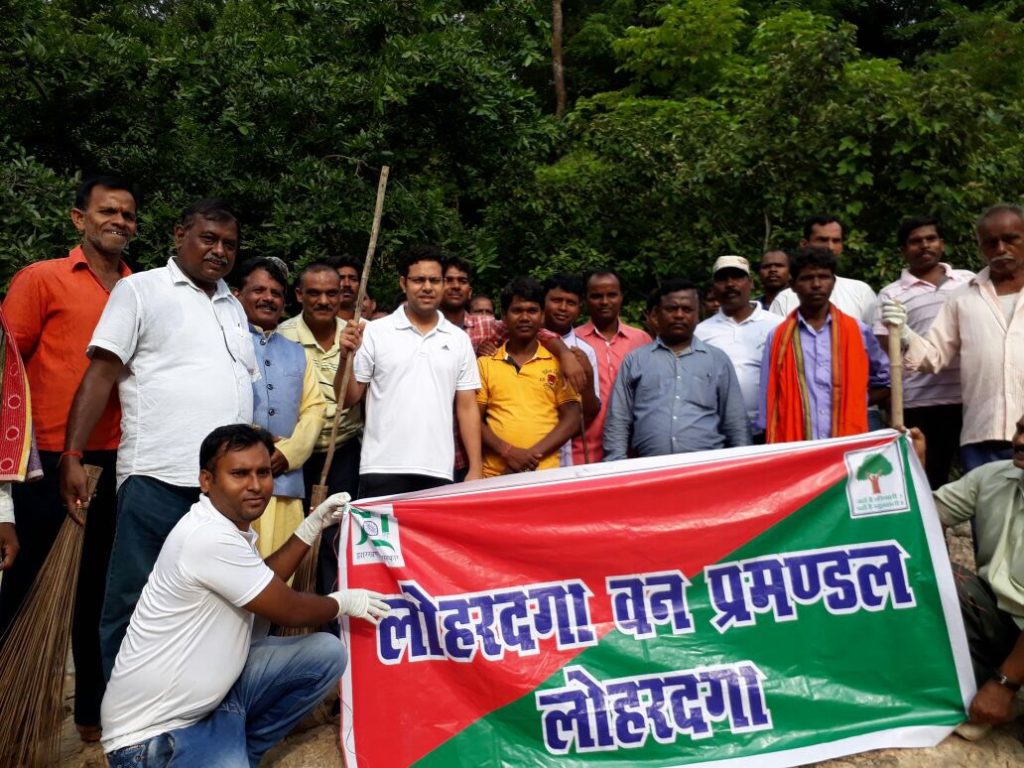
In Jharkhand, the forest fire season is from March to June. A 2014-batch Indian Forest Service officer, Vikas Ujjawal, devised a plan to prevent it by involving the community at his place of posting – Lohardaga in Jharkhand, which has the wide Kuru range along with its 6000 hectares of forests. This forest division is crucial for the water security of the state as three major rivers – Damodar, Auranga and Sankh – flow through it.
During a conversation with Indian Masterminds, Mr. Ujjawal spoke about the reasons behind the breaking out of forest fire, and the economic model his team devised to control it.
THE ALARM
In April 2019, there was a huge fire in Tisiya forest which is the habitat of many species including the sloth bear. When the fire broke out on 19 April, some bears came out of the forest and started restlessly moving around the villages early in the morning. This created several human-animal conflicts and resulted in the death of two people and left several others injured. This incident set off an alarm for everyone. Mr. Ujjawal said, “We decided to analyse the reasons why these fires happen and tried to take some preventive steps. Generally, all the process of rescue or rehabilitation happens after the fire. We wanted to make an effort and control the fire before it ignites.”
His team started analysing the data provided by the fire alarm system monitored by the Ministry of Environment, Forests and Climate Change, which issue warnings to all the divisions. The data of around 5-6 years were analysed and the team also looked into the traditional method of reporting any fire.
It was found out that while the whole region witnesses severe to moderate fire incidents, the Tisiya forest was a hotspot. They did a sample survey to find out why some forests burn more and some less. “We got to know that Tisiya was a pure Sal forest and average leaf littering was 3000 kg per hectare in the area.”
WHY FOREST FIRE OCCURS
Explaining the necessary conditions for a fire to ignite, Mr. Ujjawal said, “There are three components needed for fire i.e. heat, oxygen and fuel. While one can’t control the first two, the availability of fuel (majorly the dry fallen leaves) can be contained.”
Although the forest litters are essential for soil formation, seed germination, moisture, microbes, etc., they are also the reason fire breaks out every year, leaving no biomass available on the forest floor to perform any of the functions. Instead, the forest fire converts these forests from carbon sink to net carbon emitter. So, under the leadership of Mr. Ujjawal, the department devised a plan to collect the fallen leaves.
THE PLAN
He said that unlike other departments, they don’t have the luxury of resources to hire people. Also, the community they deal with is largely dependent on forest and live from hand to mouth. So, they need livelihood opportunity to be of any help. “We educated the people as to why it is important to stop those fires. It was disturbing their ecology and animal conflicts were the outcome of the fires. We convinced them to collect the leaves.”
PROVIDING ECONOMIC OPPORTUNITIES
The next problem was, what to do with those leaves. The forest department started a briquet plant in the region with few machines. Briquets are basically artificial wood that are converted from dry leaves. The hammer-based machines powder the dry leaves and punch them into a shape of brick. “We started providing 2-3 rupees per kg of leaves to the people who came with them. We also made sure that they don’t bring any timber. All the briquets were then sold to nearby factories and plants for fuel.”
The plant not only provided livelihood to around 400 people in 13 villages, but also stopped the illegal cutting of timber.
It has been three years now and the forest division has not witnessed any big fire. Mr. Ujjawal is now working to explore this model further and take it to other areas as well.
“The initiative has also helped us to create eco-tourism sites with the help of the community. Some 30-40 people are engaged on a permanent basis and numerous people are indirectly benefitted from the activities. The community provided security, protection and cleanliness and all other services required for an eco-tourism site,” he said.