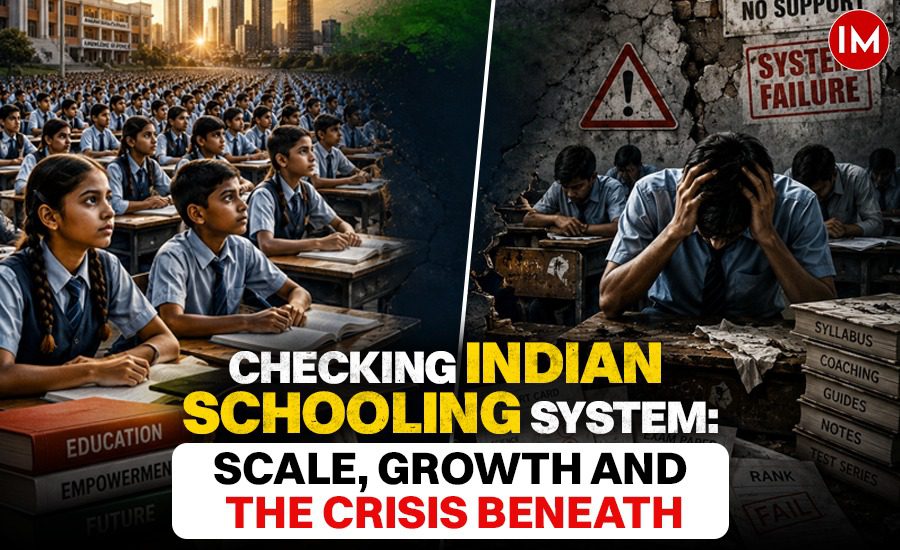
Indian education system has reached the limits of expansion but the evidences from latest UDISE+, ASER 2024, the Economic Surveys, and independent analyses points to persistent crisis. At present, it appears that there is an overemphasis on policy inputs rather than outcomes, presence of persistent inequalities across States, and weak classroom processes. No doubt, India has successfully expanded access to schooling on an unprecedented scale, but the next phase of reform must focus on learning quality, teacher effectiveness, and governance reform at the State level. The ‘Reality Check’ here, mirrors the outcomes from various reports at a very broad yet magnified criterias.
Education and Economy: Growth Without Proportionate Learning Gains
The education sector has changed into a major economic pillar, valued at U.S.D. 117 billion in 2023 and projected to reach U.S.D. 313 billion by 2030, showing sustained expansion driven by demographics, policy push, and private investment. Yet, public expenditure on education continues to remain around 4-4.5% of GDP, significantly below the long-standing 6% target. This gap is particularly consequential for school education, which relies heavily on public provisioning.
India’s demographic advantage, with nearly 26% of the population under 14 years, intensifies the urgency of aligning economic growth with educational quality. The rise of private schooling and edtech has added to the sector’s economic dynamism but has also deepened inequalities, as access to quality increasingly depends on affordability. This creates a dual reality where education thrives as a market but struggles as a public good. The central challenge, therefore, lies in bridging the gap between economic expansion and learning outcomes, ensuring that investment leads not just to growth, but to measurable improvements in human capability.
Also Read – Omkareshwar Temple Offers VIP Darshan for Blood Donation; Khandwa Collects 1,800 Units
System of Massive Scale and Uneven Outcomes
India’s school education system operates at an unprecedented scale, serving 24.8 crore students across 14.72 lakh schools with over 1.01 crore teachers, as per UDISE+ 2024-25. While this scale is often celebrated, it silently points towards buried administrative and structural challenges. Large States such as Uttar Pradesh and Bihar face immense pressure due to population size, with Bihar alone accommodating over 2.11 crore students across nearly 94,000 schools, resulting in overcrowded classrooms and stretched resources. In contrast, smaller States like Himachal Pradesh demonstrate better per capita access but often operate a large number of small, under-enrolled schools, leading to inefficiencies.
These disparities show that Indian education system is not a single uniform entity but a collection of State-level systems shaped by geography, governance capacity, and socio-economic conditions. National policies often struggle to deliver uniform outcomes due to this diversity. The scale of the system amplifies both strengths and weaknesses, while it enables widespread access, it complicates governance and implementation. As a result, outcomes vary significantly across states, making decentralised, context-specific approaches essential for meaningful reform.
Access Achieved, Retention Fragile
India has made substantial progress in ensuring universal access to education, with enrolment among children aged 6-14 reaching 98.1% in 2024, termed as a sustained success in expanding schooling opportunities. However, this achievement does not extend beyond the elementary level. The Gross Enrolment Ratio declines sharply to around 77-78% at the secondary stage and further to nearly 56% at higher secondary, indicating significant attrition as student’s progress. Dropout rates reinforce this trend, rising from 1.9% at primary level to 14.1% at secondary level, pointing to weaknesses in retention.
India has also made progress toward gender parity, with girls accounting for 48.3% of enrolment and women comprising over 54.2% of the teaching workforce. However, disparities persist at higher levels of education. In states such as Madhya Pradesh, Rajasthan, and Uttar Pradesh, more than 10% of adolescent girls remain out of school. While entry-level parity has been achieved, retention and transition remain uneven.
States such as Rajasthan, Madhya Pradesh, and Uttar Pradesh continue to report higher dropout rates, driven by poverty, gender norms, and early entry into the workforce. Even in relatively advanced States like Maharashtra, dropout rates remain concerning, with over 12% of boys and 10% of girls leaving school during secondary education. These patterns reveal that while access has been achieved, continuity remains a dream for many. The transition from elementary to secondary education emerges as a critical bottleneck, requiring targeted interventions focused on adolescent retention, financial support, and social awareness.
The Learning Crisis: System’s Deepest Faultline
The most significant challenge in India’s schooling system is the persistent gap between schooling and learning. ASER 2024 data shows that only 23.4% of Class 3 students can read a Class 2-level text, while 44.8% of Class 5 students meet this benchmark, indicating widespread deficits in foundational literacy. Arithmetic outcomes are equally concerning, with only 33.7% of Class 3 students able to perform subtraction and 30.7% of Class 5 students capable of division. These figures suggest that a majority of children progress through the system without acquiring basic skills.
The problem lies not only in curriculum but in pedagogy, assessment practices, and classroom engagement. States such as Kerala, Punjab and Himachal Pradesh consistently outperform others, while Bihar and Uttar Pradesh lag significantly. The continued dominance of rote learning further limits conceptual understanding and critical thinking. Although post-pandemic recovery has improved some indicators, these gains remain marginal relative to the scale of the problem.
Early Learning Gains, but Uneven Foundations
Early childhood education has improved, with enrolment among three-year-olds increasing from 68.1% in 2018 to 77.4% in 2024. However, this progress is uneven across States. In regions like Uttar Pradesh and Meghalaya, a significant proportion of children remain outside formal early education systems. ‘Anganwadi’ centres play a crucial role in delivering early childhood services, especially in rural areas, but variations in quality, infrastructure, and integration with formal schooling persist. States such as Tamil Nadu have made notable progress in integrating early childhood education with primary schooling, improving school readiness.
However, in many regions, early education continues to focus more on nutrition than on cognitive and socio-emotional development. These gaps have long-term implications, as children who enter school without foundational skills struggle to keep pace with the curriculum. Early deficits tend to compound over time, contributing to the broader learning crisis observed in later grades.
Teachers: Rising Numbers, Persistent Structural Gaps
India’s teaching workforce has expanded significantly, crossing the 1 crore mark, yet challenges persist. Over 1.04 lakh schools continue to operate with a single teacher in the country, serving more than 33 lakh students, highlighting serious distribution issues. In Maharashtra alone, more than 8,000 single-teacher schools cater to over 1.5 lakh students, while states like Haryana continue to experience localised shortages despite acceptable overall ratios.
Multigrade classrooms are widespread, particularly in hill and northeastern regions, affecting instructional quality and student engagement. Teacher training and pedagogical practices remain uneven, with limited focus on continuous professional development. The issue is no longer simply about teacher numbers but about deployment, capacity building, and classroom effectiveness. Without addressing these structural gaps, improvements in teacher availability are unlikely to translate into better learning outcomes.
Infrastructure Expansion, but Weak Translation into Outcomes
Infrastructure in Indian schools has improved steadily, with increased access to basic facilities such as toilets, drinking water, and digital tools. More than 60% of schools now have access to computers and internet connectivity, indicating progress in digital infrastructure. However, utilisation remains limited, and only about 55% of schools are fully accessible, pointing to gaps in inclusivity. In urban centres like Delhi, infrastructure struggles to keep pace with enrolment, with 44.9 lakh students across just 5,556 schools, leading to overcrowding.
Southern states such as Kerala and Tamil Nadu have achieved near-universal infrastructure coverage, while states like Bihar and Jharkhand continue to lag behind. The key challenge lies in translating infrastructure gains into improved learning outcomes, as the system continues to prioritise inputs over educational impact.
Inequality and the Rise of Parallel Schooling Systems
India’s schooling system is increasingly characterised by inequality, with a growing divide between government and private institutions. Government schools account for 69% of institutions but only about half of total enrolment, while private schools, comprising just over 22% of institutions, enrol nearly one-third of students. This shift is particularly evident in states like Punjab, Haryana, and Uttar Pradesh, where rising aspirations and declining trust in public education have driven parents toward private options.
At the same time, nearly 8,000 schools report zero enrolment, and about 18,700 government schools have declined over five years, reflecting consolidation and inefficiencies. These trends indicate the emergence of a dual system, where public schools increasingly serve disadvantaged populations, while private schools cater to those who can afford better quality.
Digital India vs Digital Divide
The expansion of digital access has transformed the education on a very large scale, with around 90% of adolescents having access to smartphones and over 82% able to use them, says latest NITI Ayog report. However, only about 57% use these devices for educational purposes, while the majority engage with social media and entertainment. Gender disparities persist, with lower access among girls, and state-level differences further widen the gap. States like Kerala and Karnataka demonstrate better integration of digital tools, while Bihar lags behind.
These trends highlight that access alone is insufficient without effective pedagogical integration. Without structured digital learning frameworks, technology risks reinforcing existing inequalities rather than bridging them.
PM POSHAN scheme remains one of the largest social interventions globally, providing cooked meals to over 10-12 crore children. Recent data give the real picture, that only about 10.32 crore children (41.8% of total enrolled students) are actually covered, leaving nearly 14.4 crore children outside the programme, including those in private schools. This show a critical limitation: despite universal intent, coverage is far from universal.
Mid-Day Meal (PM POSHAN): Scale, Gaps and Nutritional Realities
Financially, the programme operates with a central outlay of I.N.R. 54,061 crore (2021-26) along with State contributions, but utilisation gaps persist, with reports showing significant under-spending (only ~₹5,421 crore spent by Feb 2025 against allocations). Another major concern is shrinking institutional reach, with schools covered under the scheme declining from 11.19 lakh to ~10.35 lakh in last five years, showing consolidation, enrolment decline, and administrative restructuring. This is compounded by falling government school enrolment in large States like Uttar Pradesh (-21.8 lakh), Bihar (-6.1 lakh), and Rajasthan (-5.6 lakh), reducing the scheme’s effective impact base.
State-level disparities define outcomes. Southern states such as Tamil Nadu and Karnataka have relatively stronger systems with better menu diversity and centralised kitchens, while Uttar Pradesh and Bihar rely heavily on cereal-based meals with weaker monitoring. At the same time, innovative models in Meghalaya using local and indigenous foods have shown improved child nutrition and attendance, with over 92% children reaching healthy weight levels in pilot areas, indicating the potential of decentralised, nutrition-sensitive approaches.
Another emerging issue is nutrition quality distortion, where attempts to increase calories sometimes lead to high-sugar or low-quality substitutes, such as energy bars, raising concerns about long-term health outcomes like childhood obesity and diabetes. Simultaneously, menu redesigns in states like Gujarat and urban centres indicates a shift toward health-conscious, diversified diets, including millets and pulses, but implementation remains uneven.
Learnings from the Best: Indian Schools in World’s Best School Prizes 2026
Recently, India has marked a milestone in global education with seven schools shortlisted in the Top 10 across categories in the World’s Best School Prizes 2026. This achievement places India at the forefront of global school education this year but also signals a shift in how Indian schools are being recognised internationally, not merely for scale, but for innovation, impact, and community engagement. There are various learnings that can be set as examples from these internationally recognized schools.
The awards, instituted by T4 Education, evaluate schools across five key categories, Community Collaboration, Environmental Action, Innovation, Overcoming Adversity, and Supporting Healthy Lives, aiming to highlight institutions that are transforming education beyond classrooms. The selection process involves a global pool of entries, with shortlisted schools representing the top tier of innovation-driven education models worldwide.
A closer analysis suggests that these schools share certain common characteristics. These include strong community engagement models, integration of technology in learning, focus on sustainability, and inclusive education practices. Unlike traditional metrics that emphasise exam performance, these awards prioritise real-world impact, such as improving student well-being, addressing local challenges, and fostering innovation ecosystems within schools.
The recognition also highlights the growing role of public and low-cost schools in global excellence narratives. In previous editions, Indian government and affordable private schools have been acknowledged for delivering high-impact outcomes despite resource constraints, emphasizing the idea that innovation in education is not limited to elite institutions. From a policy perspective, this global recognition upticks India’s broader push under the National Education Policy (NEP) 2020, which emphasises holistic education, experiential learning, and competency-based outcomes.
Also Read – The 5 am IAS Officer Who Transformed An Entire City