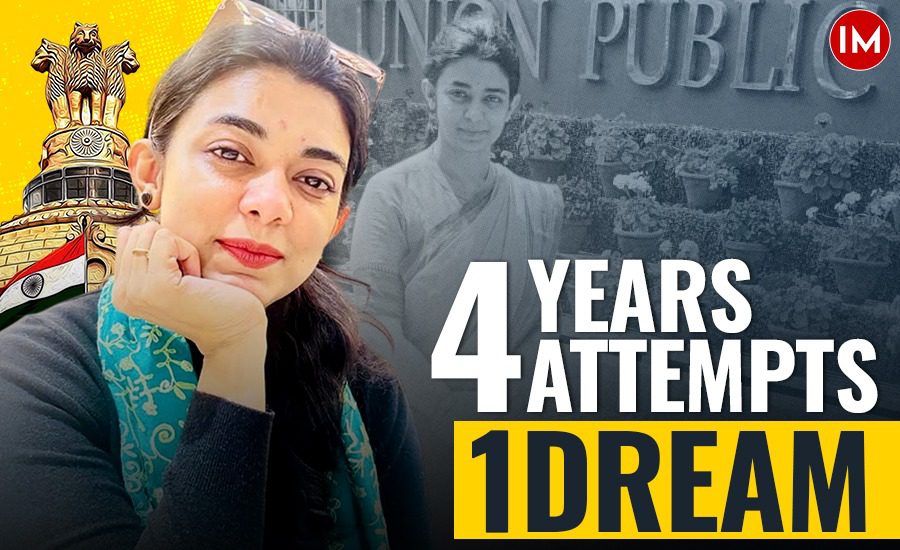
In the world of competitive examinations, few journeys capture the process of learning, unlearning, and evolving as clearly as that of Rupal Rana, a young woman from Baghpat, Uttar Pradesh, who secured All India Rank 26 in the UPSC Civil Services Examination 2023 on her fourth attempt. Her story reflects how disciplined effort, thoughtful strategy, and self-awareness can turn repeated failures into lasting success.
Rupal grew up in Baghpat, completing her schooling there till Class 10 before moving to Pilani, Rajasthan, for Classes 11 and 12. She later pursued Mathematics Honours from Delhi University, where her logical and analytical strengths flourished. But during her second year of college, she discovered the Civil Services Examination—a turning point. “I wasn’t aware of this exam before,” she recalls. “But when I learned about it, I felt my efforts in academics weren’t giving me the satisfaction I craved. I wanted to challenge myself and excel in everything.”
That decision set her on a completely new path. Coming from a science and mathematics background, she suddenly found herself immersed in subjects like polity, history, and current affairs—fields she had left behind years ago. What followed was a four-year-long preparation journey, filled with trial, error, and continuous improvement.
EARLY ATTEMPTS AND LESSONS LEARNT
Rupal’s first three UPSC attempts ended at the prelims stage. Each attempt taught her something new about the exam—and herself. “In my first attempt, I wasn’t prepared at all,” she admits. “I had only read Laxmikanth and gave the exam just to ‘see what happens.’ I wasted that attempt.”
In her second and third attempts, she approached the paper cautiously, attempting only 71 and 78 questions, respectively. “I was afraid of negative marking and thought if I don’t know something, I won’t take the risk. That was a big mistake,” she says. Despite studying hard, she realised that her method of attempting fewer questions was holding her back.
After her third attempt, she decided to reassess her entire strategy. “I had read all the books and followed current affairs, but I wasn’t analysing the paper the right way,” she explains. She began to study previous year question papers (PYQs) to understand how UPSC framed questions. This analysis gave her clarity on how to approach the exam more intelligently.
She also changed her test-taking style—attempting 90+ questions in mock tests. Over time, her mock scores improved consistently. This change made all the difference in her fourth attempt. “Even though the prelims pattern changed that year, I attempted 94 questions and scored 23 marks above the cutoff,” she says with a quiet smile.
THE STRATEGY BEHIND THE SUCCESS
Rupal’s success came from refining her process rather than reinventing it. Her advice to aspirants is simple yet crucial: limit your sources. “There’s a tendency to chase new resources for more knowledge, but this causes you to forget what you’ve already studied,” she says.
“Revise one book multiple times rather than reading many books once,” she advises.
For mains, her approach was built around quality notes and PYQs. “You need one to two pages of good content per topic,” she explains. She structured her notes around problems, issues, and solutions, enriching them with examples from current events.
For Ethics (GS Paper 4), she referred to coaching notes and often used examples from the Ramayana, Mahabharata, and Gandhi’s writings to support her answers.
Her optional subject was Political Science and International Relations (PSIR)—a deliberate choice. “Many suggested Mathematics since I had a background in it, but it required a master’s-level understanding and wouldn’t help with GS,” she says. For PSIR she read The Indian Express, and The Hindu. She also followed interviews of the External Affairs Minister for insights into foreign policy questions.
RISING ABOVE PERSONAL LOSS
Just two months before her interview, tragedy struck—Rupal lost her mother suddenly, leaving her devastated. “It was a huge personal loss, and I wasn’t in my senses for days,” she says. But the dream she had nurtured for years—and her mother’s faith in her—pushed her to continue. “I gathered the courage to prepare the best I could.”
She prepared for her interview with complete sincerity, attending 14 mock interviews and interacting with retired IAS officers to polish her responses. Her preparation was based on two principles: a well-prepared DAF (Detailed Application Form) and strong current affairs awareness through The Hindu and The Indian Express.
“Be very honest in your DAF,” she advises. “Interviewers can immediately sense if you’re bluffing.”
Her honesty and composure impressed the board. The 30-minute interview covered topics from PSIR to mathematics and her college, Ramanujan College. She scored 201 marks—a reflection of her knowledge and clarity.
KEY PILLARS OF HER PREPARATION
Rupal identifies four key factors that shaped her journey:
- Limit Your Sources: Rely on a few authentic books and revise repeatedly.
- Mock Tests: Test yourself regularly and learn from mistakes.
- Previous Year Questions: Study PYQs to understand UPSC’s question framing.
- Consistency: Maintain discipline every day, even during setbacks.
She also emphasises note-making as a non-negotiable habit. Her prelims notes contained quick facts, while her mains notes were theme-based, and her interview notes covered her district, hobbies, and major current topics.
STAYING MOTIVATED AND BALANCED
When asked how she stayed motivated during four long years of preparation, she says, “You need to know why you want to be in the services.” Her parents were her biggest inspiration, especially her mother. “She believed in me even when I doubted myself,” Rupal shares.
To prevent burnout, she took short daily breaks and allowed herself one or two rest days a month. “You can’t study continuously. Take breaks, talk to your family, have tea with them—it keeps you grounded.” Her preparation schedule was anchored in daily and monthly targets, using early morning hours for the most challenging subjects.
A MESSAGE TO ASPIRANTS
Rupal believes that confidence grows from knowledge. “If you have knowledge, you can talk confidently about any topic,” she says. Her calm, self-assured communication helped her shine in the interview stage.
Her advice to aspirants is both practical and heartfelt: “Trust yourself, trust your strategy, and be consistent in your hard work. It’s easy to get distracted or doubt yourself, but self-confidence is key.”