For decades, the story of Uttar Pradesh (UP) was one of unrealised potential. As India’s most populous state, it was often viewed through the lens of its demographic weight rather than its economic velocity. But if you stand on the median of the newly minted Ganga Expressway or watch the sunset over the Bundelkhand high-speed corridor, you aren’t just looking at bitumen and concrete. You are witnessing the literal paving of a $1 trillion economy.
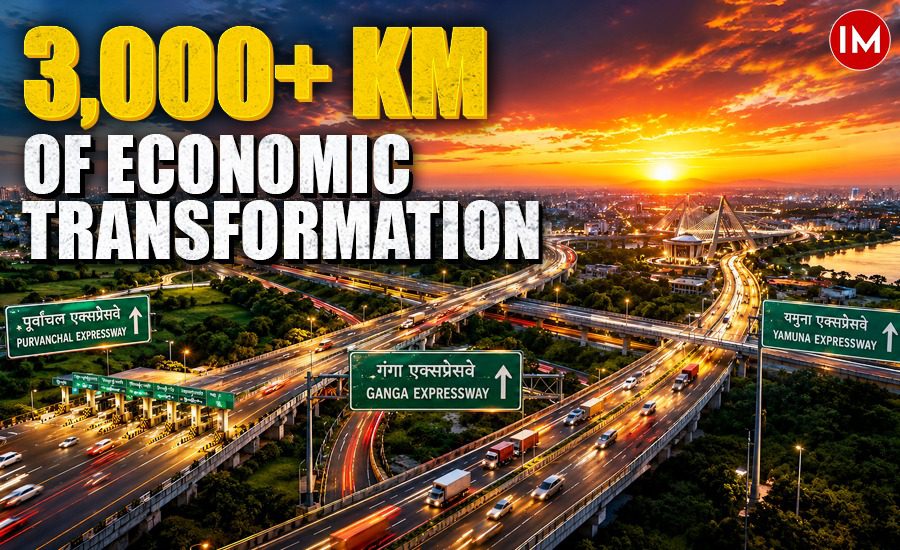
Over the last decade, Uttar Pradesh has undergone a metamorphosis so radical that it has earned a new name: The Expressway State. From a meager 93 km of access controlled roads in 2014 to a staggering 3,052 km in 2026, a growth of over 3,180%. UP has utilized road infrastructure not just as a means of transport, but as a primary engine of tectonic economic shift.
The Speed of Commerce: Breaking the Time Barrier
In the world of economics, time is a non-negotiable currency. Before 2017, traveling from the eastern fringes of Ghazipur to the national capital was a grueling 15-to-20-hour ordeal. Today, the Purvanchal Expressway has slashed that to roughly 10 hours. Similarly, the Ganga Expressway, nearing total completion, is set to bridge Meerut and Prayagraj in just 6 hours, down from 11.
Also Read – Swetha Chhoriya Driving People-Centric Governance in Railways
This isn’t just about passenger comfort; it’s about the Logistics Efficiency Ratio. High-speed corridors reduce fuel consumption by an estimated 30% and dramatically lower the maintenance costs of heavy-vehicle fleets. For a landlocked state like UP, these expressways act as virtual coastlines, connecting inland manufacturing hubs to the ports of western and eastern India with unprecedented velocity.
The Multiplier Effect: Beyond the Toll Gates
The true genius of UP’s infrastructure model lies in its integration. The state isn’t just building roads; it is building Industrial Ecosystems. Under the Triple S framework; Safety, Stability, and Speed, the government has mapped 27 industrial parks and clusters along these 22 operational and planned expressways.
- The Defence Industrial Corridor: The Bundelkhand Expressway is the backbone of India’s push for “Aatmanirbharta” in defense. By linking Jhansi and Chitrakoot to the global supply chain, a region once synonymous with drought and migration is now hosting manufacturing units for aerospace and arms.
- ODOP and Global Reach: The One District One Product (ODOP) initiative has found its wings through these roads. A leather craftsman in Kanpur or a perfume maker in Kannauj now has a direct, highspeed link to the Integrated Industrial Townships in Greater Noida, making the transition from local craft to global export a logistical reality.
Real Estate and the “Urban Pull”
The economic landscape is also shifting through Reverse Urbanization. Historically, wealth was concentrated in the NCR bubble. Today, the Yamuna Expressway and the Agra-Lucknow Expressway have democratized development. We are seeing a real estate explosion in Tier-2 and Tier-3 cities. In Delhi’s backyard, areas like the Freedom Fighters Enclave and IGNOU Road are seeing renewed interest as the commute-to-work radius expands, while cities like Lucknow and Gorakhpur are emerging as independent economic magnets.
The $1 Trillion Roadmap: By the Numbers
The fiscal impact is undeniable. UP’s Gross State Domestic Product (GSDP) is projected to reach ₹39.8 lakh crore for 2026-27, a blistering 28% growth over previous estimates. This is supported by an investment pipeline worth over Rupees 50 lakh crore.
A New Template for Federal Growth
What Uttar Pradesh has achieved in a decade is a masterclass in infrastructure-led development. By prioritising the last mile and first mile through a web of link roads and spurs, the state has ensured that the benefits of the 6-lane highways trickle down to the smallest village mandis. Farmers can now transport perishable dairy and produce to urban centers in half the time, doubling their shelf-life and market value.
As the Noida International Airport at Jewar nears its operational peak, the synergy between air and road will create a multimodal hub that rivals the best in Southeast Asia.
The UP Model proves that infrastructure is the most potent antidote to poverty. By investing nearly a trillion rupees into these corridors, the state has not just built roads; it has built a bypass around the bureaucratic and geographical bottlenecks of the past.
Uttar Pradesh is no longer a state that India passes through; it is the state where India’s economic future is being built. The roar of engines on the Purvanchal Expressway is the sound of a giant waking up, and this time, it has the horsepower to lead the nation.
Also Read – A Poet in the Corridors of Power: How Tushar Dhawal Singh Kept Poetry Alive Inside Bureaucracy