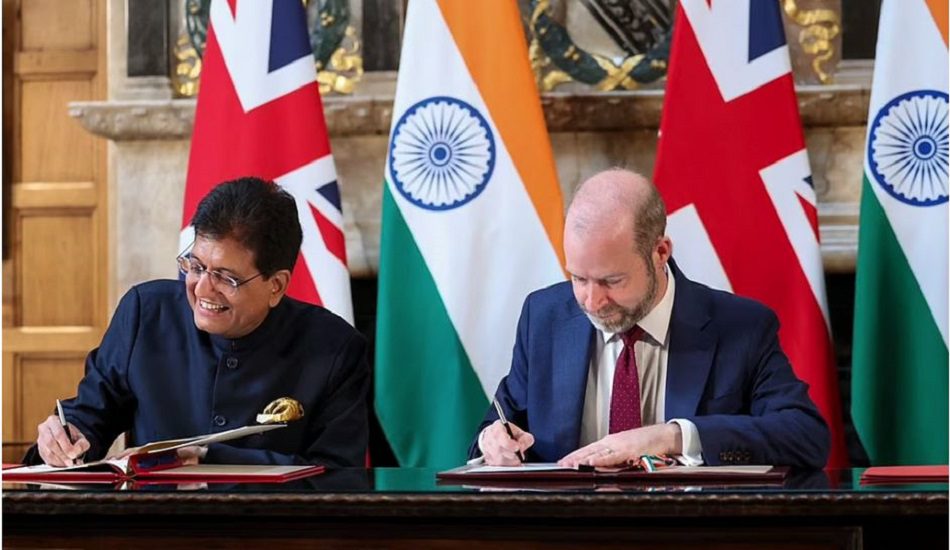
The India-Britain Comprehensive Economic and Trade Agreement (CETA), along with the Double Contribution Convention (DCC) on social security, will officially come into force on July 15, marking a major milestone in bilateral ties. The agreement is expected to deepen cooperation across trade, technology, investment, defence and clean energy while opening new opportunities for businesses and professionals in both countries.
The pact builds on the long-standing relationship between India and the United Kingdom, which is strengthened by strong cultural connections and a large Indian diaspora. With the implementation phase now beginning, both governments are shifting their focus from negotiations to delivering tangible outcomes.
A New Chapter in India-UK Trade Relations
The agreement aims to double bilateral trade from nearly $56 billion to $112 billion by 2030. CETA provides duty-free access for almost 99% of India’s exports to the UK while also introducing frameworks covering digital trade, intellectual property rights and services.
Unlike conventional free trade agreements that primarily focus on tariff reductions, the pact seeks to establish clearer rules for emerging sectors, giving businesses greater certainty while encouraging investment and innovation.
Ahead of the agreement’s implementation, Union Commerce and Industry Minister Piyush Goyal visited the United Kingdom to participate in the India Global Forum and hold discussions aimed at strengthening economic cooperation between the two countries.
Expanding Cooperation Beyond Trade
Beyond commerce, the agreement complements the India-UK Vision 2035 roadmap and the Technology Security Initiative (TSI). Both countries have committed to deeper collaboration in artificial intelligence, quantum computing, semiconductors, 6G technologies and critical minerals.
The agreement also strengthens cooperation in financial services and fintech while making it easier for professionals to move between the two countries for work and business.
Defence remains another important area of collaboration. The long-term roadmap includes joint research and development, advanced manufacturing, electric propulsion systems, next-generation defence technologies and enhanced maritime security cooperation.
Clean energy is also expected to receive a boost. India and the UK will expand cooperation in offshore wind, green hydrogen, battery storage and small modular reactors. Indian electric vehicles are also expected to receive zero-tariff access to the UK market from the sixth year of the agreement.
Supporting India’s Broader Global Trade Strategy
Agriculture is among the sectors expected to benefit from the agreement. According to ET, more than 95% of agricultural tariff lines will become duty-free, with the Commerce Ministry projecting around 20% growth in agricultural exports over the next three years. Products such as millets, marine products and processed foods are expected to gain wider market access.
The agreement also supports cooperation on resilient supply chains for critical minerals, an area that has become increasingly important amid global geopolitical uncertainties.
The India-UK CETA is also being viewed as an important milestone in India’s evolving trade strategy. Following its signing in July 2025, India went on to conclude a free trade agreement with the European Union in early 2026, reflecting the country’s growing emphasis on rules-based economic partnerships.
With shared democratic values, historical ties and strong people-to-people connections, the India-UK CETA is expected to provide a long-term framework for expanding cooperation across trade, technology, and strategic sectors in the years ahead.