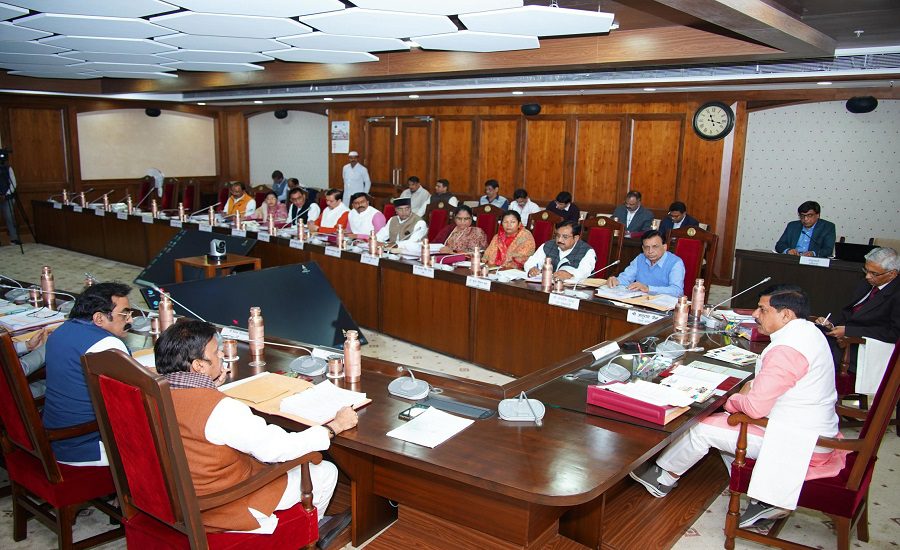
Bhopal: The Madhya Pradesh Cabinet chaired by Chief Minister Dr. Mohan Yadav on June 22 approved a series of major decisions aimed at strengthening education, supporting farmers, expanding social welfare initiatives and improving public service delivery across the state. The decisions involve development works worth approximately ₹5,960 crore, including the continuation of key welfare schemes, upgradation of schools, farmer-friendly reforms in crop loan disbursement, establishment of a new Government Law College and continued support for the Public Distribution System (PDS).
The Cabinet’s decisions are aligned with the state’s long-term development goals under the Viksit Madhya Pradesh@2047 vision and are expected to benefit lakhs of citizens, including students, women, farmers and economically weaker sections.
₹1,740 Crore Approved for Mukhyamantri Kanya Vivah and Kalyani Vivah Schemes
One of the most significant decisions taken by the Cabinet was the approval of ₹1,740.57 crore for the continued implementation of the Mukhyamantri Kanya Vivah Sahayata Yojana and Kalyani Vivah Sahayata Yojana for a period of five years beginning April 1, 2026.
The Mukhyamantri Kanya Vivah Sahayata Yojana has been operational in Madhya Pradesh since April 1, 2006. Under the scheme, financial assistance of ₹55,000 per beneficiary is provided for the mass marriage of eligible daughters, widows and abandoned women belonging to poor, needy and economically weaker families.
According to official figures, between the financial years 2021-22 and 2025-26, more than 1.72 lakh beneficiaries received assistance amounting to over ₹989.80 crore under the scheme.
The state government considers the scheme an important instrument for women’s empowerment. Apart from reducing the financial burden on poor families, it promotes legal-age marriages and contributes to the social upliftment and welfare of women.
Read also: CM Dr. Mohan Yadav Inspects ₹1,697 Crore Simhastha 2028 Ghat and Kanha Diversion Projects in Ujjain
Major Educational Expansion: 175 Schools to be Upgraded in 2026-27
In a major boost to educational infrastructure, the Cabinet granted in-principle approval for the upgradation of government schools across Madhya Pradesh.
Under the approved plan for the 2026-27 academic session, 75 government middle schools will be upgraded into high schools, while 100 high schools will be upgraded into higher secondary schools.
The Cabinet also approved the continuation of this expansion plan over the next two academic years. During 2027-28 and 2028-29, another 75 secondary schools and 100 high schools will be upgraded annually.
An estimated expenditure of ₹635.24 crore has been approved for the school upgradation initiative.
The decision is linked to the state’s ambitious Viksit Madhya Pradesh@2047 vision, under which the government aims to achieve a 100 percent Gross Enrolment Ratio (GER) by 2029.
Official assessments indicate that Madhya Pradesh requires 315 additional high schools and 214 higher secondary schools to meet future educational needs. The actual requirement will be determined through district-level mapping using data from the Gati Shakti Portal, population statistics and Unified District Information System for Education (UDISE) records.
At present, the state’s Gross Enrolment Ratio stands at 75 percent at the high school level and 55 percent at the higher secondary level. The transition rate from Class 8 to Class 9 is 77 percent, while the transition rate from Class 10 to Class 11 is 68 percent.
The government noted that long travel distances to schools often discourage students from continuing their education, leading to absenteeism and higher dropout rates. The school upgradation initiative aims to make educational institutions more accessible and improve student retention.
The Cabinet also clarified that schools located within the catchment areas of Sandipani Schools will not be upgraded. Instead, once students are shifted to Sandipani Schools, existing institutions may be relocated to areas where educational facilities are needed through a rationalisation process.
Farmer-Friendly Changes Approved in Zero-Interest Crop Loan Scheme
The Cabinet approved significant reforms in the state’s short-term crop loan scheme that provides loans to farmers at zero percent interest.
For the 2026-27 financial year, the government has decided to replace separate due dates for Kharif and Rabi crop loans with a single annual credit limit system. The revised arrangement will include separate sub-limits for cash and kind components.
Under the new system, farmers will receive a single sanctioned annual credit limit, and the repayment due date will be fixed at 12 months from the date of the first withdrawal.
To ensure continued access to interest-free loans, the state government will provide a standard interest subsidy of 1.25 percent. Additionally, farmers who repay their loans within the prescribed period will receive an extra four percent incentive as additional interest subvention.
The zero-interest crop loan scheme has been in operation through Multipurpose Primary Agricultural Credit Cooperative Societies linked to District Cooperative Central Banks since 2012-13.
Under the scheme, farmers can avail short-term crop loans of up to ₹3 lakh without paying interest, provided repayment is made within the prescribed deadline. The state government bridges the interest burden by combining central assistance and state-funded interest subvention.
The latest reforms are expected to simplify the credit process and provide greater flexibility to farmers in managing agricultural finances.
New Government Law College to Be Established in Shujalpur
The Cabinet approved the establishment of a new Government Law College in Shujalpur district beginning from the 2026-27 academic session.
The decision has been taken in accordance with an announcement made by Chief Minister Dr. Mohan Yadav and is aimed at strengthening legal education infrastructure in the region.
For the new institution, the Cabinet approved the creation of 17 posts, including nine academic and eight non-academic positions. A budgetary provision of ₹2.39 crore has also been sanctioned.
Currently, the three-year LLB programme at Jawaharlal Nehru Memorial Government Postgraduate College, Shujalpur, is being conducted as a faculty within the college. However, the Bar Council of India’s Legal Education Rules, 2008, require law courses to operate through an independent Government Law College for recognition purposes.
The establishment of a separate law college will help ensure compliance with regulatory norms and improve legal education opportunities for students in the region.
₹3,580 Crore Approved for Public Distribution System Operations
The Cabinet also approved an expenditure of ₹3,580.07 crore for the continued implementation of transportation and commission reimbursement under the Targeted Public Distribution System (TPDS).
The approved funding will support the scheme during the 16th Central Finance Commission period from April 1, 2026, to March 31, 2031.
The expenditure has been sanctioned following the prescribed procedures for scrutiny and administrative approval of public expenditure projects under the Department of Food, Civil Supplies and Consumer Protection.
The decision is expected to strengthen the state’s food security framework and ensure uninterrupted delivery of subsidised food grains and essential commodities to eligible beneficiaries.
Support for Tribal Electrification Projects
In another important decision, the Cabinet approved a proposal under which the Madhya Pradesh Government will provide the SGST component payable on the central share of electrification projects undertaken under PM-JANMAN and Dharti Aaba Janjatiya Gram Utkarsh Abhiyan.
The support will be provided to electricity distribution companies in the form of equity capital, helping facilitate the implementation of electrification works in tribal and remote areas.
The move is expected to accelerate infrastructure development and improve electricity access in tribal regions across the state.
Focus on Inclusive Development
The Cabinet decisions reflect the state government’s emphasis on inclusive development through investments in education, social welfare, agriculture, food security and infrastructure. With nearly ₹5,960 crore worth of approvals, the government has sought to address critical gaps in educational access, farmer welfare, women’s empowerment and public service delivery while advancing its long-term development agenda under the Viksit Madhya Pradesh@2047 vision.