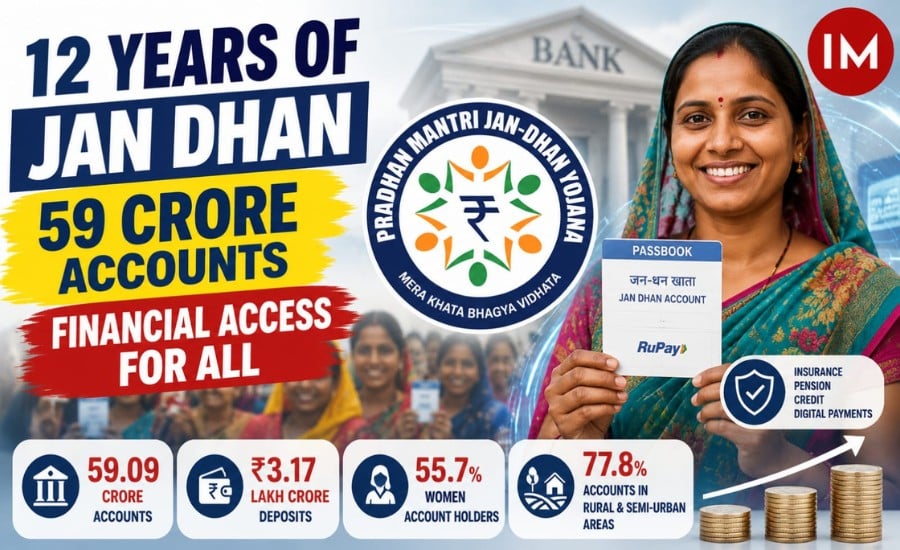
New Delhi: The Pradhan Mantri Jan Dhan Yojana (PMJDY) has completed 12 years since its launch on August 28, 2014, with the financial inclusion programme recording 59.09 crore bank accounts and deposits of ₹3.17 lakh crore as of August 19, 2026.
The scheme, launched as a national mission for financial inclusion, has expanded formal banking access among women and people in rural and semi-urban areas, while linking account holders to digital payments, insurance, pension and other financial services.
59 Crore Accounts, ₹3.17 Lakh Crore in Deposits
According to data released by the Ministry of Finance, the number of PMJDY accounts stood at 59.09 crore as of August 19, 2026.
Key figures include:
- 59.09 crore total PMJDY accounts
- ₹3,16,514 crore in total deposits
- ₹5,356 average deposit per account
- 41.29 crore RuPay cards issued
- 55.7%, or 32.92 crore, of account holders are women
- 77.8%, or 45.95 crore, of accounts are in rural and semi-urban areas
The ministry said deposits in PMJDY accounts have increased around 12.8 times, while the number of accounts has grown 2.3 times over the 12-year period from August 2015 to August 2026.
Women and Rural Households Form a Major Share
Women account holders account for 55.7% of all PMJDY accounts, while nearly 78% of the accounts are located in rural and semi-urban areas.
The figures highlight the programme’s reach among groups that were previously less connected to formal banking services.
The government said saturation drives conducted across states and districts have helped move the country towards near-universal access to bank accounts while expanding access to insurance and pension schemes.
RuPay Cards and Basic Banking Services
PMJDY accounts provide access to basic banking facilities without a minimum balance requirement or account maintenance charges.
Account holders are provided RuPay debit cards, which carry an accident insurance cover of up to ₹2 lakh, subject to applicable conditions.
Eligible account holders can also access an overdraft facility of up to ₹10,000.
The accounts are also used as a channel for accessing insurance schemes under the Jan Suraksha framework, including the Pradhan Mantri Jeevan Jyoti Bima Yojana (PMJJBY) and Pradhan Mantri Suraksha Bima Yojana (PMSBY).
JAM Trinity Strengthens Direct Benefit Transfers
The Jan Dhan-Aadhaar-Mobile (JAM) trinity, with PMJDY accounts forming its banking component, has been used for direct transfer of government benefits into beneficiaries’ accounts.
The Ministry of Finance described the system as a mechanism that enables direct delivery of financial assistance while reducing dependence on intermediaries.
Union Minister of State for Finance Pankaj Chaudhary said the significance of PMJDY extends beyond the number of accounts and deposits, pointing to its role in making financial services accessible to people at the last mile.
“We should not see PMJDY just in the light of the opening of more than 59 crore accounts.”
He also acknowledged the contribution of bankers and business correspondents in expanding the scheme’s reach.
Average Deposit Rises to ₹5,356
The average balance in a PMJDY account reached ₹5,356 as of August 19, 2026.
The ministry said the average deposit has increased around 3.4 times over the past 12 years. It described the rise as an indication of increased account usage and greater saving activity among account holders.
The number of accounts and deposits has also created a wider base through which eligible beneficiaries can access other financial products, including credit facilities such as MUDRA loans.
PMJDY Enters Its 13th Year
Launched on August 28, 2014, PMJDY enters its 13th year with the government continuing to position it as a core component of India’s financial inclusion framework.
The programme combines basic bank-account access with digital payment infrastructure and links to insurance, pension and credit services.
According to the Ministry of Finance, its continued expansion is aimed at ensuring wider participation in the formal financial system and improving access to financial services for previously underserved sections of the population.
Read Also: RRBs Net Profit Hits Record ₹10,176 Crore in FY26, Total Business Crosses ₹13.5 Lakh Crore