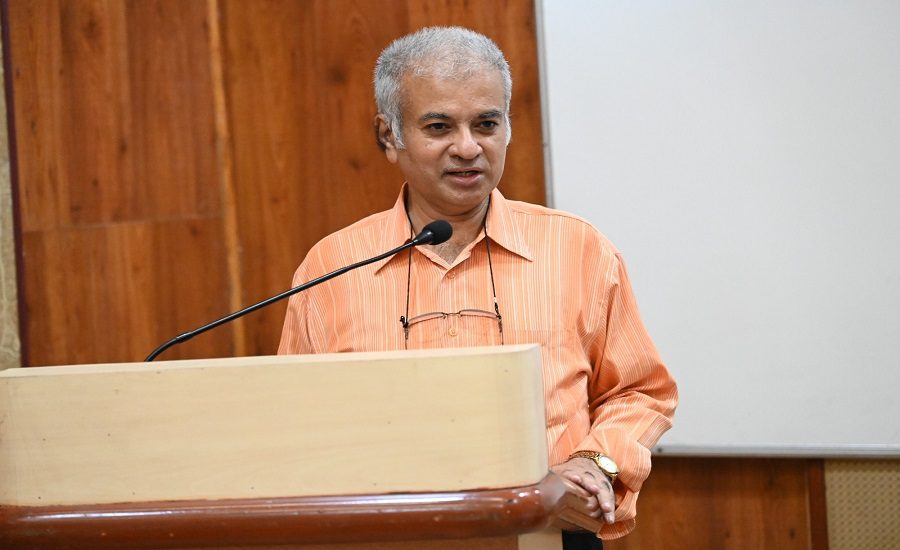
Thiruvananthapuram: An insightful research article authored by Dr Raju Narayana Swamy, a highly decorated 1991-batch IAS officer of the Kerala cadre, has garnered national attention for its critical examination of India’s cybercrime framework and its implementation challenges at the state level.
Titled “Mind the Gap: An Empirical Analysis of India’s National Cybercrime Framework and Its State-Level Implementation in Kerala,” the paper has been published in the flagship journal of the National Law School of India University (Volume 9, Issue 2).
Bridging Policy and Practice
The study highlights a significant disconnect between national cybercrime policy design and its actual enforcement on the ground. According to Dr Swamy, India’s cybercrime framework under the Information Technology Act 2000reflects a gap between “de jure” provisions and “de facto” outcomes.
While most existing literature focuses on legislative aspects, this research goes a step further by examining how cyber laws function within India’s federal structure, particularly at the state level.
Read Also: Cybersecurity Must Shift from Reactive to Proactive Approach: IAS Raju Narayana Swamy at Bodhi 2026
Kerala as a Case Study
The paper uses Kerala as a case study—an interesting choice given the state’s high literacy rates and strong digital penetration. Despite these advantages, the study points out a paradoxically low conviction rate in cybercrime cases.
This contrast underscores the broader issue of implementation inefficiencies in even relatively advanced states.
Methodology: Data-Driven and Field-Based
The research adopts a mixed-methods approach, combining:
- Doctrinal legal analysis
- Quantitative examination of cybercrime data
- Surveys involving 300 end users
- Inputs from 50 law enforcement officials
This comprehensive methodology allows the study to present both statistical insights and ground-level perspectives.
Key Findings: Structural and Capacity Gaps
The findings reveal that enforcement challenges stem from multiple systemic issues:
- Institutional fragmentation affecting coordination
- Federal tensions between Centre and states
- Low public awareness about cyber laws
- Limited technical capacity within police forces
A significant proportion of respondents indicated that cybercrime investigation techniques in India are still at a nascent stage, pointing to a major gap in technical preparedness.
Way Forward: Strengthening the System
The study emphasizes that bridging this gap requires a multi-pronged approach, including:
- Improved governance mechanisms
- Strengthening state capacity through advanced forensic training
- Better Centre-State coordination
- Targeted digital literacy campaigns
According to the research, empowering both institutions and citizens is essential to ensuring justice in an increasingly digital society.
About Him
Dr Raju Narayana Swamy is widely known as a reform-oriented officer and anti-corruption crusader in Kerala, with a reputation for taking on systemic challenges through both administrative action and intellectual engagement.
AIR 1 in Civil Services Examination
- He secured All India Rank 1 in the 1990 Civil Services Examination.
- He belongs to the 1991 Kerala cadre of the IAS.
IIT Madras Graduate in Computer Science
He studied Computer Science at Indian Institute of Technology Madras and graduated with an outstanding 9.41 CGPA.
More Than 30 Transfers in Career
Because of his uncompromising administrative style, he has reportedly faced more than 30 transfers during service.
Served in Five Districts as Collector
He has served as District Collector in five districts and held major positions including –
- Director of Fisheries
- Principal Secretary
Recipient of Satyendra K Dubey Memorial Award
He was honoured with the Satyendra K. Dubey Memorial Award for integrity in public service.
Author and Literary Contributor
Apart from administration, Dr Swamy is also a prolific author with more than 30 books to his credit. He has also received recognition from Kerala Sahitya Akademi.