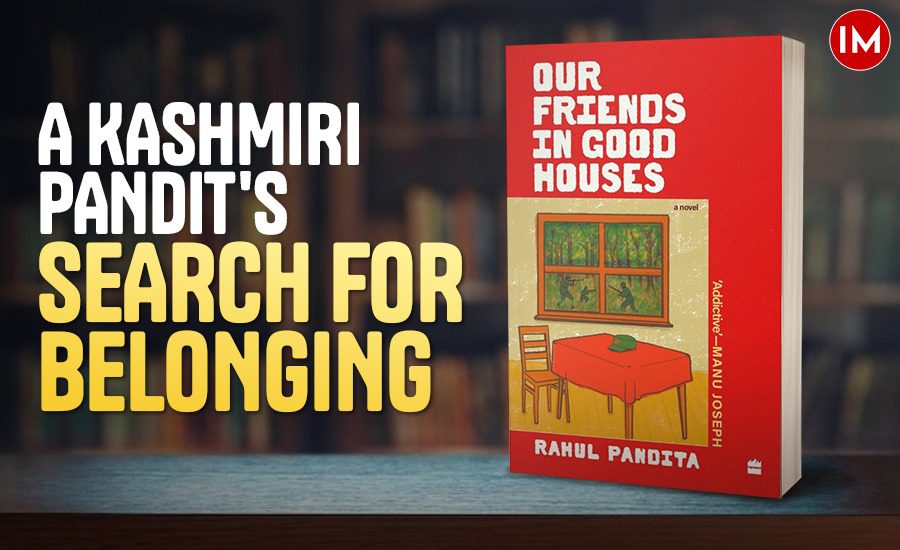
Let me begin with a question. Is the binary between fiction and non-fiction real, or is it an artificial construct? Can Our Friends in Good Houses by Rahul Pandita be read without reference to his earlier nonfiction books – Our Moon Has Blood Clots (2013) and Hello Bastar (2011) – both of which have given Pandita a solid reputation as a ground reporter who brings perspective to raw facts? Life, as they say, is stranger than fiction. Themes of war and peace, love and longing, yearning and solace are eternal dualities for a muse.
Nearly two centuries ago, in 1883, Lord Alfred Tennyson wrote a poem which is affirmed by our protagonist in Rahul’s novel, the forty-year-old conflict journalist Neel: “I hold it true, whate’er befall; / I feel it, when I sorrow most; / ‘Tis better to have loved and lost / Than never to have loved at all.”
Also read: Sita Was Never Silent: How Sita’s Veil Reimagines the Goddess as a Symbol of Strength
This then is the story of Neel having found and lost his “love” in many different landscapes – in Yale, in Delhi, in Dandakaranya. Neel’s angst is perhaps different from what Tennyson described. He finds it difficult to anchor his grief, for his loss also emanates from a state of ‘Ungrund’, which is the German mystic Jakob Böhme’s term for the primal void that is not merely empty but represents a ‘nothing’ that hungers to become ‘something.’ Because there is no floor or solid ground underneath, it is a bottomless well of freedom as well of chaos, out of which all specific existence eventually emerges.
The story begins with Neel’s innocent childhood in Kashmir before the catastrophic exodus of Kashmiri Pandits from the valley in 1990. Three decades later, during a six-month fellowship at Yale, he befriends Annie, an American Jew with whom he has a wonderful physical, emotional and psychological connect that feels natural and unforced. Their brief relationship offers him a gentle intimacy that hints at the possibility of permanence although eventual reality proves the opposite. Many moons later Gurupriya, a Naxalite from the Dandakaranya jungles, refuses to accept the ‘domesticity’ that he offers her in his Delhi home. She leaves – for she too feels a loss of ground.
Incidentally, the only landscape where Neel experiences a profound sense of grounding is the dangerous, heavily militarized Dandakaranya forests of Chhattisgarh. While in NCR, where he works for a living, Neel suffers from an acute “ontological dissatisfaction,” a persistent alienation that he tries to fight by obsessively decorating hired apartments with curated objects—coffee percolators, rugs, posters, penknives. These physical fixtures are tragic attempts to construct a tangible antidote to the relentless impermanence around him. While in Delhi, he meets and falls in and out of love with other professional, powerful women. They have read as extensively as him, and there are meaningful philosophical discussions, but his quest for a permanent foundation does not manifest. While these relationships provide brief moments of comfort and passion, they also serve to highlight the same pervasive Ungrund. Their presence reinforces Neel’s habit of preferring short-term associations to lasting stories. Trauma from childhood displacement thus causes our protagonist to seek a futile permanence from either geographic spaces or human relationships.
When Neel steps into the heart of the Naxalite-Maoist insurgency, his internal fracture suddenly aligns with the fractured world around him. In the dense jungles, under the constant surveillance of the state and the shadow of the gun, the background noise of his displacement drops away. The landscape of war becomes, ironically, his ultimate sanctuary. And it is in this sanctuary that he bonds with the revolutionary Gurnaam-alias-Jassi: both have a shared understanding of pain and a mutual recognition of what it means to be an outsider forever. Gurnaam does not offer Neel easy answers or ideological comfort. Instead, he offers the support of a comrade-in-arms. Through Gurnaam, Pandita illustrates the human cost of the Maoist movement, shifting focus away from political ideology and focusing squarely on the profound bonds which can be forged in a crucible of survival.
Reading this book made me reflect on my time as a Magistrate in Kalimpong at the peak of the Gorkha National Liberation Front movement, which formed the backdrop of Kiran Desai’s The Inheritance of Loss. Set in the mid-1980s in Kalimpong, the novel captures the violence and counter-violence of the Gorkhaland agitation for a separate ethnic state within India. Explosions of strikes, weapon-seizures, and guerrilla warfare isolate the characters of a crumbling hillside estate and shatter their fragile domestic peace. But while Desai places “loss” as the slow decay in the identity of her protagonist, a retired ICS officer who realises that a world in which he once wielded power is now indifferent to him, “loss” for Neel, (and perhaps Pandita himself), is the acute scar of the open courtyard of the homes in Kashmir which had been abandoned overnight.
A similar sort of suffering is reflected in the poetry of Mirza Ghalib whose world also was torn apart in 1857. Ghalib’s melancholic romance and existentialism mirror Neel’s continuous cycle of building and losing temporary sanctuaries. The revolutionary yet deeply sensitive subtext of Faiz Ahmed Faiz also finds natural reflection in Pandita’s book. Iqbal’s concept of the ‘self -in-control’ as “khudi” is seen in the eternally wandering human soul, and its internal spiritual struggles. Not to be missed is the resonance with Kashmiri-American poet Agha Shahid Ali, whose English verses capture the yearning for a lost homeland that directly mirrors Neel’s psychological landscape.
Is there closure in this book? Our Friends In Good Houses doesn’t necessarily provide any neat resolutions. Neel’s efforts to find love, to find home, to find contentment with what he’s creating seem to fail constantly. Therefore, perhaps it is better to adjust one’s aspirations, for as Nida Fazli writes: “Apna gham leke kahin aur na jaaya jaaye, / Ghar mein bikhri hui cheezon ko sajaya jaaye.” Let’s not go anywhere with our sorrows; / Let’s rearrange the mess of things at home.
Also read: Combat Chuckles: Twenty-One Stories That Capture the Human Side of the Armed Forces