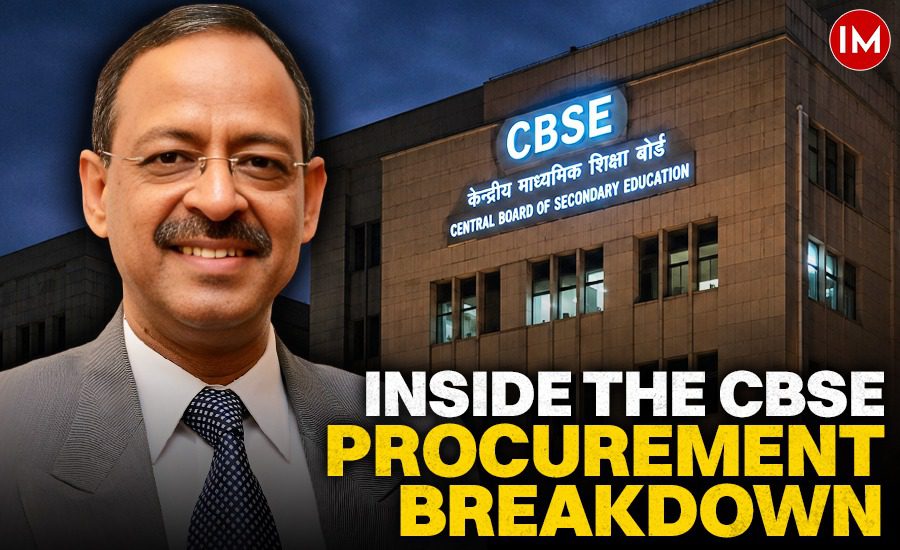
The recent storm at CBSE began, as these things often do, not with a scandal but with a specification document that was drafted and released as a part of an RFP to select the agency that would deliver the On-Screen Marking (OSM) solution to CBSE. Long before the blurred answer sheets, the portal crashes and the transfer of senior officers, there was this tender document that quietly changed shape between rounds. As per the information which is now publicly available and as reported in detail by Dainik Bhaskar, key technical and eligibility conditions were progressively softened between rounds — among them the software maturity bar, the requirement for dedicated Indian data centres, the resolution requirements, the minimum experience threshold and even the permissible error rate. The cumulative effect, it seems, was to lower the very bar that a serious bidder for such a sensitive task should have had to clear. The adjustments to the OSM tender are a textbook case of a government body trapped between rigid regulatory ideals and imminent project deadlines.
While everyone is questioning the intent of the officials and transfers have been made, most are entirely missing the most critical aspect, which is the self-evolved procurement process that invariably leads to such blunders in most RFPs, whether they come out in the open or are covered up.
Also Read – From Battling Kidney Surgeries to AIR 4 in UPSC IFS: How Karan Singh Turned Setbacks into Success
CBSE maintains that the relaxations were made only because earlier rounds had failed to produce a qualified bidder. But what CBSE doesn’t answer is why the earlier RFPs were drafted in a manner that no bidders participated? Why was the February 2025 RFP not released after due consultations with the industry, taking their suggestions on record and deep deliberations on the objectives, the quality standards and how to solve those challenges?
As I had witnessed during my career as a civil servant, most of the government procurement becomes hurried and therefore substandard, because we waste the initial months in releasing RFPs which are completely out of the industry sync, and then cancelling them repeatedly, and getting into a self-created timeline issue, which then snowballs into various challenges. This was taken care of in the Coal Ministry in 2015 in a much more complex situation. The system put in place to auction coal mines has stood the test of time primarily because of the extensive consultation with the stakeholders.
Why can’t the CBSE/Ministry of Education and State Education Departments hold broad industry consultations with the top 15-20 organizations and solution providers before every RFP that is released, set minimum standards, ask for documented reasons, specifications and criteria and then take the best of them to draft an RFP which does not need such repetitions, changes and cancellations? Why aren’t these industry consultations video recorded, and then their inputs are also placed on record in the project files, for transparency?
A fundamental problem is that we still see the industry with suspicion and not as our partner to serve the students and teachers, or maybe the current system is such that, at least, we have to publicly show and treat them as suppliers drawing money out of the government machinery.
We are seeing Ministry of Education and Govt Departments competing with the industry, trying to make their own platforms, softwares, apps and assessments engines which is not their core competency, and ultimately they have to indirectly involve industry players in liasoning through a DIC or an EdCIL or another PSU, but leading to no accountability and damaging the industry’s confidence and participation in the educational reforms and growth initiatives.
Ironically, this attitude towards the industry is what creates the opaqueness, which then gives space and opportunity to some disturbing elements who secretly partner with these suppliers to pilfer government resources and derail the procurement process to damage the actual use and outcomes.
Therefore, a timely, officially recorded, inclusive and partnership-oriented industry consultation being the base of every RFP can be the long-pending procurement reform, especially regarding digital education/e-learning and all ICT initiatives in improving the teaching/learning outcomes.
The second major challenge that this fiasco highlights is the specification details, quality standards and penalty clauses.
For example, in this case of the CBSE OSM fiasco, the details reveal that while specifications and penalty clauses were revised repeatedly on the premise that participation was not happening, there was no point-by-point deliberation on the reasons thereof. There was apparently no deliberation on the risks that such a lowering of quality standards and removal of these penalty clauses would bring to the entire solution implementation and delivery process. If we treat the industry as our partners, the Government can clearly put out the minimum standards, the reasons for having them in place, and the end objectives clearly highlighted. This can then be discussed/negotiated with the industry to help them serve the objectives and work backwards to determine the specifications required to achieve those objectives.
In the process, we may have to change/relax some specifications, but then we also further detail out the other part of the specifications and related penalties so as to ensure that the objectives are not compromised in any situation. Why are we not drafting detailed specifications for our educational and assessment software, teaching/learning platforms and resources?
The records reveal that the work order was issued on 5 December 2025, and the trial runs started in mid-January, with the software going live on 17 February 2026. Such a short timeline for such a critical project?
As per The Economic Times and Hindustan Times, even CERT-in (Indian Computer Emergency Response Team) by MeitY had raised concerns and flags regarding the solution and submission of expired CERT-in security audit certificates, and such strong concerns regarding testing, quality and security of solutions to be used by students and teachers should have been taken utmost seriously, whatever emergency steps would have needed to be taken.
If the RFP was delayed since Feb 2025 to a stage where the actual implementation was just a couple of months away, and the trial runs revealed major issues and gaps, why was it still pushed through instead of going back to the ministry and requesting a revised timeline and an alternate plan?
When we have security standards like CERT-in and testing/quality controls like the STQC under the Ministry of Information and Technology, why are they not a minimum requirement for every solution provider or bidder? Why shouldn’t this be made a non-negotiable criterion?
Its high time that, while procuring critical solutions that directly impact our students and teachers, we very clearly define our usage and outcomes expected from these solutions, we differentiate expert solution providers from generic and liaisoning-oriented bidders, accept the genuine and sincere industry organizations as partners while filtering out the opportunists, and then co-create the specifications, quality & security standards and strong penalty guard rails to ensure that no stakeholder can derail the delivering of high quality and precise outcomes as envisioned.
The CBSE fiasco should be a wake-up call. This crisis should be seen as an opportunity to take a close look at the procurement system in education, both at the central and state levels. Looking for scapegoats will not help. Transfers and suspensions will also not help. It is a systemic issue and should be treated as such. If it could happen in a much more complex sector like coal, why can’t it happen in education?
Also Read – New Age Warfare: Drones, Missiles and Layered Defence Dominate India’s Military Planning